Wednesday, December 21, 2016

Column: Advent 4: The dawn from on high

A winter's dawn at Wernersville's Jesuit Center.
I am still clinging to Advent, to the minor keys and clear tones, to the short days and the sun that reaches deep into the shadows.

I was struck by how much energy the sun puts out — 1026 joules per second — and how little of it reaches my sunroom floor...

This column appeared in at CatholicPhilly.com on 21 December 2016.


In the tender compassion of our God
the dawn from on high shall break upon us,
to shine on those who dwell in darkness and the shadow of death,
and to guide our feet into the way of peace. — From the Benedictus, Luke 1:78-79

It’s still Advent in my house. The only signs of the impending Solemnity of the Nativity of the Lord are the small Holy Family on the mantle, bought by my youngest for me this summer on a trip to Iceland, and the Nutcracker half hidden on a bookshelf, forgotten since last Christmas.

It’s still Advent in part because it’s the end of the semester, a time when I think it a miracle if I manage to get the laundry not only washed, but folded and put away. But even if it weren’t the most wild and crazy time of the year for me, it would still be Advent, because I am loathe to let go of these precious few days of lingering light.

The dawn breaks late these last Advent mornings, washing over my shoulder at Morning Prayer. Midmorning, the light leans in through the windows, stretching out its rays deep into my office, its warmth defying the cold outside. From almost 100 million miles away, this light seems gentle, comfortable, wrapping around me like a cloak, turning the steam above my tea into smoky whirls, like incense, rising in prayer.

Yet this tender light pooled on the floor by my feet is but a tiny fraction of the power residing in that single star. A million billion billion times more energy pours forth each second, streaming out into the universe. Untouchable, unthinkable power, the merest tendrils of which are enough to let forests flourish and people in darkness find their way.

It’s still Advent in my house, because it will always be Advent, until the end of time.  Every morning, the church raises her voice in the Benedictus, Zachariah’s hymn upon the birth of John the Baptist. At each celebration of Morning Prayer proclaiming again and again the dawn that will come, in power and glory, radiant with joy, resplendent in majesty, full of mercy and compassion.

It’s always Advent, for we are ever awaiting the coming of God among us, to shine on those who dwell in darkness, to guide our feet into the way of peace.


From Jesuit Father Karl Rahner’s reflection, “God who is to come” in Encounters in Silence.

O God who is to come,
grant me the grace to live now,
in the hour of your Advent,
in such a way that I may merit to live in you forever,
in the blissful hours of your eternity.

Saturday, December 17, 2016

Expectation values

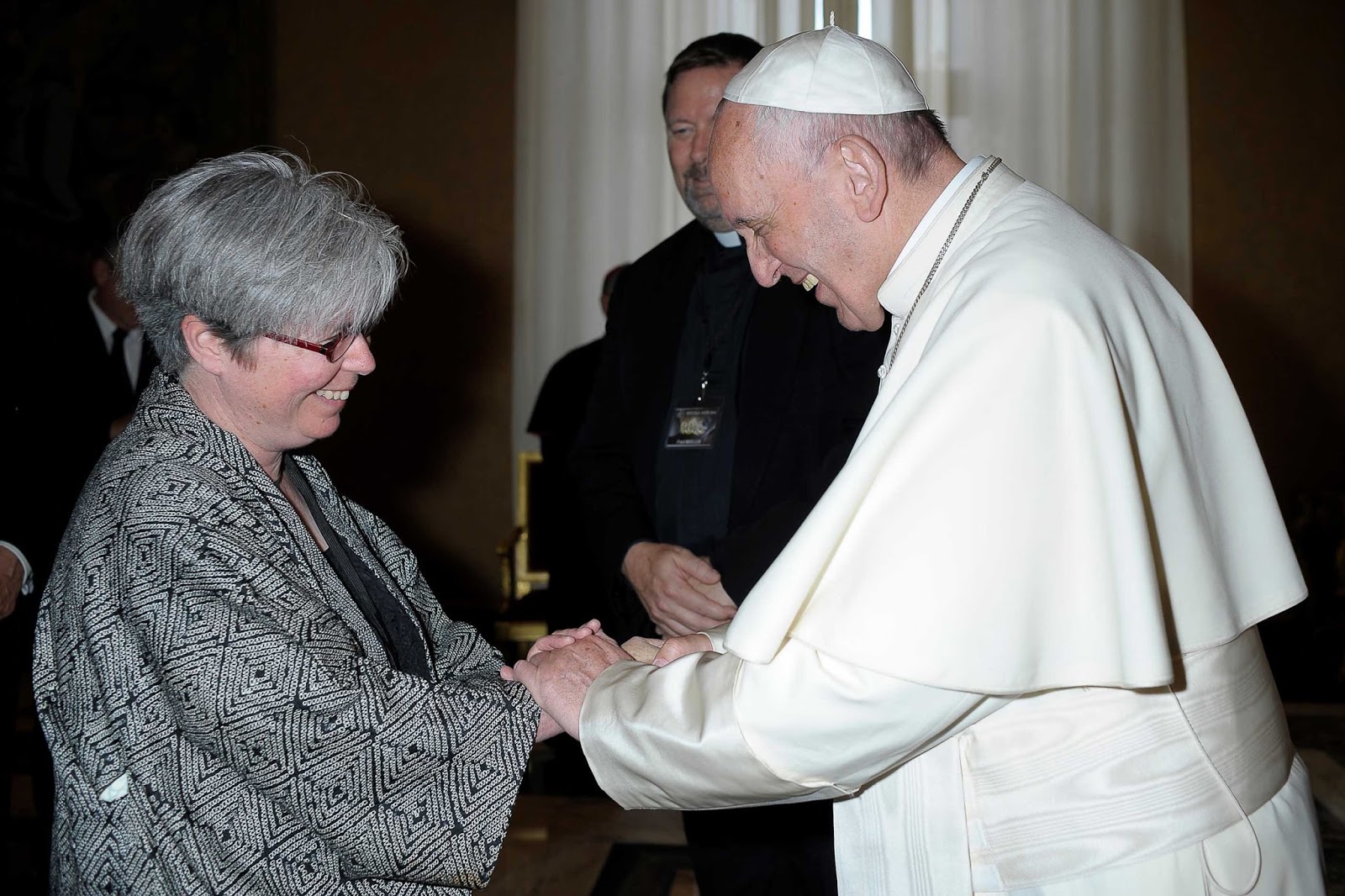
It's my boss' (Guy Consolmagno, SJ's), boss' (Cardinal Bertello's) boss'  birthday today. Ad multos annos, Pope Francis!

I'm thinking about what his mother must have thought when he was born, what expectations she had of what his life might be like.  No inkling, I imagine, that he might walk into the Sistine Chapel one day, and walk out as -- among other things -- the absolute monarch of Vatican City State.  And today's readings (well, really tomorrow's, but I'm scheduled to serve at the vigil Mass in a few hours and sat with the readings for a stretch this week in preparation for writing the universal prayers) with babies whose arrival raises expectations - of rescue and salvation, also have me thinking about all the as yet to be realized possibilities contained in such tiny bodies.

But it's Paul's language writing to the Romans, "to all the beloved of God" that leaves me wondering...what expectations does God have of us?


The geekier part of me is thinking about operators and eigenvalues and what that has to say about possibilities.  #grading #finals

Thursday, December 15, 2016

Column: Advent 3: Heavy with the incarnate Christ

Jacques Daret - Altarpiece of the Virgin
Wikimedia
It was 23 years ago, on a Sunday in Advent when I felt the first stirrings of Mike within, an experience I wrote about here.

This column appeared at CatholicPhilly.com on 14 December 2016, along with additional materials.

…cheer the fainthearted,
support the weak, be patient with all.
See that no one returns evil for evil;
rather, always seek what is good for each other and for all.
Rejoice always.
Pray without ceasing. — 1 Thessalonians 5:14b-17

St. Paul’s parting advice to the Church at Thessalonica is spot on for this week of final exams. Students come to my office hours and send me email. They catch me in the corridors, full of chemistry questions, but equally in need of reassurance. I cheer the fainthearted: “Yes, I expect you to do fine on my exam!”; support the weak: “Sleep. Eat. Everything looks better after a nap.” And I stretch my time, and thereby my patience, with varying success.

As I approached this Advent, which arrived at the end of a more chaotic than usual semester, I asked God for the grace to be “in love with the roughness of this world in hopes of the eternal,” as an ancient commentary on the book of Job suggested. I wanted both the patience to sit with the world as it is — slow traffic, purgatorial parking lots, and all —  and a sure hope for the future.

In a sermon on Christmas Day, St. Augustine encouraged us to be re-born, to see Christ’s birth as both a one-time event and an eternal reality; Jesus, born of a virgin in Bethlehem, and born of the Father before all ages. This was not just a theology lesson from Augustine, but a challenge — a challenge to let Christ be born in us, always.

When I was expecting my sons, it was hard to avoid knowing I carried someone else within me. Their elbows and hiccups were potent reminders that they were with me.  Advent offers me the same chance to be nudged interiorly to recall that we, too, are pregnant with God. Let us be as Mary, says Augustine, “heavy with the incarnate Christ.” We, too, should be heavy with the God-made-man, letting his compassion be born in our hearts.

Augustine is suggesting that we be aware of God within us, and how we bring that incarnate God into the world. Do we see those in need? Can we offer a cheerful smile, simple courtesy, or a bit of support, whether it’s to the man trying to get out the door of the Acme with an overflowing cart and two little ones in tow, or to the confused student at my door?

Can we seek what is good for each other? Cheer, support and be patient with all?

As we move deeper into Advent, I long to be heavy with the incarnate Christ, to know him stirring within. To rejoice always; for God is with us, before all ages. To pray without ceasing. For God will come again.

________________________________________________________
I've been listening to Bernadette Farrell's God Beyond All Names — which pulls many of Augustine's themes into a composition as still and sharply clear as an Advent night.

God, beyond all words, all creation tells your story,
you have shaken with our laughter, you have trembled with our tears.

All around us, we have known you;
all creation lives to hold you,
In our living and our dying
we are bringing you to birth


Thursday, December 08, 2016

Column: Advent 2: O nata lux

I wrote the first draft of this while listening to Morten Lauridsen's Lux Aeterna, which includes a setting of the traditional hymn for the Tranfiguration, O nata lux, but which seemed as appropriate for Advent. It is, to quote a friend, an ineffable piece of music. You can listen here and if your week is anything like mine, do!

I recalled the Our Father in so many languages on the wall at Sagrada Familia in Barcelona. I thought, too, of the mosque I visited in Abu Dhabi years ago where one gold splashed and white wall was covered with words, ninety-nine attributes of God:  the All Merciful, the Truth, the Maker of all things.  Peace.

A column for the first week of Advent which appeared at CatholicPhilly (along with some suggested materials for additional reflection) on 7 December 2016.


What came to be
through him was life,
and this life was the light of the human race;
the light shines in the darkness,
and the darkness has not overcome it. — John 1:3b-5

“And by light you mean photons, right?” asks the student in the first row. “Yes, I do.” At least in this context. There is always a bit of irony in these last classes of the semester. I’m lecturing about light as the winter darkness grows deeper. Or maybe not.

As I packed up to return to my office, the lines from the Prologue to St. John’s Gospel ran through my head, “the light shines in the darkness and the darkness has not overcome it.” Chemists see light as active. It doesn’t just illuminate, driving away the darkness, it can fundamentally change what it touches. One molecule becomes another. Yet more wonderfully, once the light has soaked in, it can shine forth again, in new ways and new directions.

The Light has shone in the darkness, and we are fundamentally changed. But to those who did accept him he gave power to become children of God. What’s more, we are called to be beacons of light: You are the light of the world.

We have been kindled, we hear in St. Matthew’s Gospel, not to be hidden under a bowl, or within the walls of our parish churches, but to shine forth, banishing the darkness around us.

Reflecting on these lines from John in his “City of God,” St. Augustine tells of St. Simplician, a late fourth century bishop of Milan, who recalled a pagan scholar once told him that the opening lines to John’s Gospel “should be written in letters of gold and hung up in all the churches in the most conspicuous place.” This is where our faith begins. In the darkness, yearning for light, life and God to come among us.

As Advent moves more deeply into the darkness, I imagine John’s words, written in letters of gold, shimmering on the walls of churches everywhere. And the Word became flesh and made his dwelling among us, and we saw his glory … full of grace and truth.

I look for the Light dwelling among us, praying that it might change me; that I, too, might be aflame with the Word, filled with grace.

Sunday, December 04, 2016

Collisional cross sections

The kinetic theory1 of gases connects the properties of individual molecules with the behavior of the bulk gas.  For example, if you know the mass of a particular gas present in a bottle of known volume and temperature, the idea gas law (PV=nRT) lets you predict the pressure in the bottle.  Since the pressure of a gas is related to how often the molecule hit the walls of the container, collision rates are a fundamental part of the theory.

How often molecules collide is of interest to chemists because getting molecules close together (really close together, within tenths of nanometers) is fundamental to their ability to react, to change into other things.  Molecules bump into each other more often when the temperature is high (they are moving faster and so cover more territory) and when the pressure is high (there are more of them to hit).  But collisions also increase when the target area is larger.  Think about trying to move through a crowded grocery store with a big cart versus when you just need to grab a gallon of milk.  The surface area you present to other shoppers is large when you have that cart and you are more likely to run into other things.2  This surface area is the collisional cross section.

I've been moving fast lately and the pressure has been high, which if I were a gas would mean I would be having more collisions, but in reality has left me feeling like all I do is wave as I race past people in the hallway or on campus. Sorry, can't talk now, have to run. Whoosh.  The semester is winding down, with the gift of a Friday with no classes or meetings on it.  Not only that, but this was the very same Friday that The Egg is singing as part of a quartet at his SoCal college. A most welcome collision on my calendar.  

I booked a flight, and now I am here. Not only that, but Math Man figured out he could take a day off and come, too.  So this morning, I met The Egg on campus and as we walked to get breakfast, we "ran into" Math Man on the sidewalk.  Surprise!

But there was more collisional fun to be had. A delightful colleague was in Philly to give a talk which I couldn't go to (vide infra).  We booked a time for tea and Skype later in the month, a moment to virtually collide, if not literally.  But on Thursday evening, while headed to my gate at PHL, my phone rang. The number was delightful colleague's.  "Are you by any chance at PHL?" she asked.  "I am."  We were flying out from adjacent gates.  Which resulted in two women running (literally) into each other at PHL, and we enjoyed twenty wonderful minutes to hug, hang out and catch up on the really big things that had happened to each other.  And some of the small delights. 

A high collisional cross section?  Almost worth the pressure.

1. Theory in the sense scientists use it, meaning a coherent system of ideas used to explain something,  not theory as it is often used outside of scientific circles, where it carries the connotation of something unlikely to be realized in actual practice, or notions that are not yet and probably won't  proved true. 
2.  To get a sense of how lightly populated a gas is, a molecule at room temperature on average travels about 300 times its length before hitting another molecule, the equivalent of my walking 500 yards without getting close enough to anyone to shake their hand.  Not my experience of the grocery store after work!