Showing posts with label preaching. Show all posts

Wednesday, May 13, 2026

Seriously, I preach

Heidi Schlumpf has an article about lay preaching in Commonweal that I read with particular interest as I did an 8-week preaching practicum for Catholic women this spring. 

A couple of friends shared the Commonweal article on social media and in the comments on one post someone implied that those who grumble and push back against the prohibition of lay preaching at the Eucharist aren’t serious about preaching. If they were, they’d put their energy behind celebrating and preaching at the Liturgy of the Word or the Liturgy of the Hours (particularly Vespers, or rather Evening Prayer) where preaching by the unordained is permitted. Besides, he noted, it's a moot point, because the priest shortage means no one is going to be getting much access to the Eucharist anyway.

I bristled at this take. I wanted to say, "Dude, I think the prohibition should be eased and I take my preaching very seriously!" I did not. Also, there is not really as much space for licit lay preaching at liturgies outside the Eucharist as he seems to think. I didn't say that either. I did say that preaching outside the Eucharist tends to be marginalized.

I note the liturgical norms that restrict the homily at the Eucharist likewise forbid lay persons from reflecting on the readings at many (most?) celebrations of the Liturgy of the Word.  The norms for Sunday celebration in the absence of a priest restrict the homily to the ordained (in this case a deacon) regardless of whether they include distribution of Holy Communion. If a lay person must lead such a liturgy, then they must read a homily written by a priest or deacon (New Zealand's bishops also provide a collection of generic seasonal reflections.) Even on weekdays, the preference is for someone to read a prepared homily, though the UK bishops conference permits a reflection on the reading by a lay person (not to be confused with a homily). Per the USCCB "A Liturgy of the Word with Distribution of Holy Communion should never be scheduled for the purpose of 'providing a role' for deacons or lay ministers." In other words, lay leadership (and/or preaching) in this context is a last resort, not a regularized space for lay preaching.

The norms regarding the Liturgy of the Hours say that a lay person cannot preside if a priest or deacon is present. Can they still preach? The norms are silent on this point, and presumably what is not explicitly forbidden is allowed. But even this still leaves lay voices on the margins.  I have lived in some of the largest dioceses in the country (LA, Orange, Philly). I have lived most of my life in parishes staffed by. religious orders (Franciscans and Augustinians). I have never lived in a parish that regularly celebrates Evening Prayer on a Sunday (my parish does celebrate Morning Prayer every day but Sunday). Philadelphia's cathedral parish does not have public celebration of any of the Liturgy of the Hours as far as I can tell. Would people come out a second time for for Vespers? Probably not. And given the hunger that has been inculcated in Catholics for the reception of the Eucharist, I don't think people are going to line up for Vespers in lieu of a Communion service. (Though apparently you can swap in the Sunday readings at the LOH and follow with communion, so that would serve as an opportunity for lay preaching.)

I know for certain that I have “preached” at the Eucharist, in that a reflection I have written has been read at the time of the homily (sometimes with actual attribution, or as it was once reported to me, "written by a devout lady" which felt terribly medieval to me). At least once at a cathedral (though not by the bishop). If that is licit, why could I not read my own words? Or have my words blessed by an ordained minister ahead of time and read them with my own voice? Is it because my body is wrong? Not Christ-like enough? (I suspect that's the actual answer, a woman can never be as close an image of Christ as a man. Which grieves me, but that's another post.)

Seriously, I do get to preach (as one Carthusian abbot put it, the  presumably ordained  brothers were to preach with their hands, that is by the written word) a lot. I will preach to thousands of people in that sense every day next Lent, having written a book of daily reflections that comes out in the fall from Liturgical Press. I preach at retreats. I have contributed to collections of homilies. I reflect in Give Us This Day which offers a veritable banquet of voices, from Augustine to my friend Fran, scientists and theologians, ordained and lay, saints and the rest of us. I believe that preaching, however I do it, is my vocation. How do I know? Of all the hundreds of reflections I've written or given, only once have I volunteered. Every other one has been asked for.  Called forth.


Friday, April 03, 2026

Stripped of words: a homily for Good Friday


I am preaching at Morning Prayer at the parish today, a reflection which had its seed in an interview with Cardinal Timothy Radcliffe by Fr. Jim Martin SJ (you can hear the relevant piece here) and in a reflection in the forthcoming book for next Lent.


…So shall he startle many nations,
because of him, kings shall stand speechless;
For those who have not been told shall see,
those who have not heard shall ponder it.…Isaiah 52:15

As we move through the Triduum, we also grow silent in the face of the enormity of what has been accomplished by God. Later today we will sit with St. John’s account of the passion, invited as Isaiah implores us to watch and to ponder. When I hear this version of the passion I am often struck by how Jesus, too, gradually grows silent. Gone is the sharp give and take with the religious authorities. He offers virtually no defense to Pilate. There are no words to reassure the repentent thief crucified next to him about paradise.

Once Jesus wept as he fervently prayed for relief. Now, we no longer hear him lifting up long, eloquent prayers to the Father. In John’s account of the crucifixion, we do not hear him pray at all. He does not cry out to God asking why he was abandoned. He does not commend himself to the Father’s care.

In the end, there is only his battered body, wracked with thirst, hanging on a cross. 

Some time ago I heard Cardinal Timothy Radcliffe reflect on what it had been like to try to pray during his recovery from a grueling surgery. “When I tried to pray the Our Father,” recounted Cardinal Radcliffe, “I couldn’t get past the two words…Our Father…I was just a body lying in bed.”  Still, he thirsted, not just for the water he was not allowed to have, but for God.

Here is this man who preached to the synod — who preached to the pope about hope and prayer —  confessing he could not pray. How many of us have found ourselves in these straits? Caught up in the maelstrom of illness — our own or those of people we love —  or overcome by fear or despair in the face of events that upend our lives, or shake the world, and unable to find the strength to reach for God. When even the prayers we know by heart slip away from us.

I am reminded of a snippet of poetry from Ranier Rilke’s Book of Hours, “like sand slipping through fingers,  all my cells are open, and all so thirsty. I ache…in a hundred places, but mostly in the middle of my heart.” Thirsting for God in every cell, aching for mercy in the depths of our hearts, our physical body becomes the prayer. Like the disciples who ask Jesus to teach them the words to use in prayer, we, too, are looking to Jesus to teach us how to pray in our most desperate moments, when the anguish of our wounds  is more than we can bear, and we cannot find even those words, “Our Father”.

Jesus’ silence on the cross speaks volumes. His arms wordlessly stretched out between heaven and earth, his whole body is a prayer offered to the Father for our salvation. It is a potent reminder that when our strength fails us, we can still pray as Jesus taught us from the cross, arms stretched out in longing, every cell thirsting. That when injustice or illness or infirmity or age strips us of our words, our very body becomes a prayer.


Tuesday, March 31, 2026

In transition: Preaching Tuesday of Holy Week

olive branch across the top, in the background a blurred cross
When I was preparing to preach today, I thought that like Peter I've had three chances to preach these readings — for books of Lenten reflections in 2018, 2020 and the one coming out in the fall for 2027.  And when I look back at the reflections I wrote I feel like I've fumbled them a bit, not quite recognizing the weight of what is moving in this liturgy. But as St. Benedict was apparently wont to say, "every day we begin again." So here I try again to capture a little bit of the unfathomably holy space we are sitting in today.


I sometimes wonder if we think that the Monday, Tuesday and even Wednesday of Holy Week are sort of a holding pattern, where we are just marking time between Palm Sunday’s intensity and the solemnity of the one long liturgy that is the Triduum. (And also some time for rehearsing and decorating and perhaps juggling our regular jobs).

Even if these days are just holding space, space, as musicians know, matters. Rests give shape to music as much as the notes.

But I hear more than a rest marker in the Gospel for today. Today’s pericope from John is a bit of a jumble. It  comes after the account of the washing of the feet and before the Farewell Discourse which will occupy the next three chapters. It’s a narrative transition, setting up the betrayal by Judas, and Peter’s betrayal, too. The choice of this Gospel for today scrambles the timeline a bit. Yesterday’s installment was a flashback — we were clearly outside Jerusalem with Mary and Martha and the anointing with aromatic oils. Today we have skipped past the washing of the feet which we will return to on Thursday. Tomorrow we will see Judas’ betrayal through Matthew’s eyes, positioned, it seems, well before the entrance to Jerusalem.

Praying with this Gospel the last few days, it occurred to me that today is the pivotal moment, the moment at which we are staggering at the edge of catastrophe, the moment when we tumble over the edge into chaos and confusion, into passion, death and resurrection. 

In chemical reactions, there's something called a transition state. It’s a tipping point, a fleeting moment in the course of a chemical change. Move a fraction backward and you return to whence you came, unchanged. But move a fraction forward and you tumble inexorably to completion, transformed — transfigured. From that point on there is no turning back, even if at first little has seem to be changed.

What John recounts in today’s Gospel feels like a transition state. Once Jesus hands Judas that morsel, once Judas picks it up and leaves the room, there is no turning back, even as the disciples don’t yet see what is coming. Peter surely does not. But at this moment, it is all set in train.

This is when theory becomes practice.

I was reading Annie Dillard’s Pilgrim at Tinker Creek this weekend and I ran across these lines.

"Divinity is not playful. The universe was not made in jest, but in solemn, incomprehensible earnest. By a power that is unfathomably secret, and holy, and fleet."

God is not toying with Judas, or with us. For this fleeting moment we stand at a point where we can see Jesus’ life and death laid before us, where we can see all of salvation history spread out like a banquet, where we can see the choices. Jesus' choice. Judas’ choice. Peter’s choice. Our choice. Today. May we have the courage to choose the unfathomably holy, in solemn, deliberate earnest. 

Monday, March 16, 2026

The world is full of marvels…and things that sting.

The world is full of marvels. I saw Portuguese men o’war (is that really the right plural, surely it isn’t “Portuguese man o’wars”?) on the beach over spring break. Or I am almost sure that’s what the translucent balloons dotting the shoreline were. (I had somehow imagined them to be much larger, based on some real life account I had read when I was a kid.) I was sure enough that I didn’t touch them. Men o’war or not, I have a healthy aversion to jellyfish. I’ve been stung before.

So I was surprised to find they aren’t jellyfish at all, but siphonophores. They aren’t a single individual but a colony of clones, genetically identical but each individual manifesting a different function. A marvel indeed.  

Of all things, it made me think of the passage in Paul's first letter to the Corinthians (1 Cor 12:12): we are one body in Christ, though each of us manifests that differently in service to the whole. What would a homily framed around stinging groups of clones and Paul's letter look like? or better yet, sound like? I'm doing an 8 week course in preaching, so homilies are on my mind.

It also brought to mind Frederick Buechner: “Here is the world. Beautiful and terrible things will happen. Don't be afraid.”

But perhaps be cautious about what you touch?

Thursday, January 01, 2026

Pondering : A homily for Mary, Mother of God

wooden statue of Mary, eyes closed, child Jesus in her lap, from St. John's Abbey. Mary, Seat of Wisdom
This homily was written for one of the Homilists for the Homeless volumes. I have been rummaging around in my old writing as I prep for a couple of upcoming retreats. I am reminded of the need for prayerful reflection, not just at the New Year but every day. There are many frames for the daily Examen, but this list is a good starting point for me. What might you add?

  • What astonished me? 
  • What brought me to tears? 
  • What made me howl with laughter? 
  • What suffused me with joy? 
  • What brought me closer to God?


As for Mary, she treasured all these things and pondered them in her heart. — Luke 2:19

These days in particular —  poised between seasons, teetering on the edge of a new year — lend themselves to pondering, to treasuring the past year in our hearts.  What astonished us? What brought us to tears? What made us howl with laughter? What suffused us with joy? What brought us closer to God?

We contemplate, too, what the new year will bring. Will it astonish us? What new griefs will we have to bear? Where will we find God? When will we desperately need God?

Luke tells us that Mary pondered the all the events that surrounded Christ’s birth in her heart. I imagine her cradling a young Jesus in her arms, still astonished at her visit from Gabriel, still overwhelmed with joy, still worried what Simeon meant when he promised her heart would be pierced. What, I’m sure she wondered, would the next days and months bring? How would she cope?

How can we follow Mary’s example and prayerfully ponder our past, present and future with God? In his Spiritual Exercises, St. Ignatius of Loyola suggested a short daily practice called the Examen, a way to recognize God at work in every aspect of one’s life. Take ten minutes at the end of the day, advised Ignatius, and seek out God’s handiwork in your life.

Ignatius’ prayer begins by recognizing that we are always in the presence of God. Don’t be timid, ask God to help you pray, to bring his light to bear on your day. The line that opens today’s psalm well captures what Ignatius hopes for those praying the Examen: O God, be gracious and bless us and let your face shed its light upon us. [Ps 67:2]

Next, says Ignatius, tell God you are grateful. Ingratitude — not pride or greed — was the ultimate root of all sin, thought Ignatius. If we cannot see that all we have, our very lives and all that surrounds us, comes from God, then we are blind to God. God is our true treasure. Be specific, search your day for one or two luminous moments for which you are particularly grateful, and give God thanks for these gifts. 

The meat of the Examen is a review of the day. Take it hour by hour, noticing with God where you felt his presence, where you felt particularly beloved. Where did you love in return? The point is not to scour for sins, small or large, but to become more and familiar with how God is at work in your life. This is what God desires for us, as he asked Aaron to bless the Israelites, and by extension, us. May the Lord uncover his face to you reads the last line of Aaron’s blessing in one translation. May you see the Lord.

It is often the small things that turn out to be most important, the moment when someone unexpectedly waved you ahead in a long line at the grocery store, or the sense of awe you experienced walking out the door into a beautiful afternoon. As C. S. Lewis in noted in his Letters to Malcolm: Chiefly on Prayer, “We must not be too high-minded. I fancy we may be sometimes deterred from small prayers by a sense of our own dignity rather than of God's."  Don’t be too high-minded, share it all with God.

We are humans, and inevitably we fail in our love for each other and for God. So notice, too, the moments that make you wince as you review the day. Ask God to forgive you and prayerfully seek his advice on what remedy you might make. Who should you apologize to? Is it once again time to seek out the sacrament of reconciliation? What might you do differently next time? Ask God for the grace to walk anew in his pathways.

Pay attention to your feelings during the review of your day, what part of this prayer stirred your heart the most? Talk it over with God. Ignatius recommended doing this as one friend might speak with another, heart to heart. Finally, look to tomorrow. What are you worried about? What are you looking forward to? Close your prayer by asking for God’s grace and strength 0for what is to come.

As we begin this new year, resolve to take up the habit of sharing your day with God, treasuring its joys as Mary did, and pondering anew how you might in this moment grow closer to God. Like the shepherds and all who heard their stories, allow yourself to be astonished at what God has done for you, the small miracles as much as the large. 

May the Lord bless you and keep you, may his face shine upon you, and may you have peace, today and all the year to come.

____________

Image is Mary, Seat of Wisdom, at St. John's Abbey.


Thursday, April 17, 2025

Holy Thursday: Fully Immersed


I am "preaching" Holy Thursday (Carthusian style — a long ago abbot of that most silent of orders told his confreres that they preach with their hands, by writing, not with their voices). Or maybe I should just say I am preaching today. Period.

Today begins the Triduum, a single liturgy unfolding over some 5o hours. We will come and go, but there will be only one collect — tonight — and one closing prayer — at the end of the Vigil. Holy Thursday is sometimes celebrated as the institution of the Sacrament of Holy Orders, sometimes as the institution of the Eucharist. But either of thsoe two characterizations seems to do justice to the depths of the mysteries at play in this liturgy. It's not an anniversary, it is a prophetic call to the baptized.

Last summer, when Give Us This Day's editor invited me to write the reflection for today, I will admit to being slightly intimidated. I have written many pieces for them over the years (50? I haven't really kept count), including for Christmas and other major feasts, but this day, these days, felt far more freighted. 

I sat down to write this with the powerful readings that direct our attention both inward — take this and drink — and outward — wash the feet of others, but my mind kept drifting to the unspoken, to what lies above and beside and below. Wade in with me to all that surrounds us, and that invites us to become what we receive, that calls us to be the Word made flesh. In the world today, where cruelty seems to be the watchword and mercy and justice are given short shrift, it seems all the more important to gather our strength and go forth as Christ commanded.

"After the starkness of Lent, with its stripped altars and veiled statues, it’s always a shock when I walk into the church on Holy Thursday. The altar is draped in crimson satin, the chapel where the Eucharist will repose is overflowing with flowers and candles. Tendrils of incense wind toward the ceiling, a gathering cloud of prayer above the nave...

Listen! Hear the Word that commands me to wash my neighbors’ feet, that whispers to me, “take up your cross,” that speaks my name and sends me out to make manifest the Good News. Verbum caro, panem verum, Verbo carnem éfficit. Become flesh in me."

The full reflection can be found here, along with a beautiful icon by Olga Bakhtina.

Friday, April 07, 2023

Do this in memory of me

(This is an edited and expanded version of a very brief reflection I gave at my parish's mission a few weeks ago. The movie is wrenching, and a difficult watch, but also beautiful.)

A few weeks ago I watched a movie on PBS. My oldest son had worked on the production, stage managing the play and then the film  and I wanted to see what he had done. The film, Remember This, was about listening, about listening deeply, and about seeing and what happens when we are deliberately blind to those around us. It told the story of Jan Karski, a Catholic and who worked with the Jewish Polish resistance during World War II, who told of the horrors they were enduring even before the US entered the war. Warning the world, warnings that went unheard. We could have stopped it, but we refused to hear. Forty years after the war, Karski said that he was still haunted by what he saw, and moreover that he wanted to be haunted by it. 

I want to tell you about a time when I saw something, and then chose to be blind to it. The experience haunts me, and I think, as Karski did, that I want it to haunt me. It was a bitterly cold December day and I was in a taxi outside Union Station in Washington DC on my way to give a talk. I looked out the window to see a man in a beige wool coat with a cup of coffee in one hand and a bagel in the other. As he crossed the street he tossed the half eaten bagel into the trashcan on the corner. I can still see the arc it made as it sailed through the air. And then I saw a man in a thin sweatshirt get off a nearby bench and reach into the trashcan, pick up the bagel and take a bite.

I was horror-struck. How hungry do you have to be to fish a half-eaten bagel out of the trashcan? I knew what I should've done, gotten out of that taxicab, and given him my hat, my gloves and my jacket — though in retrospect it was unlikely to fit — and taken him for breakfast. But I did none of these things. The traffic eased, the taxi drove on. If I saw Jesus on the street corner, how fast would I have bounded out of the car and said come have breakfast with me? The trouble is, I did see Jesus on the street corner, and chose to be blind. I still cringe when I think of it, and have mentally dubbed this experience the parable of the two men and the bagel.

When Karski walked the Jewish ghetto in Warsaw, his companion kept repeating to him, “Remember this. Remember this." I want to hear as I walk the world Jesus repeating in my ear, "Remember this, remember me." I want to be haunted, so that in the end when Jesus asks me when I saw him, when I fed him and clothed him and cared for him, I can say, “on every street corner.”

In his homily last night for Holy Thursday our pastor asked us what we thought Jesus meant when he said, "do this in memory of me." Do we think he meant solely the celebration of the Eucharist? Or perhaps this yearly washing of the feet? Or is Jesus asking us to shape our whole lives in memory of everything that we have seen and heard of his life. So yes to the Eucharist, and yes to the washing of the feet. But also yes to the feeding of the hungry, and yes to the healing of the sick, and yes to the welcoming of those who the world pushes to the edges, unheard and unseen. And I thought again of Jan Karski, and those whispered words "remember this, remember this."


Friday, December 09, 2022

A list of things to write about

I've been teaching a first-year course that centers around close reading and writing. The title of the course is "Women Who See Through Walls" about women poets and mystics and scientists. As part of the thread that links the course together we have been reading selections from Natalie Goldberg's beautiful book Writing Down the Bones. One of the last selections we read was called "A list of things to write about". I haven't had much time to write on the blog this semester, teaching three different courses with three different preps each of with a boatload of grading, along with a couple of other writing assignments, have sucked up all my time. But I have been keeping a list of things to write about!

1. The blessing of sparrow-grass; also some weird word that started with c or g and that I can't figure out where I scribbled it down.

2. Shrikes. OMG, I cannot get a description of these birds and their habits when it comes to food out of my head. Thanks New York Times crossword puzzle.

3. Fingernails. Not the things on the end of your fingers but what my grandmother used to call a particular sort of butter mint. The college bookstore had the peppermint version of these, which I had not seen in years. I bought a bag.

4. It appears that AI can write homilies, but should they? I'm really bothered by the thought.

5. Advent calendars are having a moment. I heard a piece on NPR about them, and there was a piece in the Washington Post. I was struck by someone who said the point was to get rewarded every day that we managed to wait. I'm all about waiting, and leaning in to my desire for the living God in Advent. There is an asceticism to that waiting that I'm loathe to give up. That said I'm also all in on Advent calendars, both those that just have numbers behind the doors and those that might have special treats behind them.

6. There's a whole set of math memes going around riffing on the elf on the shelf. Heard about the elf on a shelf? What about the quadratic in the attic? or X on the T Rex? or the lemniscate on the gate?...tell me you're laughing...

And last but not least, a new book is out which has two of my homilies in it. One for Lent and one for the feast of All Saints. A Prisoner and You Visited Me is part of the Homilists for the Homeless series, put out by Clear Faith press and edited by indomitable deacon Jim Knipper. All of the homilists (which include Fr. Jim Martin and chemist Mags Blackie) have donated their time and writing and all the proceeds from this particular book to help those in prison. You can find the book here!

Thursday, February 10, 2022

Preaching rebellion


"For I handed on to you as of first importance what I also received: that Christ died for our sins in accordance with the Scriptures; that he was buried; that he was raised on the third day in accordance with the Scriptures; that he appeared to Cephas, then to the Twelve. After that, Christ appeared to more than five hundred brothers at once, most of whom are still living, though some have fallen asleep. After that he appeared to James, then to all the apostles. Last of all, as to one born abnormally, he appeared to me." 1 Cor 15:3-8

Listening to the second reading on Sunday I was struck by how absent women were in it. Paul lists the witnesses to the resurrection, but fails to note that the first witnesses were the women, Mary Magdalene in particular. 

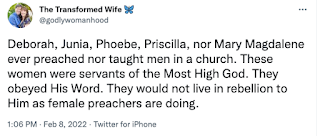
Later this week, I ran into this tweet from The Traditional Wife (in someone else's stream, I don't follow her.) It was a bit ironic as this week I was scheduled to preach. A group of us gather once a week to celebrate the Liturgy of the Word, using the readings of the day. We take turns to offer a brief reflection and then open the floor for some faith sharing. It has been a powerful experience through this pandemic to listen to my brothers and sisters in faith turn over and shake out the word of God for each other. Each time we celebrate together, I am in awe of what the Holy Spirit does in the world. Of how we can all preach.

So this week I preached about churches, about sacred space and time. About how all places are sacred, all of us holy. And this characterization of women preaching as living in rebellion, like fallen angels utterly divorced from God, just makes me laugh. Also, I don't think there were churches for Deborah to preach in, to men or women...


For more women preaching try:

The latest volume of Homilists for the Homeless (all the proceeds from this series go to the poor)
There's a Woman in the Pulpit a collection from the RevGals

Wednesday, December 29, 2021

Thirsting for the face of God: new book of homilies

What does it mean to thirst for the face of God? It's a question I wrestle with in the little book on prayer which was published by Liturgical Press this fall, and it is the subtext of many of the homilies collected in the latest book by Homilists for the Homeless: Thirsty, and You Gave Me Drink: Homilies and Reflections for Cycle C. The Homilists for the Homeless project is led by Deacon Jim Knipper and Clear Faith Publishing. All of the authors have contributed their writing to these collections, so all the proceeds go to projects to care for the poor. This book will support projects that help people get access to clean water, as a chemist something I support wholeheartedly. (I'm not the only chemist contributing to this volume, Magg Blackie also has two homilies in here and Jim Knipper started as a chemist.)

My homilies are for the second Sunday of Lent and the 17th Sunday of Ordinary Time. The first reflects on an experience of the Transfiguration on the hot and humid day on the streets of Rome, what should we do when we encounter the transfigured Christ sprawled on the ground? The second dares us to pray boldly:

So dare to beg God for what you desire. Dare to be persistent. Dare to be shameless. Dare to pray for the improbable and the impossible. Dare to pray for the insignificant and the inconsequential. Pray boldly as long as you have breath, for our God always bends down to listen.

The volume includes homilies by Phyllis Zagano, Fr. James Martin SJ and Fr. Greg Boyle, SJ as well as the delightful Fran Szpylczyn, Meredith Gould and many more.  Find the whole list here.


Tuesday, December 22, 2020

A stranger and you welcomed me

Crash Kid is looking to establish a base in another country. He and his brother have reclaimed the German citizenship the Nazis stripped from their grandmother, which makes this easier, though in no way was it easy. It took them three years to work through the process to get to this point. Details took on an outside importance, and a lack of attention to them could have derailed the process at any time. But in the end, all the umlauts fell into place and they went to the German Embassy in Washington, DC to collect the paperwork that said they were German citizens (and very snazzy challenge coins). They said they felt welcomed!

A couple of days later I got a package in the mail, my copy of A Stranger and You Welcomed Me, the latest in the Homilists for the Homeless series that Deacon Jim Knipper launched in 2012. This cycle I have homilies for the Solemnity of the Blessed Virgin Mary and one for the 28th Sunday in Ordinary Time. Both are Ignatian inflected, particularly the one for January 1 which sketches the Examen. I note that I'm not the only chemist in the collection, Mags Blackie has two homilies in there as well, including a beautiful reflection for the 20th Sunday in Ordinary Time which wonders at the Eucharist through the eyes of a chemist — what happens to the molecules of the Eucharist?

All of the proceeds from the sale of this volume go to organizations that help immigrants, all of the authors donated their work. There are homilies from James Martin SJ and Nadia Bolz-Weber, from Fran Szpylczyn, Dan Horan OFM and Phyllis Zagano. So many different voices. 


A cool 99% Invisible podcast about challenge coins.

Thursday, November 07, 2019

Reefing the sails of our oration

I've been to a lot of meetings in the last few weeks. A lot. In the last four days I've spent more than 8 hours in one meeting or another. A whole working day. This morning I was reading St. Methodius (the fourth century bishop, martyr and Church Father, not St. Cyril's brother). To signal that he is wrapping up an oration on Simeon and Anna, he declaims, "let us reef the sails of our oration." There were a few moments this week when I wished I had the nerve to make a similar suggestion to whoever was speaking.

I do note that when Methodius suggested reefing his sails, he wasn't ready to bring them down all together. That reflection still had almost 10 minutes to run, for a total of about an hour and a half.

Thursday, March 24, 2016

Holy Thursday: May we be all flame


Lord, enfold me in the depths of your heart;
and there hold me, refine, purge and set me on fire,
raise me aloft, until my own self knows utter annihilation.
—Pierre Teilhard de Chardin, SJ

We gathered in the small chapel we use for daily Mass and for the Liturgy of the Hours.  The altar has been stripped, the tabernacle is empty, the presence lamp gone.  Light flows in.  Our voices were strong as we began, "O Sacrament of love, sign of our unity, bond of our community, whoever longs for life has here its source, let us come here and believe, united with you, and live."

Tonight I will walk in solemn procession, a river of light and incense and prayer wending its way through the church, bearing fire, standing guard.  I thought this morning of the story of Abba Lot, one of the desert fathers.  He came to Abba Joseph and said, "as far as I can I say my little office, I fast a little, I pray and meditate, I live in peace..what else can I do?” Abba Joseph lifted his hand to heaven and his fingers became like ten lamps — aflame. "If you will, you can become all flame."

We have come to the end of Lent.  As we were able we have kept to our obligations, fasted, prayed and meditated; we prayed fiercely for peace.  And now?  Now it time for us to become all flame.


Photo is of Sagrada Familia in Barcelona.

Sunday, October 04, 2015

One Flesh

It's a complicated Sunday. World Communion Sunday. Respect Life Sunday. Opening of the Synod on the Family in Rome. Feast of St. Francis of Assisi. On my more local calendar, we are anointing the sick at my parish this week, I gave a talk at the a nearby Episcopal Church on science and religion, and went to a friend's husband's funeral. In the greater world, there are floods and shootings and mudslides and "collateral damage" at hospitals.

It has me thinking about what it means to share in the sufferings of the Body of Christ, of the world.

And in this reflection, written many months ago for Give Us This Day, I wonder if we are missing something about the sacramental sign that is matrimony.

Do we weep for each other, as we would weep for a beloved spouse?
"'Are you trying to tell me that my husband is dead?' I asked the surgeon. 'Yes.' In that harrowing moment of my first marriage’s dissolution, I finally grasped in my bones the reality of these words: They are no longer two but one flesh. Half of me had been torn off, and what remained was pouring out onto the floor in a pool of tears.

It is tempting to hear these readings from Genesis and Mark as mere marriage instruction, demanding husbands and wives to cleave to each other no matter the cost. I see in them instead potent images of what it feels like to be one body, not just in marriage but as the People of God: you are bone of my bone, flesh of my flesh. We proclaim in the Communion antiphon that we are one body. But do we feel in our bones that we are one flesh, mingled with Christ in our communion, as the water and wine mingle in the cup we share? One. Inseparable.

These readings point us to realities beyond marriage, challenging us to deepen our fidelity to one another and to Christ as members of his One Body. This indeed is a hard teaching for all of us, not just those struggling with marriage. Are we torn open by the sufferings of our brothers and sisters? Do we weep for each other as we would weep for a beloved spouse? We are no longer two, but one flesh."

Friday, August 21, 2015

Choose. A homily for the 21st Sunday in Ordinary Time.

"Sugus" by aTarom
I wrote this homily for the collection Sick, and You Cared For Me (part of the Homilists for the Homeless series - all the profits go to aid the poor), which was published last fall.  We called the candies, "eggman candy" because we called the farmer who brought the egg the eggman.  He always kept a few of these Swiss sweets tucked into his basket.

It's not the big choices that confound me, but the little ones.  The choices I sometimes don't even realize are choices until I reach the examen at the end of the day.

This is a homily I wish I could preach aloud.


“Choose,” urges my mother, as I peer into the basket the farmer set down in our dim front hallway. The pale grey cartons of eggs are stacked on one side, a sharp contrast to the brightly colored candy on the other. I clutch a nickel in my small hand; do I want purple or red? Is there no green apple? Candy was an infrequent treat in my rural childhood, making it so hard for me to choose.

Forty-some years later I’m sitting in a sun-drenched office overlooking the Atlantic, clutching a cup of tea, listening to my director explain the next step in the Spiritual Exercises of St. Ignatius, the Meditation on Two Standards. “It will be here to see a great plain, comprising the whole region about Jerusalem, where the sovereign Commander-in-Chief of all the good is Christ our Lord,” says Ignatius, “and another plain about the region of Babylon, where the chief of the enemy is Lucifer.” Lucifer sits on a thrown of fire and smoke; Jesus stands in a lowly place. Their standards are flying; the battle lines are drawn. Choose.

For anyone drawn to spend four weeks walking with Christ through the Spiritual Exercises, the bare choice itself isn’t hard. It’s already been made. As Joshua proclaims in the first reading, “As for me and my household, we will serve the Lord.”

Or is it? Many of the disciples walking with Jesus in John’s Gospel complained that the choice was tough, sklērós it says in the Greek, as something dried up and hard to chew on. “Unless you eat the flesh of the Son of Man and drink his blood, you do not have life within you,” Jesus has said to them just before this Gospel opens. Words that scandalized them, words that shook their faith, words that were hard to swallow.

To choose to stand with Christ is a choice that leads to things we are not sure we want to eat, cups we are not sure we can drink. “If you want to get warm you must stand near the fire: if you want to be wet you must get into the water. If you want joy, power, peace, eternal life, you must get close to, or even into, the thing that has them,” says C.S. Lewis. “Eat my flesh,” says Jesus, “that I might abide in you, and you in me.” Choose.

Ignatius invites us to look closely at the camps, to see what we are getting into when we eat of the flesh and drink of the blood of God’s Holy One. To choose to carry Christ’s standard, says Ignatius, is to welcome poverty — spiritual poverty and perhaps even material poverty. To choose Christ is to prefer rejection over worldly honors. To choose Christ is to elect to stand with the foolish and the useless, to joyfully embrace humility for the sake of the Gospel. Choose. It could be tough.

The difficulty in choosing, for me, lies not in my intention, but in noticing the choices before me in the midst of my daily life. Choices rarely present themselves cleanly, with bright flags flying to identify the camps, and the lines of battle so clearly drawn. Instead it is a man facing me on the sidewalk, asking for something to eat. Choose. It is the mentally ill woman who wants a ride home from church. Choose.

Ignatius hoped this meditation would give those who made it a concrete understanding of what is fundamentally driving their choices, in our hearts as well as our heads. Can I recognize what is stirring me up in each situation? Is it greed? Is it fear? Or is it Love?

Pedro Arrupe, S.J., the former Superior General of the Society of Jesus said, “Nothing is more practical than finding God, than falling in Love in a quite absolute, final way. What you are in love with, what seizes your imagination, will affect everything. It will decide what will get you out of bed in the morning…what you read…whom you know…Fall in Love, stay in love, and it will decide everything.” Where else would we go, Lord?

The Twelve remained with Jesus, not for power, nor out of fear, not because it was a rational decision, but because Who they fell in with was Love. And what we love, decides everything.

Sunday, May 10, 2015

Of Penguins and Kairos

The building in which I have worked for the last 30 years is at the start of a much needed renovation.  Parts of the building are more than a century old, it's been added onto over the years until a map of its hallways resembles an octopus, and I sometimes worry that the student who hasn't been in class all week is not napping in one of the hammocks under the cherry trees on the green, but lost in the depths of the building.

Sometime in the next five years, my beloved office, set on one truncated arm overlooking a courtyard alive with groundhogs, birds and the occasional hawk looking for a warm spot out of the wind, convenient to the photocopier and the kitchen, where I can open my windows and hear the bell pealing as seniors finish their exams, will be subsumed into a new public space.  And I'll be...where?  I have no idea.

Moving is hard, particularly when you can't envision the new space.  Will my table fit?  Will I be banished to a space far from where students wander?  Will I have sunlight on a winter afternoon?

Enter Robin's wise, warm and witty sermon about gifts and change, about what ignites us and why, about time. Read on to find out "What do penguins have to do with it?"  Thanks for preaching beyond the walls of your church, Robin!

Wednesday, March 18, 2015

Preaching Ahead of Myself: A Homily for the 9th Sunday in Ordinary Time Cycle B

Simeon the Stylite
The next time the 9th Sunday in Ordinary Time will be celebrated is in 2038, but it will be the A liturgical cycle readings, not the Cycle B reading this homily was written for.  The B cycle readings will not come up in my lifetime, so this is a homily for a Sunday that will not be celebrated 'preached' by someone who cannot preach.

My friend Robin talks about "preaching ahead of yourself," and while this preaching for a moment far ahead of me in time is not quite what she means by the term, I think I can stretch it to accomodate.  I reflected a bit here about the writing of this piece, and  homilies in general.

This was written for Sick, and You Cared for Me, the third book in the series by the Homilists for the Homeless. You can read about the series here.


In the fourth century, Simeon the Stylite, it is said, spent more than thirty years living on top of a fifty-foot high pillar on the edge of the Syrian desert, confined to a platform three feet on each side. He was driven up the column, not so much by his desire to get closer to God, though that surely played a part, but to get further from the crowds who clamored for his advice, disturbing his prayers. Still they came, from Constantinople and Antioch, emperors, archbishops and farmers alike clambered up a ladder to have a word with the saintly Simeon, until finally his brother monks built a double wall around the pillar to keep the curious at bay.

There are weeks where my calendar makes a pillar in the desert, guarded by high rock walls and a solid community, seems like a great idea. I imagine the items on my to-do list jumping up and down, yelling for my attention, surrounding me on all sides, scrambling to find a ladder to climb up to the top of the list. It’s tempting to try to quiet the demanding crowd by plunging into the list first thing, crossing off this task, answering that request. But the tasks keep coming up the ladder.

A few years ago I started writing “pray” at the top of my daily to-do list, to be sure I didn’t fail to start my day with God no matter how chaotic life was. I confess I also put it there so I could cross it off, so I could feel productive, even in prayer.

God? Great! Help? Thanks. Bye. Amen.

And I check off God for the morning.

The Catechism of the Catholic Church reminds us that “prayer ought to animate us at every moment…we cannot pray “at all times” if we do not pray at specific times.” [2697] My habit of scheduling prayer on my calendar is not a bad thing; it’s a jumping off point, not just for my day, but for the formation of my prayer life. Writing about living with a religious rule, with its ordered times of prayer, Richard Rohr, OFM observed that it kept “my feet to the fire long enough for the Gospel to become fire, and my feet to become feet.”

My daily reminder to pray holds my feet to the fire, too, until I can pick up the day’s work and walk. Until I can, as fourth century doctor of the church Gregory Nazianzus advised, remember Christ more often than I draw breath. Of late I’ve started to wonder if I should stop crossing it off and simply let it stand at the head of my list, to be more aware of God’s presence as He “guides the beginning of my work, directs its progress, and brings it to successful completion” as Thomas Aquinas’ prayer before study so beautifully captures.

Prayer is not inherently productive, however. “Being useless and silent in the presence of our God belongs to the core of all prayer,” wrote Henri Nouwen. Can we waste time with God, even in the face of urgent tasks? Can we practice simply letting God look at us? Saying nothing. Doing nothing.

The Sabbath holds our feet to the fire in this regard. Today’s first reading from Deuteronomy exhorts us firmly to be unproductive one day in seven. Do no work. Let no one work in your stead, not even your animals. Let the world lay fallow for a day and see what happens when you are useless and silent in the presence of God.

Mark’s Gospel offers us one image for what might happen when we give ourselves over to sabbath time. The Pharisees are fussing about the precise limits of the rules, Jesus is letting the disciples flout the rules — fresh ears of wheat are not edible, they were not picking up a snack on the way — and all the while a man with a withered hand sits in the synagogue. Silent and useless.

“Stretch out your hand,” commands Jesus. And the hand is whole again, perfect. I gaze upon you, says God, and you are healed. Did the man notice the moment he was once again made whole, when the bones knit and his muscles responded with strength? How not? But did the person next to him?

Sunday is not the day we flip the week’s calendar over, not merely a day we are obliged to go to Mass, to make a return to Lord for what we have been given. It is not about the rules. The Sabbath is for noticing. For noticing that God is present, for noticing that we have been healed, for noticing that our neighbor has been healed.

The Sabbath is a reminder to sit unproductively, and be alert to what happens when Light shines forth from darkness and God beholds us. Stretch out your hands, and see that what has been crushed has been made whole in Christ’s dying and rising.

Sunday, December 07, 2014

Silent preaching: Sick and you cared for me


...as we cannot preach the word of God by our mouths, we may do so with our hands. — from Chapter 28 of Consuetudines Cartusiae

Guigo, the fifth prior of the Carthuisan monastery of the Grand Chartreuse, 1was reflecting on the work of copyists, not of homilists, in this line from his collection of Carthusian customs, but I thought of his image of preaching with our hands when I was asked to contribute two homilies to the third volume of of the Homilists for the Homeless project.

Edited by Deacon Jim Knipper, Sick and You Cared For Me contains homilies for each of the Sundays of Year B in the lectionary cycle.2 Each of the writers contributed his or her work to the book, preaching literally with their hands, and all the proceeds go to care for the poor.  We have raised more than thirty thousand dollars with the first two volumes.

I am preaching on the 9th Sunday in Ordinary Time (which won't appear next year, or any year soon) and on the 21st Sunday in Ordinary Time. The homily for the 9th Sunday reflects on the story of the man with the withered hand, who was healed by Jesus on the Sabbath - about Simon the Stylite on his pillar and the ways in which Sabbath is a time for noticing.  On the 21st Sunday, where the readings are from Joshua ("as for me and my household, we will serve the Lord") and John ("these teachings are hard"), it's about Ignatius and the meditation on the two Standards. Choose.3 

There are homilies from many voices and traditions. Contributors include Richard Rohr, Jesuits Rick Malloy SJ (his mother was my neighbor for many years) and James Martin, Mike Leach, Fran Szpylczyn, Jan Richardson, Mags Blackie (how many books of homilies have two Ph.D. physical chemists in them?!).

I am giving away a copy of Sick and You Cared For Me to celebrate the start of the new liturgical year. Leave a comment, and on Friday, I'll draw a winner.  Prefer a sure thing?  You can order a copy from Clearfaith.


1. This is the monastery featured in Into Great Silence - a beautiful film that opens in Advent and covers a full liturgical year.
2.  Homilies for cycles A and C are in Naked and You Clothed Me, and Hungry and You Fed Me, both of which won awards from the Catholic Press Association.
3.  I chose in writing this not to reflect on the "wives be submissive to your husbands" passage from Paul.

Thursday, January 16, 2014

Garlic and sapphires in the mud

Used under a Creative Commons License.  c. John Arnold
[The last bit of this is a much redacted piece of the reflection...]

Last night I gave a reflection at a local retreat house for their annual blessing of calendars and clocks. It is a lovely custom, starting with a simple dinner. Soup and bread, cookies and tea. As we moved into the chapel after dinner, people began coming up to the foot of the altar and leaving their planners and calendars on the steps, stripping off their watches and setting them on top. Here, in front of the tabernacle, we moved from chronos to kairos, not just in mind, but in body. We literally stripped ourselves of the things that which mark and measure, cajole and contain counted time for us.

As I stood in front of the altar and set down my calendar and took off my watch, I had a moment of angst. I wanted to say to God, "You want what?" My watch? How would I keep track of the time when I spoke? Mind you, I have a prepared text, and no tendency to stray far from it. At 1500-ish words, it's a 12-15 minute reflection.

Despite the two angels sternly guarding either side of the altar, no divine help was apparently forthcoming. No cherubim appeared to peel off my watch and bear it with glee to the altar. No seraphim stood before me and boomed, "Step away from your time piece." I just had to. Take. It. Off. And walk away.

I will admit to having a somewhat fraught and fragile relationship with time. As a scientist, I know something of time and how it measured by clocks and by calendars. One second, the time it takes for a particular atom (Cs-133) to move between two states 9,192, 631,770 times. Exactly 9,192, 631,770 times. The very atoms from which we are made are ticking clocks.Less than one half-life of C-14 has passed since a man named Jesus, the Nazarean, hung on a cross on a hill on the outskirts of Jerusalem. As a person of faith, I get that God set time into motion with the creation of the universe. But time and I are still at odd with each other more often than not.

In an article written ten years ago in America, Jesuit Dennis Hamm suggests praying not just over, but with, one’s calendar in hand, as part of the Examen. I’m going to admit that when my spiritual director first suggested this, my reaction was visceral. After a crazy day, the last thing I wanted in my prayer space was my calendar. I wanted to meditate on the eternal, to sink into the vast stillness of God. Not contemplate the to-do list that chases me from one end of campus to the next. No. No way.

But my ever patient director kept gently suggesting it. At first I couldn’t even open the thing, it would sit on the carpet in my prayer space, where I would watch it carefully. Would the demons trapped inside fly out if I cracked the cover? Gradually I found the courage to open the @#$$% thing, and found that praying with my calendar helped me discover the moments of consolation, that even if I appreciated them in the moment — the uninterrupted lunch, the walk from one building to the next, the student who finally figured out the tricky titration proclems — by the time I reached the end of the day, were lost in the evening maelstrom of dinner making, homework and lecture preparation.

Crash calls once a week, via Skype from WJU (Wonderful Jesuit University), and when I ask “How has your week been?” he pulls up his calendar and uses that to prompt his memory. I’m delighted to be welcomed into his life, to walk along with him, through both the quotidian — the math test, finding a barber to cut his hair — and the memorable — he spoke to Madeleine Albright, he got into the class he really wanted to. To hear what he thinks these events mean, and a chance for him to ask me for what he needs. Books and key deposits. Calculus help.

I wonder if God takes equal delight in my invitation to be welcome within my calendar, my days, the seconds he set the beat for? As happy to hear how I feel about my finally getting the laundry not only done, but folded and put away, as He is to know that I went to Mass this morning. To know where I might have encountered “Garlic and sapphires in the mud."

My relationship to time is still a complicated one, but there are blessings here, year round. But God, can I have my watch back now?

Saturday, January 04, 2014

Strangers in a strange land

It's the feast of the Epiphany, an apt time, perhaps, to think a bit about strangers who appear suddenly in our midst, and of weary travelers. We've had one such traveler appear late on Thursday night, in the midst of a snowstorm.  My nephew, driving back to New York from Virginia, an 8 hour drive that had already taken him nearly 12 when he arrived at our doorstep, bedraggled and wringingly exhausted.

Rita Ferrone, reflecting at PrayTell on her experience of Midnight Mass, notes that the presider "gave a self-righteous scolding to the occasional attenders." Meanwhile the comments on an article I wandered onto (about ways to make Christmas Mass accessible to those who are not habitual attenders) made me nearly weep, and glad I was not a stranger showing up at their parishes for they would prefer I neither have a seat nor receive the Eucharist, for that should be reserved for those (who they know) to come regularly to Mass.  Stranger?  You must be a C&E (Christmas and Easter) Catholic, which is, of course, no Catholic at all.

I can't imagine what it might feel like to have made the time, even just this once a year, to go to Church and be treated to a scolding.  The lost sheep has returned, do we not feast, rejoice?  There is a spark, do we sniff and blow it out?

Nor can I quite imagine what it must be like for those who regularly attend to be upbraided.  Is this how the Word that comes to dwell in our midst is to be preached at the celebration of the Incarnation?  Do not those who regularly come to this table deserve to be fed with carefully prepared preaching appropriate to the Solemnity which they have waited for through Advent's weeks?  Apparently not.

One commenter speaks of struggling with the contempt in which s/he holds the interlopers at Christmas Mass.  I'm struggling, too, with my feelings about those who feel there is no room at the inn for strangers, however they've found their way to the door, and however long before their next visit.