Showing posts with label women in the church. Show all posts

Tuesday, July 22, 2025

Mary of Magdala Aflame


Happy Feast of Mary Magdalene, Apostle to the Apostles!

— Excerpt from Rejoice and Be Glad 2019 reflecting on John 20:11-18

St. Augustine called Mary Magdalene “the apostle to the apostles” because she was sent from the garden to tell the apostles the good news. Magdala means tower in Aramaic, and I find the image of Mary the Tower a potent complement to Peter the Rock. The church may be built on the rock of Peter, but Mary of Magdala ignited it with these words: “I have seen the Lord.”

Every time I hear this gospel I wonder what happened to Mary Magdalene next. Medieval legends say she retreated to pray in a cave in France, where she was fed by angels. The Orthodox Christian tradition places her with Mary, the Mother of God, in Ephesus.

“Go,” Jesus told Mary Magdalene in the garden. I doubt Jesus meant for her to take a walk and deliver his message to the disciples and then vanish. Poreuou, the Greek word translated in today’s gospel as “go,” carries the sense of heading out on a journey. Its ultimate root is “pierced through.” It is a call to reorder your life’s direction, to push a message out into the world despite barriers and with a piercing clarity. Go out, Jesus demands of Mary Magdalene, I want you to proclaim again and again, “I have seen the risen Lord.”

So I doubt Mary Magdalene stopped proclaiming the Good News when the disciples laughed at what they thought was nonsense, to quietly retire to a cave or a small house in Ephesus. I imagine her so aflame with the Gospel that wherever she went and whoever she met she could not help but deliver the message for all ages to come, “I have seen the risen Lord.” And I cannot imagine that Christ expects me to do anything less.


Thursday, February 10, 2022

Preaching rebellion


"For I handed on to you as of first importance what I also received: that Christ died for our sins in accordance with the Scriptures; that he was buried; that he was raised on the third day in accordance with the Scriptures; that he appeared to Cephas, then to the Twelve. After that, Christ appeared to more than five hundred brothers at once, most of whom are still living, though some have fallen asleep. After that he appeared to James, then to all the apostles. Last of all, as to one born abnormally, he appeared to me." 1 Cor 15:3-8

Listening to the second reading on Sunday I was struck by how absent women were in it. Paul lists the witnesses to the resurrection, but fails to note that the first witnesses were the women, Mary Magdalene in particular. 

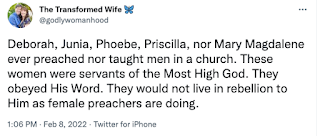
Later this week, I ran into this tweet from The Traditional Wife (in someone else's stream, I don't follow her.) It was a bit ironic as this week I was scheduled to preach. A group of us gather once a week to celebrate the Liturgy of the Word, using the readings of the day. We take turns to offer a brief reflection and then open the floor for some faith sharing. It has been a powerful experience through this pandemic to listen to my brothers and sisters in faith turn over and shake out the word of God for each other. Each time we celebrate together, I am in awe of what the Holy Spirit does in the world. Of how we can all preach.

So this week I preached about churches, about sacred space and time. About how all places are sacred, all of us holy. And this characterization of women preaching as living in rebellion, like fallen angels utterly divorced from God, just makes me laugh. Also, I don't think there were churches for Deborah to preach in, to men or women...


For more women preaching try:

The latest volume of Homilists for the Homeless (all the proceeds from this series go to the poor)
There's a Woman in the Pulpit a collection from the RevGals

Tuesday, January 18, 2022

St. Hildegard’s cookies

"Take one whole nutmeg, add equal amounts of cinnamon and a pinch of cloves, grind it together until it forms a fine powder; add the flour and a little water. Make small cookies and eat these often. They will reduce the bad humors, enrich the blood, and fortify the nerves.” — Hildegard of Bingen, Physica, Book 1, XXI. Nutmeg

I gave a day of reflection on Hildegard of Bingen at a local retreat house. One of the conferences was on Hildegard’s Physica where she recommends mint for the digestion and spicy cookies to fortify the nerves. I sent retreatants home with tea and ginger snaps. 

It’s the start of the semester for me tomorrow, so I’m in need of something to fortify the nerves with. I’m on Zoom to start, while students await test results. Next week — back in person!


St. Hildegard’s cookies


1 3/4 c sugar
3/4 c butter
1/4 c molasses
1 egg
2 c flour
2 tsp baking soda
1/2 tsp salt
1 tbsp ground ginger
1 tsp ground cinnamon
1/2 tsp ground cloves
1/4 tsp grated nutmeg
extra sugar for rolling

Beat sugar and butter until fluffy. Add molasses and beat until well blended. Add egg, beat on low to combine. Add flour, baking soda, salt and spices to batter and blend well. Chill dough, covered, for at least 1 hour.

Roll dough into 1 1/4 inch balls. Roll the balls in extra sugar. Place 2 inches apart on baking sheet lined with parchment. Bake at 375F for 8-10 minutes. Cookies should just be brown around the edges. Cool on a rack, cookies will firm up as they cool. Store in airtight container or freeze.

Sunday, December 19, 2021

Unbridled Joy


Twenty-six years ago, I was standing in my parish church rehearsing the music for an upcoming Mass, eight months pregnant with my youngest son. The choir director went to move the grand piano into place, and suddenly its top came down with a discordant crash. I didn’t jump, but the babe within my womb did, his arms and legs flailing out in that classic newborn startle reflex. It made me viscerally aware that there was someone inside of me whose thoughts were not my thoughts.

I vividly recall that experience every time I hear the gospel story of Mary’s visit to Elizabeth. It surfaces more than sweet memories of my son, each time it reminds me to contemplate who is moving within me now, whose thoughts are not my thoughts. How do I notice and respond to God dwelling within me?

The nineteenth-century French Catholic novelist Léon Bloy wrote that joy was the surest sign of the presence of God. Surely Elizabeth’s experience of both her own joy and that of the infant John the Baptist was a sure sign that they were in God’s presence. In his encyclical on love, Deus Caritas Est, Pope Benedict XVI reminded us that being Christian isn’t a purely rational choice based on some ideal or ethical system, but an encounter with an event, a person; a meeting with God that decisively orients our life. Elizabeth and Mary’s lives were profoundly reoriented by their joyful encounters with God. 

How do we discern God’s movements within us? How might we know we have encountered the Word among us? We might be alert to those moments of unbridled joy that arise in our hearts. For joy is the surest sign. 

— From M. Francl-Donnay, Waiting in Joyful Hope, Liturgical Press, 2020.


The baby is me.


Wednesday, May 05, 2021

Feminine or masculine genius

Necessary emphasis should be placed on the "genius of women," not only by considering great and famous women of the past or present, but also those ordinary women who reveal the gift of their womanhood by placing themselves at the service of others in their everyday lives. For in giving themselves to others each day women fulfil their deepest vocation. Perhaps more than men, women acknowledge the person, because they see persons with their hearts. They see them independently of various ideological or political systems. They see others in their greatness and limitations; they try to go out to them and help them. In this way the basic plan of the Creator takes flesh in the history of humanity and there is constantly revealed, in the variety of vocations, that beauty not merely physical, but above all spiritual — which God bestowed from the very beginning on all, and in a particular way on women. —John Paul II Letter to Women 29 June 1995

There was a recent editorial in Our Sunday Visitor wondering about whether "masculine genius" was a thing. I read it and wondered briefly if the real masculine genius is convincing (at least some) women that they are fundamentally created by God to be servants, to do the work of seeing and accommodating the emotional and material needs of others before anything else. That the default assignment of emotional labor to women is not cultural, but ontological, and therefore unavoidable. Men might be able to do these things, but it is women's "deepest vocation." Women are thus created to enable men to do...what precisely? What are men's deepest vocations, if not service?

I remain convinced that service is fundamentally what we are called to do as Christians, not by virtue of gender, but by common vocation. We are called to feed the hungry, clothe the naked, welcome the stranger, accompany the sick and those in prison. We are called to kneel at each other's feet and wash away the dust of the day.  Should men not see each person as they are, acknowledge the human dignity of each person they encounter? Should men not be able to perceive the strengths and limitations of others? Ought they not be oriented toward service? To serve is not a particular genius, but a universal call realized in particular ways by particular people.

My particular genius is quantum mechanics, work which has aided in the development of drugs for cancer, hypertension and AIDS. It is not to keep the family calendar, or arrange flowers for the altar. The first is a skill that can be mastered by any competent adult, the second perhaps requires a sense of color and proportion and of the sacred, which a quick gander through the works of "the great masters" suggests is not limited to women. 


Tuesday, April 06, 2021

First and afire: Mary of Magdala


“…go to my brothers and tell them, ‘I am going to my Father and your Father, to my God and your God.’” (John 20:17b)

St. Augustine called Mary Magdalene "the apostle to the apostles" because she was sent from the garden to tell the apostles the good news. Magdala means tower in Aramaic and I find the image of Mary the Tower as a complement to Peter the Rock a potent one. The Church may be built on the rock of Peter, but Mary of Magdala ignited it with these words, "I have seen the Lord.” 

Every time I hear this Gospel I wonder what happened to Mary Magdalene next.  Medieval legends say she retreated to pray in a cave in France, where she was fed by angels.  The Orthodox Christian tradition places her with Mary, the Mother of God, in Ephesus. 

“Go” Jesus told Mary Magdalene in the garden. I doubt Jesus meant for her to take a walk and deliver his message to the disciples, and then vanish.  Poreuou, the Greek word translated in today’s Gospel as “go,” carries the sense of heading out on a journey. Its ultimate root is “pierced through.”  It is a call to re-order your life’s direction, to push a message out into the world despite barriers and with a piercing clarity. Go out, Jesus demands of Mary Magdalene, I want you to proclaim again and again, “I have seen the risen Lord.” 

So I doubt Mary Magdalene stopped proclaiming the Good News when the disciples laughed at what they thought nonsense, to quietly retire to a cave or a small house in Ephesus. I imagine her so aflame with the Gospel that wherever she went and whoever she met she could not help but deliver the message for all ages to come, “I have seen the risen Lord.”  And I cannot imagine that Christ expects me to do anything less. 


From Rejoice and Be Glad, Liturgical Press, 2019. Painting is Rembrandt, Christ and St. Mary Magdalene at the Tomb.

Sunday, April 04, 2021

The work of Easter


Like the women in the Gospel this morning, Mary of Magdala and Salome, I rose early this morning. As they undoubtedly were, I was wrapped in a shawl against the cold, all of us off to seek the Lord. There was no music, no alleluias at the first Mass of the morning. No Easter sequence. Just the Paschal candle burning hard and bright next to the ambo, a reminder of the mysteries celebrated here last night. I prayed. I listened for the Lord. I received, that I might become...if not whole, at least less fractured.

Then I went home and cleaned the kitchen and made sweet spice bread for breakfast. As I scrubbed last night’s sheet pans, I wondered if this really was how I should be celebrating Easter, clad in a well-worn apron and wielding a soapy sponge. Or perhaps this is precisely how Jesus imagined the celebration as he knelt on the floor, a towel around his waist, washing feet. Women, up early to do the work of feeding the hungry and tending to the needs of the living and the dead. Women with the courage to stay in the face of unspeakable pain, and a scandalous death. Women with the courage to profess what they had seen, in the face of mockery and derision.

I didn’t hear about these women in this morning’s homily, though I wished I had. I hear them now, though, wondering how they would roll the stone back so they could care for the Body of Christ. I’m wondering much the same thing.

Friday, January 03, 2020

Via media in the Catholic media

Massimo Faggioli, a professor of theology and religious studies at Villanova University just down the road, has a new article up at Commonweal. In "Dangerous Disconnects" he expresses concern about the ways that the formation of Catholic priests is disconnected from the broader intellectual world, as well as from the day to day lives of the laity. Likewise, he notes that academic theology is also
"..if seminary formation is too cut off from the real lives of Catholics, then I think (and I realize that I am generalizing here) the same can sometimes be said for academic theology. Yes, there are numerous examples of theologians who clearly have an ecclesial intentionality and do wonderful work for the people of God. It is not an issue of personal intentions, however, but of the systemic position of academic theology in an endangered Catholic intellectual ecosystem, one in which the magisterium and theologians in the academy also have to compete with the “teaching” found on Catholic blogs and websites and various other outlets."
I don't disagree with Faggioli's basic premise that seminary education and theology departments are too often disconnected from each other and from the lives of the faithful, but I take some issue with all Catholic blogs being rolled into one bundle and with their content described as "teaching" — which I'm certain is not meant as either a compliment nor as an assurance of orthodoxy. I write a (small) Catholic blog, I'm theologically trained at a Roman Catholic seminary and consider myself part of the Catholic intellectual ecosystem. I'm pretty sure I'm doing the work Faggioli is suggesting should be done.

Yes, I know, I have a limited audience compared to many blogs, but I'm not a single voice crying out in the wilderness and I write in other outlets as well. I've written books, contributed to larger blogs and written hundreds of columns for my archdiocesan paper. Currently active Catholic bloggers and writers with strong theological training are out there, including Mags Blackie, Fran Szpylczyn at There Will Be Bread, Mary Poust at Not Strictly Spiritual, Catholic Mom (which I found through Franciscan Mom), and Fr.Austin Fleming at A Concord Pastor Comments. Many more voices are active on Twitter and other social media platforms. The Catholic intellectual sphere is less of a monolith than Faggioli suggests and I wish Fagglioli's article had explored the Catholic intellectual and social media ecosystem a bit more deeply.

Still, I fear we are conceding the field to loud voices who indeed field dubious teaching and preach divisiveness rather than unity. Many of these sites are like train wrecks, it's hard to look away. I understand, I'm guilty of giving them clicks and browsing their Twitter feeds and wondering if we are in the same church (should priests be hawking ammunition on their web sites? Discuss!). Can Catholic Twitter stretch to be as catholic as the Church?

Wednesday, July 11, 2018

The eyes of a handmaid

Like the eyes of a servant
on the hand of her mistress,
so our eyes are on the Lord our God
— Psalm 123:2b-3a

This was Sunday's psalm. Several years ago, when unbeknownst to us all, our pastor was dying, this verse was often in my head. He was having difficulty walking and eventually, standing for any length of time.  When I was serving Mass and he was presiding, my eyes were on him all the time, to be sure he didn't have to take an extra step at the altar, to be sure his cane was near to hand, to be sure he had an arm to get down the steps.  But also sure to not fuss, to simply be there if needed.

When I think about those days, I think about whether I'm bringing that tender attentiveness away from the altar, taking it out the doors, rather than parking it with the processional cross in the narthex. Are my eyes on those around me, ready to be there, but not intruding?  When I volunteer at the shelter, where however temporary a landing spot it is,  I am in someone else's home, can I be there to hold the door in the morning, or tie a shoe so a parent can pack lunches or go to the bathroom? Can I fade into the woodwork otherwise? It takes sharp eyes indeed, ones that I'm still working on.

Friday, July 22, 2016

Mary, Mary, I'm going to be contrary

In working on a piece about Mary Magdalene I did I quick search for the collect for the feast (because I was too lazy to walk downstairs and get my breviary).  This page from Fisheaters came up, and while it didn't have the collect on it, it did have some recipes for ointments on it, as something traditional to do for the feast of Mary Magdalene.  I put it aside, and came back to it after a day of writing thinking to stash the material for a possible retreat.

Alas I read it.  It starts out by trying to straighten out any "agenda-driven obfuscation" about the good saint.  Great.  If only it did.  Instead the author suggests any attempt to unwind St. Gregory the Great's conflation of three women into one is not careful exegesis, but an attempt to "undermine the authority of the Church and paint Her hierarchs as 'woman-haters'".

It is barely possible to connect Mary of Bethany, who is identified in John's gospel as the woman who anointed Jesus' feet [Jn 11:1-2], with the unnamed woman who comes to the house of the Pharisee and anoints Jesus' feet in Luke [Luke 7:37-50], by assuming this was a one time event and the same event described in Matthew and Mark [Mt 26:7-13; Mk 14:3-9], and that the Mary who had chosen the better part, living with her brother and her sister was also a notorious sinner.  We could all argue the point until kingdom come (at which point surely we can just ask Mary of Bethany).

But to say that Mary of Bethany is without a doubt Mary of Magdala stretches credulity. Fisheaters explains that because Luke mention a Mary of Magdala a few lines after his account of the sinful woman who anoints Jesus, she must be the sinner.  Really?  Do we think Luke just suddenly remembered her name after penning the previous story?  Why isn't Susanna the sinner?  Or Joanna?  By this logic, we must assume that Simon Peter is the demoniac of Luke's chapter 4.  Because that story follows directly, in the same style.  Possible? Sure.  Probable.  No.

And why is the sin committed by the woman Luke describes necessarily sexual?  The stated agenda of Fisheaters here is to keep the most prominent female figure in the Gospels (after Mary the Mother of God) associated with sexual sin.  If we did not associate Mary Magdalene with sexual sin, we would be "keeping them out of mind, ignoring the need of repentance for such acts." And if she were not, no one would ever think of them?  never repent?  Um.

As an aside, I'm puzzled by the assertions here and in other places that the Talmud use "Magdala" (see figure for what shows up in the old Catholic encyclopedia) to mean "curling women's hair" which is a euphemism for adulteress, and that is used as further support to assign Mary Magdalene the role of sexual sinner.  The Gospels refer to her in Greek as Mary of Magdala, suggesting a place name, which itself means "tower."

So here's the scoop:  Mary Magdalene was the first witness to the resurrection, remanded by Jesus to bring the Good News to the apostles. She remained faithfully at the foot of the cross.  She supported Jesus and his disciples in their travels. She was the embodiment of fidelity.  She was a tower of strength, as her name might suggest, while Peter was having a rocky time.  Was she a sinner?  Of course, aren't we all?