Showing posts with label tea. Show all posts

Sunday, August 16, 2026

Is my office bugged?

Is my office bugged? Short answer. Yes.

Well literally, yes. Also metaphorically. Or it least it feels that way. My latest column for Nature Chemistry is titled "Bug Bites," about the taste of bugs (and having a taste for bugs). It hatched while at my niece's wedding reception early in the summer. The crew of cousins got onto the topic from a conversation about cilantro (stink bugs taste like cilantro, as it happens), and then suggested I write about it.

As I was drafting the piece, I went downstairs to grab a second cup of tea from the carafe in the kitchen. I carried it upstairs, set it down on the desk, and got back to work. I absently-mindedly picked up the mug and noticed something off with the scent. It wasn't quite as floral as I expected. I peered into the cup to find a (dead) earwig bobbing about. Oh dear. Its alarm cocktail of dimethyl disulfide and dimethyl trisulfide had given my tea a mephitic edge.

I removed the unfortunate earwig, and drank the tea.

It seemed beyond coincidental that my tea should be bugged, was the universe listening in? I still can't figure out where it came from. I had rinsed the carafe with hot water before filling it with tea, and it had been tightly sealed. I had already had one cup of earwig-less tea in the mug. The sugar bowl is covered. Where did it come from? 


I took a photo of the bugged tea and of the earwig I fished out, but it felt a bit too gross to illustrate this post. (I described it to Math Man over dinner who winced every time I said "mandible".) So the mug is my organic chemistry mug.

Thursday, April 09, 2026

Talking heads

I’m at Notre Dame (the one in South Bend) today to record a podcast, one of a couple this month. I met the host of this podcast through the blog twenty years ago, when our kids were young, and over the years I have treasured our criss-crossing interests in theology and science. She also introduced me to rose congou tea, a cup of which is sitting next to me as I write. I am also going to the Madeleva lecture tonight — “The Wrath of God(dess): A Spirituality of Feminist Rage” given by theologian Tracy Sayuki Tiemeier. Several of the previous Madeleva lectures are on my shelf, including Kathleen Norris’ The Quotidian Mysteries: Laundry, Liturgy, and 'Women's Work’ and Sidney Callahan’s Women who Hear Voices: the Challenges of Religious Experience. Sidney Callahan is a Bryn Mawr alum, and came to speak to one of my (non-chemistry) courses. 

A couple of weeks ago I was privileged to sit down with Mike Laskey of the AMDG podcast to talk about how science and faith work in my life as a scientist. (This is a great podcast series, in my Saturday morning rotation, with tons of interesting guests, most with some connection to the Jesuits and things Ignatian — rare books, material science, astronomy, songwriting.) I talked a bit about awe and mystery and finding God in a handful of water. Also tea, perhaps because you can (sorry!) hear the noise of my tea cup hitting my desk periodically (also one loud beep from an incoming text — this was not my smoothest interview). 

Tuesday, after a hard PT session, I checked my email to find a request for an interview from EWTN Nightly News to talk about the Artemis II mission. Sure, when? It was 11:35. Could I do this at 12:15? I was sitting in my car, soaked in sweat in desperate need of a shower. 12:45? I got home, showered, professionally attired and to my office in time. Whew — shades of the first days of the great tea kerfuffle!


Listen to the AMDG podcast here, and the EWTN clip here

Photo is from an interview for On The Media recorded at WHYY 11 years ago, about the Food Babe. 

Tuesday, March 31, 2026

Rube Goldberg mornings


Rube Goldberg's Professor Butts and the Self-Operating Napkin (1931). Soup spoon (A) is raised to mouth, pulling string (B) and thereby jerking ladle (C), which throws cracker (D) past toucan (E). Toucan jumps after cracker and perch (F) tilts, upsetting seeds (G) into pail (H). Extra weight in the pail pulls cord (I), which opens and ignites fuse (J), setting off skyrocket (K), which causes sickle (L) to cut string (M), allowing pendulum with attached napkin to swing back and forth, thereby wiping chin.
I like a good Rube Goldberg machine, I do. Push the marble down the track and zip, ping, zap, eventually the cat's food pours into the dish. Or whatever. But the unplanned machines can be a mess...

This morning I went to put away the clean dishes from last night's dinner. The sheet pan had been set down on a wet soapy counter. It was stuck. I pulled it off. My elbow knocked over my water glass sitting by the sink spilling water. The glass straw from the cup hit one of my favorite tea cups*. Which fell into the sink and broke.  And I cried.

*The tea cup was from the pandemic, depicting all manner of calamities in a classic Delft blue. It always made me laugh.

Sunday, December 14, 2025

A cup of grace


"You know that you are drinking a cloud; you are drinking the rain. The tea contains the whole universe.” ― Thích Nhất Hạnh, How to Eat

How much grace is there in a cup of tea? Or is it all grace? If all the universe is caught in my cup,  can it be otherwise? 

After two weeks of a Goldilocks diet (nothing too hot, nothing too cold, nothing with too much texture...or I suppose, too little) I was cleared last week to eat pretty much what I please. Despite my general inclinations toward staying firmly in Advent and not anticipating the upcoming solemnity of the Nativity, "Gloria in excelsis Deo!” was my refrain of the day.

This afternoon's cup of hot tea was glorious, definitely a grace of the day (maybe the week).  Hot,  sweet, fragrant, the cup warm in my hands, its steam swirled up like incense. There is strength in there, cloaked in caffeine's bracing bite. Like Isaiah’s parched desert steppe I come to life.

I think I like my grace like my tea: fragrant and bracing.

Thursday, February 27, 2025

Heavy metal band: tea edition


"Though we might conceive of scientific language as objective, rather than sensual or poetic, in fact phonesthemic considerations play an important role. We know a science word when we hear it, even if we don't know what it means." Nature Chemistry 3, 417–418 (2011)

About 15 years ago I wrote an essay for Nature Chemistry titled "Neolexia," about how new science words get birthed. What should they sound like, what languages should they draw from, should there be humor. (You can read the whole essay here.) In it, I noted that zoologist Lancelot Hogben (Lancelot?!) had very firm ideas on how new science terms should be built.

Heavy metals and tea have been in the news this week, which made me wonder if I should start a tea-themed heavy metal band. Which of course needs a name. And like science words, we know a heavy metal band name when we hear one: Led Zeppelin, Kiss, Anthrax. There should be some hard consonants, and perhaps a whiff of danger. Herewith....

The Katekins (cat-eh-kins, for the catechin molecules that act as antioxidants)

Agonized Leaves (for the agony of the leaves, the way that the dried tea leaves writhe as they unfurl in hot water)

Redox (so much of tea chemistry is redox)

Tea Scum (IYKYN)

Thoughts?


Friday, January 24, 2025

The tale of the great tea kerfuffle


A year ago today, Steeped was published by the Royal Society of Chemistry. I was excited to see all my work come to fruition. But little did I know what the day would bring.

There had been an article in La Civilta Cattolica, and another in the Philadelphia Inquirer a few days before publication. I had gotten up at 4am a couple of mornings to check my mail for interview requests with UK publications. I did a couple, including one with The Telegraph and one with the Daily Mail. I might have mentioned that adding a tiny amount of salt to tea can ease the bitterness, particularly if you'd let your tea oversteep. 

On Wednesday, I woke to a lovely email from my editor at the RSC offering her best wishes and some suggestions for publicizing the book. It was the first day of teaching, so I figured I'd tackle some of those tasks after my classes wrapped up at 1 and before office hours at 3:30. (Confession, there are still a couple of those tasks I haven't managed yet.) And off I went to the college to catch the 9am departmental meeting. 

I went to pull the meeting agenda out of my inbox and noticed I had an email from the RSC's PR firm. The Telegraph was wondering if I had a response to the US Embassy's statement. What statement??? This statement! Turns out that Britain was up in arms over the suggestion that salt in tea could be desirable. We drafted something light and I went off to the departmental meeting. But I kept a wary eye on my inbox. An email from a reporter at the NY Times popped up. Would I have time to talk to him now? I excused myself and went back to my office. We had a lovely conversation, and I was pleased he asked me about my (non-tea related) science. I rang off.

That's when chaos ensued. My phone started ringing. There were DMs on what-was-once-known-as-Twitter, on LinkedIn. In my college email, my personal email. A text from my sister summed it up, "this isn't REAL is it?" It was crazy real. I grabbed a marker and started writing times and interview requests on my glass-topped desk - a space I usually used for working out quantum mechanics problems with my pchem students. Then I went to teach.

The next three days were wild. I did an interview with Lauren Frayer on NPR, and was too flustered to dig out the passage in the book about salt and bitterness when she asked me to read it to her. A TV crew came from the Philly station. I did interviews for media outlets in Ireland and Canada and South Africa and Turkey and Australia and Japan. And of course for the UK. For CNN and the BBC and PBS. At all hours. Like at 1:30 am my time - morning in Britain. By Zoom and phone and via fancy web set ups. And I taught my classes. 

I was the subject of a press briefing at the US State department.

Saturday morning I was sorting my laundry as one does on the weekend when the texts flew again. I was a limerick on NPR's Wait, Wait Don't Tell Me:

Before all you Britains find fault
Take a sip and your whinging will halt
While sugar is nice it’s not quite the right spice
Because your tea needs a wee pinch of…salt

It got a bit less wild the following week. I did more interviews, but got more sleep. One of my favorites was with WHYY's Cherri Gregg and Avi Wolfman-Arent for their show Studio 2. I brought tea to taste and it was fun to meet the people behind the voices that I had heard so often. I enjoyed giving a Joseph Priestly Society lecture at the Science History Institute in Philadelphia, which played a role in the book. In the end the PR people estimated that the news had been seen 19 billion times. I'm with my sister, this isn't real is it?


I'm still talking tea (four events coming up in the next month including a reading at an independent book store and a virtual talk with the ACS -- you can sign up for free here) and doing the occasional interview about the chemistry of tea (December's Consumer Reports) beyond salt. I got to meet and talk tea and baking with chemist and Great British Bake Off finalist Josh Smalley in London last summer, hosted by the RSC. Most of all I enjoy taking people for a dip into their cup to better appreciate the rich molecular mash-up that is the world's most popular beverage after water. And to find ways to make their tea taste better! Even to the adding of a pinch of salt.

Tuesday, January 14, 2025

MMOD: My mug of the day


I have so many mugs. Mugs that were gifts. Mugs that were swag. Mugs I bought because I was enamored of their shape or color or material. Mugs bought as mementos of a trip or event. Mugs bought out of desperation. (I'm thinking of one bought in South Bend so I could make a morning cup of tea that did not taste of coffee.) I still have the Sandra Boynton mug Tom bought me in graduate school during a particularly awful week, 45 years ago.

I keep a selection of mugs in the kitchen, and a few at the office. Periodically I rotate what's out. When I grab a mug for the day I often pick one to match my mood or one that speaks to the work of the day. Yesterday was a mug from the Vatican Observatory, to get me in the mood to talk about my work there with a group of 7th and 8th graders at a local parish.

I bought today's mug at the St. John's Abbey pottery when I was on retreat there for a few days in 2014. I met the potter who shaped  it. This is a traditional Japanese pottery, where the wood-fired kiln is loaded with a year's worth of ceramics, then sealed and fired for 10 days. After everything is cool, the pieces are dug out of the ashes.

I think about the shape of this mug, which feels so suited to my own hand, but also reflecting the hand of the potter. It looks delicate, thin. But cup it in your hands and you can feel its strength. Fire has turned clay to jeweled stone. The glaze pattern has a touch of cool blue at the top, yet you can see the marks of the firing on the side, like stigmata. Fire and water.

What do I feel like held in the hand of God, I wonder. Shaped by the divine potter, by water and fire. Dug out from the ashes, again and again. 

Wednesday, January 01, 2025

Time past and time future

"Time past and time future
What might have been and what has been
Point to one end, which is always present." TS Eliot, Four Quartets

The year of our Lord 2024 faded to 2025 as I climbed out of a hot soaking tub last night. The light was dim, the towel warm and soft. The aches of one year soaked out, the grit of another year washed away. A baptism of sorts. I spent the first minutes of 2025 in prayer, the ablutions an apt way to enter into that time and space.  

This last year has been eventful. Delightfully so at times, and at others presenting new and enormous challenges. In January, Steeped came out and caused a minor brew-ha-ha. (Or perhaps not so minor, the PR people estimate the news was seen more than 19 billion times.) There were many puns. There was a limerick (on Wait, Wait Don't Tell Me). There was a US State department briefing. There have been molecular tea parties. I did a tea and cake meet-up hosted by the Royal Society of Chemistry with Josh Smalley  — a chemist and GBBO finalist. I signed many books. And most delightful of all, I heard from so many former students.

In early April I gave a weekend retreat at a retreat house on the Finger Lakes in upstate New York just before the total solar eclipse. The retreat was a chance to read God's other book with a wonderful group of people  — friends old and new. Despite the clouds that obscured the sun, the eclipse was a moment of awe. 

I wrote about hope in the context of the election and in my own life, and about what made chemists think about putting fluorine in so many drugs. 

In July, on the feast of St. Ignatius of Loyola, I learned that I had Parkinson's disease. For the moment my symptoms are well-controlled and physical and occupational therapy have given me back so much that I had thought lost. May I never again take for granted the ability to sign my name or stir a cup of tea or cut a sandwich in half. Or fold my laundry. I haven't been able to bring myself to watch some of the video footage from the RSC event last summer, it is painful to see how much difficulty I was having. As for the future? It is unknown.

To what end does all this point? When I was studying for my master's in theology, one of my professors said if you were ever stuck in your comps, remember that the answer was always the Paschal Mystery. (This, I would like to point out, was no help at all when I failed to remember the dates of the minor prophets.) Passion, death and resurrection, a triplet of mysteries, all arising from the incarnation. Or if you'd rather, the mysteries of beginnings and endings, joys and pains. Woven together by threads of hope and wisps of grace. Everything points here.


Monday, April 22, 2024

Itadakimasu: wearing gratitude

“Itadakimasu," a Japanese word said before eating, roughly translates as "I humbly receive." It's an expression of gratitude for the meal and for those who prepared it. When I traveled to Japan with students we taught them to say, “Itadakimasu” before any meal.

A film crew from a Japanese news show came on the Friday after my book launched to interview me about the kerfuffle around the salt but also about the making of tea. (You can watch it here, the scene where I make a cup is at the beginning. Yes, it’s in Japanese.)

They had asked me to be prepared to make a cup of tea for them on camera, which I did. When I handed the interviewer the cup that I had made, he murmured, "Itadakimasu." In all the whirlwind of those days that one word — said so quietly, so matter of factly — touched me deeply.

I’m grateful for so much lately. I’m trying to “wear gratitude like a cloak” (to quote Rumi) to let it be what I wrap myself in, to let it be what I show first to the world. Itadakimasu.

Saturday, April 20, 2024

Lessons in chemistry


One of the questions I’ve often been asked in the interviews I have done around the tea book has been, “Have you read the book Lessons in Chemistry?” and when I acknowledge that I have, the logical follow up:“What did you think of it?”

The first time the question arose I was surprised, and had to scramble for an answer. I shouldn’t have been. It is a best selling book, it has been made into a series. It has chemistry in the title. The interviewer is fishing for a bridge to what’s in the current cultural zeitgeist. 

But for me the answer is, as the kids say, complicated. Even though the book is set slightly earlier than my time as a graduate student and newly minted scientist, my experiences were not so different from Elizabeth Zott’s. There was enough similarity that it was an uncomfortable read at the start. And then there is the day that Elizabeth‘s partner is suddenly killed. When I was reading the book, it was like a gut punch.  It was as if some enormous hand had picked me up and dumped me back into the confusion and chaos of that April night when Tom died so suddenly. Still, I needed to read to the end. I had to know if Elizabeth made it out of the depths of grief. Truth  be told if I known what the plot was, I wouldn’t have read the book. (I really want something like the website “Does the dog die?” for books. No children in peril, no suddenly grieving widows.)

Of course, to say that I found the book difficult for a very personal reason is not the answer a reporter is looking for. I finally settled on saying that I enjoyed the scenes where Elizabeth gave as good as she got, and that the historical difficulties of being a woman in science inspired me to teach the next generation. True, and truly bland. Next question!

Friday, December 15, 2023

Taking tea with a grain of salt - the Boston tea party


Tomorrow is the 250th anniversary of the Boston Tea Party, the day protesting American colonists dumped 42,000 kg1 of tea into Boston Harbor. That's enough to make about 21,000,000 cups of tea. While that might sound like a lot of tea, several billion cups of tea  are drunk across the world  every day2. Each year humans drink enough tea to to fill Boston Harbor end to end. That's a bit less than half a cubic kilometer (which in those terms I confess does not sound like very much - but Boston Harbor).

The tea, once dumped in the harbor, was unusable due to contamination not only by the salt water, but by the sewage that surely polluted the bay. (I was fascinated to find that a vial of the tea leaves purportedly collected from the harbor still exists.)

Salt would seem to be the last thing you want in your tea, but in the eighth century manuscript Classic of Tea, the tea master Lu Yu recommended adding a dash of salt to water before using it to brew tea. Salt, actually the sodium ions in it, suppresses our perception of bitterness. A small amount of salt, not even enough to taste, reduces the bitterness in a cup of tea. Other ions will do this too, including zinc. Beware, zinc also interferes with the perception of sweet!


1. If you prefer this in Imperial units, that would be 92,000 pounds.
2. At this point I'm apparently contractually required to tell you that tea is the most popular beverage in the world. Virtually everything I read about tea made sure to make this point early and often.


If you want to know more about the chemistry behind tea, my book Steeped: The Chemistry of Tea comes out from the Royal Society of Chemistry Books in January 2024. You can sign up to hear me talk about the chemistry of tea on February 15 with Chemistry World.


Monday, August 14, 2023

Write a book for you?


I kept getting these sorts of emails while I was  actually writing the book for my UK based publishing company. They did not all go to junk!

I love the line, "Last but not least, after the publication of your book, it will be published in Google News, Yahoo, and other major news channels. What more can you ask for?"

What more, indeed.


Dear Dr. Michelle Francl,

I am ....., Editorial assistant from UK based publishing company, contacting you with the reference from our editorial department. Basing on your outstanding contribution to the scientific community, we would like to write a book for you.

Researchers like you are adding so much value to the scientific community, yet you are not getting enough exposure. No matter how many papers you publish in famous journals, you will be still unknown to common people. To solve this problem, we came up with this unique solution.

With our book writing service, we will write your research contributions in common man’s language. We will also include all your published papers into this book in a way that a common man can understand it. And then, we will publish your book with our publishing group. Before, publication, we will send the draft to you for scientific accuracy, once you approve our draft, we then proceed for publication. You will get all the rights of your book, and all the sales generated from your book will be credited to you.

Your book will then be listed on famous websites like Amazon, eBay, Goodreads, and many other popular book websites. As a result, you will get good credit and people will recognize your hard work and your scientific contributions.

Last but not least, after the publication of your book, it will be published in Google News, Yahoo, and other major news channels. What more can you ask for?

All we need is your book writing contract, and you will get all the rights for your book.

Will be waiting to hear from you.

Best Regards,


Sunday, August 13, 2023

Done is good


It’s a book! The manuscript for Steeped: The Chemistry of Tea has been dispatched (virtually, a zip file dropped into the publisher’s dropbox). Math Man captured the moment for me. I read some 500 papers, drank 400+ cups of tea, made about 100 chemical figures and gathered it all together into what will become a 150-ish page book early next year. The final paper copy of the manuscript weighs just over 700 grams — printing it out for a last read made it feel very real. Paper has more heft than electrons. (Yes, I realize there are a lot of electrons holding that paper together!)


“Done is good!” is what students and faculty say at Bryn Mawr to encourage each other to finish something. It may not be perfect (should I have written more about matcha? Or about wind ovens and samovars? Maybe.), but it is finished. And done feels very good! So I am off on two weeks of vacation, with some time to read things unrelated to tea. (First up, Velvet is the Night, a very noir novel by Silvia Moreno-Garcia set in 70s Mexico. I spent a summer there in 1973, so the setting really comes to life for me. I adored her Mexican Gothic, and some 60 pages into Velvet I am entranced.)


Thursday, June 22, 2023

Aspergillum/Aspergillus: where science and faith collide

Today I learned that Aspergillus niger - the fungus (mostly) responsible for the fermentation of pu'erh teas - was named for the aspergillum used liturgically to sprinkle holy water, which it (vaguely) resembles. No surprise, the botanist was a priest (Pier Micheli).


I haven't been writing much on the blog of late, because I have been writing another book (#6). This one is on the chemistry of tea, titled Steeped. After a day of writing, or a day of teaching and tucking writing into the corners, I've been loath to get on the keyboard in the evening and blog. I may not be out of ideas of things to write about, but I am definitely out of energy and words at the end of the day.

I am very much at the end of the process, finishing writing the last bits, and doing a big edit on the book as a whole. The goal is to have the whole thing submitted by the end of July, so watch this space!

Sunday, August 07, 2022

The realms of the unwinking gods


“The first cup moistens my lips and throat. The second shatters my loneliness. The third causes the wrongs of life to fade gently from my recollection. The fourth purifies my soul. The fifth lifts me to the realms of the unwinking gods.”

– a mystic of the Tang Dynasty

I noted I haven’t posted for more than a month. I’m all recovered from COVID, but have been writing like a fiend to make up for lost time (also another conference, but that’s another post). By the end of the day, I’m all out of words and ready to be off the keyboard.

I’m working a book called Steeped: The Chemistry of Tea. I knew the chemistry was rich, but as I have done the research, I’m discovering just how incredibly rich and varied it is. The downside to friends and family, poke me and I disgorge odd facts about chemistry and tea. Tea is big source of dietary aluminum and fluoride and their uptake is linked. Caffeine is made from the rubble of a tea plant’s DNA and RNA (adenine and guanine). The gene for caffeine synthesis has been identified and genetic knock-outs made for coffee (but not tea)….ok I’ll stop now!

The quote from the unknown mystic is the epigraph for one of the chapters. I’m holding it to one cup of tea a day, since I’d rather not be unwinking come the wee hours of the night.

Tuesday, December 28, 2021

The best books

The New York Times Book Review recently ran a survey to find the best books of the last 125 years from their curated list of 25 books. Looking at the list — in which I note there are few books by women, 7 of 25 — I began to wonder what my list of the best books I've read would be, which of course begs the question, what does it mean to be a best book?

My definition of "a best book" would be the books that get under my skin. The books I can't forget even years later, the books that have pushed me outside my comfort zone, the books that have shaped me in fundamental ways. Forthwith my list of nine (like the NYT list, a perfect square) best books, more or less in the order I encountered them. What's on your list?

Madame Curie, Marie Curie's biography written by her daughter, Eve Curie. I continue to be perplexed that there isn’t a Disney version of Manya Skłodowska Curie’s life. Between the death of her mother, the sleigh rides with Kazimierz Żorawski, her wonder at the university in Paris, fainting in a garret, the glowing radium in the lab...her life seems Disney-princess ready. I read this book during the summer I as when I had been very ill, unable to get out of bed without help. It is more hagiography than cold biography, and perhaps that's why I hear whispers of it from time to time as I reflect on my own life work. I could not get her grief at the sudden death of Pierre out of my mind the first time I read it, and given my own experiences, have thought about it many times since.

The Sherlock Holmes stories by Sir Arthur Conan Doyle. This was another book that I read the summer I was so ill, the treat of several new hardcover books from my mother is one I still appreciate. I was taken with Sherlock Holmes scientific approach, the use of data to draw conclusions, and the attentiveness to the small clues that others might overlook. It might not be too much of a reach to say that my interest in molecules that misbehave in my attentiveness to the small clues they offer in their structures derives from reading these stories that long-ago summer.

Have Spacesuit Will Travel By Robert Heinlein. This may be the first science fiction book I read. I rode my bike to the little library which was housed with the rest of the town's services in a residential house on a humid summer day.  I can close my eyes and see the cover, a bright yellow and black. While these days I find the politics that infuse Heinlein's   writing a bit off putting (ok, perhaps more than a bit off putting) this book really captured my imagination, in part because of the strong women characters in it. And in the year that we landed on the moon for the first time, it was a particularly exciting read! 

In This House of Brede by Rumer Godden, I read this tale of a monastery of contemplative nuns when I was in high school. Since then I have read it any number of times, the nuns are exquisitely human, struggling with cold feet and academic jealousy and the budget. The main character, Dame Philippa, is a late vocation, a widow with a tragic past. After having been department chair, I also sympathize with the abbess, Dame Catherine.The book jumps in time and perspective, the nonlinearity gives it a depth that makes it worth revisiting.

Anna Karenina by Leo Tolstoy. I read this when I was 11, after an excerpt in a book I'd been given for Christmas piqued my interest. From it I learned the joys of long and richly  textured novels. A couple of years later I watched a cinematic version of war and peace and then wanted to read the book, which led to a long argument between my mother and the librarian who did not want to let me check it out. Not because she thought the themes were too adult, but she did not think I was capable of finishing the book in the allotted two weeks. When she finally reluctantly checked it out, she gave me lots of advice about how to read it, including making lists of characters. Advice which I promptly ignored and simply dug in.

The Sayings of the Desert Fathers: The Alphabetical Collection Benedicta Ward OSB's translation of the Apophthegmata Patrum, the sayings of the desert fathers, is something I return to again and again, the pithy advice of these early Christian hermits, both mothers and fathers, is often just what I need.

Ink, by Sabrina Vourvoulias. This book is rooted in places and people and rituals I recognize. There is a chemist and people who risk much for justice. And the world is more than what we see. It’s is also terrifyingly prescient, written before Trump, but plays out what could be, what now has been. I read the news and after reading Ink found I could no longer tell myself, “I had no idea. I can’t imagine such a world.” 

Book of Hours, Rainer Marie Rilke. I am particularly fond of the translation by Anita Barrows, which places her luminous translation against the original German of Rilke. I really don't have the words to say the way some of these poems reach to the heart of my experience of prayer, except perhaps to quote the poet through Barrows:

In deep nights I dig for you like treasure.
For all I have seen
that clutters the surface of my world
is a poor and paltry substitute
for the beauty of you
that has not happened yet...

My hands are bloodied from digging.
I lift them, hold them open in the wind,
so they can branch like a tree. — II,34

Liturgy of the Hours. Never far from my hand, the round of psalms enfolds me, shapes me, comforts me, challenges me. The imagery  buzzing bees, slimy snails, broken pottery, heart tearing grief, raucous parties  drags me in.


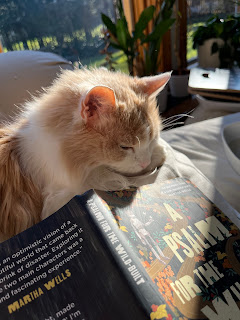
Photo is of Fluffy and my current read, A Psalm for the Wild Built by Becky Chambers. Monks, tea, robots, electric bikes, hermitages and pilgrimages. What makes a soul? It's a terrific read. 

Final list from NYT - To Kill a Mockingbird is on top.

Sunday, December 12, 2021

Can I drink tea while I pray?

There's an old joke — you can tell the age by the reference to tobacco — about a Franciscan and a Jesuit discussing a conversation with their spiritual director. The Franciscan said he'd asked his director if he could smoke while he prayed. Horrified, his director had said absolutely not. "Ah," said the Jesuit, "I asked if I could pray while I smoked. The answer was 'of course!'"

Drinking my tea with morning prayer this morning, I thought about that joke and a comment by my pastor earlier this week that perhaps people have become accustomed to going to mass online and having their coffee along with it, something you simply cannot do in person. I miss joining my community for the Office, but also find joy in praying it bathed in sunshine with a cup of tea in hand. This morning, as I drank, I noticed the way in which the ribbons of steam curled and billowed above the cup. At times it seemed to be breathing, suddenly puffing out a cloud of steam, then pausing, seemingly gathering strength for the next emanation. My prayers rose like incense along with the steam. 

What is normally hidden was suddenly revealed in all its intricacies. The air  is warm and seems still but in truth it is lively and complex. Its unceasing movement is momentarily revealed by the intersection of the condensed water within the vapor and the bright morning light of the sun, low in the winter sky.

Prayer too, has those moments, where what is hidden is suddenly revealed. Where God's breath puffs out, and we are suddenly aware of its presence, rising from the depths, twining upward, wrapping like silk around my hands.


Monday, July 23, 2018

A scholar's mug

One of the two yunomi from St. John's pottery.
Not the scholar's mug!
A few years ago I spent a few days on retreat at St. John's Abbey in Minnesota. In many ways St. John's resembles a medieval monastic enclave. There are bees, a woodworking shop that provides the furnishings for the college, a library, a guest house and a pottery. And a post office, but that sounds pretty modern. 

Caught out in a walk by a sudden thunderstorm, I ducked into the pottery.  There was a fire, there was tea. I spoke with the potters, learned about the huge wood burning kiln named Joanna that is fired but once a year, traded stories of travel in Japan. And I bought two yunomi (tea mugs), one that clearly shows the hands of the potter on it, and another, called a scholar's mug, rougher and clearly marked by the ashes of the kiln.

The first time I used the scholar's mug, I filled it generously and carried it to the table where I was writing.  I absentmindedly picked it up to take a sip, to find the cup too hot to handle.  Ouch!  I left it to cool. The next time I made tea, I made a collar for the mug using a furoshiki, like those you get at a coffee bar.  I quickly got better at folding either a small furoshiki or a thick paper towel to use.

It took almost a week for me to discover the trick of the scholar's mug. Fill it half full. The tea stayed warm, the top cool enough to comfortably hold.  It made me get up to refill it, to stretch at more regular intervals.

This is a true story. And a parable.

Saturday, April 30, 2016

Science fiction in my tea: Gagh

I have a lousy cold.  Where is Dr. Crusher when I need her?  Or barring that a replicator that can produce, "Tea.  Rose vanilla chai.  Hot." on command?

When I'm not writing final exams or grading this week, I'm working on a twinned pair of essays on science fiction in chemistry/science fictions in chemistry.  This morning I picked up my cup of tea (with honey and citron rind in it), and as a well soaked piece of citron rind slithered out, my first thought was "Gagh."  No, no, not a expression of disgust, but gagh, the Klingon delicacy, serpent worms.

Can you read or watch too much SF?  Probably not, but if you can, I clearly have.

While hunting around for science fiction references in the primary chemical literature hasn't been all that successful, I have found (and read) the original ice IX paper [JCP 48, 2362-2370 (1968)], which acknowledges Kurt Vonnegut's prior claim in Cat's Cradle, and a couple of great spoof papers, including one from the German literature in 1890 that fooled enough people to get cited in the primary literature.

Have any favorite SF novels involving chemistry, even peripherally?  Or know of papers in the scientific literature that reference alternate universes? I'd love to know! There's a whole set of compounds named for characters in Puccini'sLa Bohème, including musettamycin, but I'd be shocked if there were more opera buffs than SF fans working in chemistry.


Saturday, January 23, 2016

Winter tea: the scholar's mug

Summer yunomi on patio
at Collegeville Institute
Two summers ago I spent a week at the Collegeville Institute at a workshop on memoir.  The week before I spent time at the St. John's Abbey guesthouse, on a quiet retreat.  I took long walks, (mostly) timed to miss the thunderstorms.  One afternoon rain arrived before I was well back from my walk, so I ducked into the Abbey pottery, where a tea table, with sand and a charcoal brazier was set and ready to share with guests.  I had a cup of tea and enjoyed a delightful conversation with the artist in residence about Japan.

I bought two yunomi (the taller than they are wide Japanese everyday tea cups)  — a summer one and a winter one) — fired in the Abbey's wood kiln.  You can see the marks of the flames on the winter cup, which the potter named the "scholar's mug," and every time I drink from it I think of the abbey's hospitality and Abba Joseph, his hands aflame.

I quickly learned not to fill the handleless mug all the way with tea, the ceramic quickly becomes too hot to lift.  It's a lesson I keep re-learning, as I am tempted to add just a tad more in hopes of not having to return to the kitchen for a refill as often.

As I return to the classroom after my sabbatical, my scholar's mug reminds me not to fill my days or calendar too full.  It's a lesson I have to keep re-learning here, too.  Somehow I have three classes, in different parts of the building, in very different parts of the curriculum (an introductory class, a graduate class, a major's upper division class), scheduled back to back and through lunch.  By the end of the day on Wednesday my metaphorical mug was too hot to handle.

Every day, I begin again.