Showing posts with label books. Show all posts

Monday, September 07, 2026

A Tale of Two Offices

"It was the best of times, it was the worst of times, it was the age of wisdom, it was the age of foolishness, it was the epoch of belief, it was the epoch of incredulity, it was the season of Light, it was the season of Darkness, it was the spring of hope, it was the winter of despair, we had everything before us, we had nothing before us, we were all going direct to Heaven, we were all going direct the other way..." A Tale of Two Cities, Charles Dickens

The office was full, the office was empty. I have everything packed, I have nothing unpacked. I once had two offices, now — incredibly — they have collapsed into a single reality. Things are still jostling for space, the beakers of bright colored markers and sharp pencils patiently wait for me to decide whether they get tucked into a drawer or live on a desk. I sometimes despair of taming the chaos. 

Everything remains before me, even as nothingness blooms on my calendar. I have new projects hatching into those empty spaces: I'm learning to code in Python — my 7th coding language, a retreat to prepare and give, some exploratory noodling around for a new book. Older projects are simmering: two books in various stages of completion, a couple of talks on tea coming up. 

And there are tendrils of grief. I watched the Bryn Mawr back-to-school reel on Instagram and realized how deeply I miss the brightness of my classes, their energy, their curiosity that drove my own. I miss having that other space on campus to call home, where I hung my keys in the little cubby by the door and like Mr. Rogers donning his sweater, draped Dr. Francl across my shoulders. 

I ran into a former student this morning at the pharmacy waiting to get my flu shot (and my Covid vaccine and my shingles vaccine...I got my tetanus shot a couple of weeks ago thanks to the epic altar crash, I am awash in immunity). She came over, offered me her coupon reward for getting her vaccines and then vanished before I had a chance to catch my breath and ask her how she was and what she was doing. I miss the students.

"(Be)comings all involve goings. I keep musing about how Christ holds all these things in tension: birth/death; emptiness/fullness; light and darkness; dance and stillness….and perhaps that’s what it means to be fully human, to live in death and life, light and darkness?" 

I am going, so I must perforce be becoming? But what and how and when? Where I know — my study!


Images: My office shortly before I packed it up, and right before I closed the door on it. Last photo is of my space as a first year graduate student (a corner of a windowless office on the 3rd floor of what is now Rowland Hall at UCIrvine.) Until very recently the black and red organic chemistry textbook on my desk was still on my shelf.

The quote is me, which someone else captured and tagged as wise. 


Sunday, July 26, 2026

Proof


My seventh (!) book will be published this fall. A book of reflections for next Lent. The proofs came a couple of weeks ago, and once the manuscript for book eight (eight? eight?) went out the door, I had some time and space to devote to this devotional.

I still proof on paper, circling errors with a red ballpoint, pressing into the surface of the paper, leaving a literal wound to mark wounded text. I read it end to end, cold, then again side by side with the text I submitted. Were those snippets of scripture exactly what was in the lectionary? Quotes from the psalms sometimes are pulled from my memory (and my heart and my soul) as I write, not from any specific text. Better check against the source!

When the latest revision of the US English Catholic Lectionary came out, I didn’t add it to my collection. I have the most recent British one, the previous US one, but mostly I turn to the USCCB site or use Give Us This Day. The ritual books in my parish are stored behind the main altar, in a space reserved for quiet meditation in front of the tabernacle. So one afternoon last week, I laid the proofs on the small wooden altar, pulled the Sunday and daily lectionaries from the shelf, and with the Word before me, and the Word at my right hand, I proofed the pericopes. I could have taken the books and proofs to the small library next door, or to the sacristy, but this space felt right.

I used a book called Stones Before the Lord (about monastic architecture) when I taught a course on the history of contemplation in the West. Proofing on the altar left me feeling like I was laying stones of a different sort before the Lord. Stepping stones from Ash Wednesday to Easter, perhaps, or maybe a staircase cut into a cliff taking you from from a rocky beach on the wind-whipped Scottish coast to a chapel nestled high above. Or living stones, to use the image from the first letter of Peter, pulled from my own prayer. Stones I wanted to be properly cut and laid so they might support people's path though next Lent, and not be  stumbling blocks.

I found a few errors and marked them up, now it's headed back to Liturgical Press.
_______
Proofs. It's been a week of proofs. I proofed yeast last night to make pizza crusts. I proofed this book. I sorted through proofs of once new quantum mechanical theories, snapping a picture or two to remember the work I had done (and long ago published), then sent them into oblivion (actually the recycling bin!).


Tuesday, June 17, 2025

Three Books: Stones Laid Before the Lord

Three books set in contemplative spaces, two fiction, one non-fiction.

I picked up Stone Yard Devotional by Charlotte Wood when I was in London last year (it was shortlisted for the Booker Prize). It is set in Australia, in an isolated monastery. It reminded me very strongly of In This House of Brede by Rumer Godden, both in style and themes. So much so I went back re-read Godden's novel (which I'd first read in high school.) 

Both follow a group of women living in a isolated religious community. Overall the plots revolve around an older woman who comes into the community by a unusual route. There are mysterious deaths. Threads from the past that pull at the future.  A member of the community that doesn't quite fit in, she is a bit too high profile, a bit too polished. The style of the two is also similar, slightly disjoint, jumping in time, demanding that the reader fill in the gaps.

Wood's descriptions of the mouse plague in Australia were epic (and epically disturbing), and track actual event. While cold feet might have been a trial to my vocation as they were to Godden's Dame Phillipa, I think I could have toughed it out. The mice? I think I would have fled in horror.

Aflame, Pico Iyer's memoir of his experiences with silence and contemplative monks (Catholic and Buddhist), takes us inside a non-fictional monastery of men who cling to the cliffs overlooking the Pacific Ocean at Big Sur. I have been to this monastery and stayed in the hermitages there. I recognize some of the people and many of the places.  For all that I love this place and sacred silence in general and appreciate Iyer's writing, the book felt oddly thin. Admittedly it can be hard to wrap words around silence, to reveal what might be moving in heart and soul. Perhaps that why fiction feels more real? 

________________

The title was inspired by Stones Laid Before the Lord: A History of Monastic Architecture, a focus on the buildings, less so on the people who inhabit them. 

More books from my shelf that are related: An Infinity of Little Hours (Nancy Maguire, an anthropologist looks at the journeys of novices at a modern-day Carthusian charterhouse in England); Love on the Mountain: The Chronicle Journal of a Camaldolese Monk (Robert Hale, O.S.B. Cam., just what it says, autobiographical account of life as a monk at the monastery Iyer describes) and The Hermits of Big Sur (Paula Huston, a history of the Camaldolese monastery at Big Sur).


Tuesday, August 20, 2024

Bibliophilic blind dates


When I was visiting Crash and his partner in London I paid a visit to House of Books in Crouch End which has a delightful assortment of books to "blind date". Wrapped in brown paper and twine they remind you not to judge a book by its cover. Clues to the content are printed on the wrapping, but no titles or authors. I bought two - both tagged Noir. I was intrigued by the biopunk set in Thailand and what was Tartan Noir going to be? 

I unwrapped the surprises last week while at the beach on vacation. I am halfway through the biopunk novel, which turned out to be The Windup Girl which won both Hugo and Nebula awards in 2010. It's set in a world where global temperatures and sea levels have both risen. Reading it on a steamy summer day at the beach adds to the atmosphere which Paolo Bacigalupi evokes. A world with no ice, no AC, and where generippers try to stay ahead of the plagues.

Tartan noir? It is a mystery by Ambrose Perry!

Saturday, April 20, 2024

Lessons in chemistry


One of the questions I’ve often been asked in the interviews I have done around the tea book has been, “Have you read the book Lessons in Chemistry?” and when I acknowledge that I have, the logical follow up:“What did you think of it?”

The first time the question arose I was surprised, and had to scramble for an answer. I shouldn’t have been. It is a best selling book, it has been made into a series. It has chemistry in the title. The interviewer is fishing for a bridge to what’s in the current cultural zeitgeist. 

But for me the answer is, as the kids say, complicated. Even though the book is set slightly earlier than my time as a graduate student and newly minted scientist, my experiences were not so different from Elizabeth Zott’s. There was enough similarity that it was an uncomfortable read at the start. And then there is the day that Elizabeth‘s partner is suddenly killed. When I was reading the book, it was like a gut punch.  It was as if some enormous hand had picked me up and dumped me back into the confusion and chaos of that April night when Tom died so suddenly. Still, I needed to read to the end. I had to know if Elizabeth made it out of the depths of grief. Truth  be told if I known what the plot was, I wouldn’t have read the book. (I really want something like the website “Does the dog die?” for books. No children in peril, no suddenly grieving widows.)

Of course, to say that I found the book difficult for a very personal reason is not the answer a reporter is looking for. I finally settled on saying that I enjoyed the scenes where Elizabeth gave as good as she got, and that the historical difficulties of being a woman in science inspired me to teach the next generation. True, and truly bland. Next question!

Saturday, September 09, 2023

Vampire diaries

On Tuesday morning I had a procedure on my eye which left me as sensitive to light as a vampire and with very blurry vision.  I came home and spent the afternoon like a Victorian lady with the vapors. In a dim room propped on many pillows, eyes closed while someone read to me. It lacked only the cool compress on my forehead and some smocked white lawn dress to be a woodcut right out of a 19th century novel, well that and my intrepid book reader was not the vicar's daughter but my iPhone. 

No email, no desultory browsing the news, no list of household chores to get through, I drifted along to the voice in my ears, letting someone else choose the pace at which the story progressed. All in all it was a tiny retreat, a meditation on surrender and control.

By bedtime I could see well enough to pray Compline, “Protect us, Lord, as we stay awake; watch over us as we sleep, that awake we may keep watch with Christ, and asleep, rest in His peace.” Two Advil (the local had worn off) and indeed I slept in peace, and rose in gratitude to a less blurred day. 

Thursday, August 24, 2023

Indexing habits


I just finished Dennis Duncan's Index, a History of The: A Bookish Adventure from Medieval Manuscripts to the Digital Age. It was a great read, accessible and with lots of lovely word play to enjoy. I enjoyed his capacious definition of an index, large enough to encompass the arrangement of kitchen cabinets to allow its users to reliably locate items. I reflected to Math Man that we use that sort of index when we are at the shore. There is always a designated key and beach pass bowl established near the door. Going out for an early morning pastry run? No need to shake out everyone's pockets looking for one of the two sets of keys we were issued, they are in the bowl. 

These days I leave my phone in the bowl, too. Mostly. Today after a long beach ramble I put it down on my shoes while I unlocked the door, thinking to myself, "Don't leave it here!" Door open, I dropped the keys in the bowl. Two hours later, headed to lunch, I grabbed the keys and wondered where I left my phone...argh. On my shoes. Outside the door.

Practice good indexing habits!

Wednesday, August 16, 2023

Two universes

I started The Impossible Us by Sarah Lotz last night. It's about a couple who meet online but turn out to be living in (slightly) different universes. In another timestream Tom and I would be married 42 years today. A friend who was married a week before we were posted a picture from their wedding a few days ago. In the background was Tom, who had been a groomsman. It was if he had casually dropped into my universe for a second, to say hello.

The story is leaving me to wonder a bit what my life would have been like in that other universe. Would that Michelle be here at the shore this week? Might I run into her on my morning walk, when for a brief second the two universes intersect? Or catch her out of the corner of my eye? 

Tuesday, August 15, 2023

Ferragosto and the wedding of the sea


It is the feast of the Assumption, Ferragosto in Rome. This year I am down at the beach, where it is just as hot and humid as the last time I was in Rome for the Assumption. The church here is air conditioned, unlike the church in Albano, and the cool Atlantic waters offer sweet relief after a walk. Like Albano, church bells have been ringing all day here. To call the faithful to Mass. And the carillon currently playing an eclectic mix of patriotic songs and hymns (none of them Marian).

The tradition here is to bless the ocean, then take a dip to share in the blessing -- before the grace evaporates at midnight. The water was a bit rough, but then grace can be rough at times, too. I made sure to get in the water. The bishop starts in Atlantic City and finishes in Wildwood, it seems, so the entire Jersey shore gets a share in the grace. 

I finished Velvet the Night by Silvia Moreno-Garcia. It was a riveting read, with enough unanticipated twists and turns to occasionally make me gasp. (I could almost taste the tortas in the little cafe in Mexico City, so tried the local tacqueria for dinner.) Finished Blue Lightning by Ann Cleeves (a re-read). Dug into Frederick Buechner's The Remarkable Ordinary, which is remarkable and not in the least ordinary. Downloaded The Impossible Us to start.


Sunday, August 13, 2023

Done is good


It’s a book! The manuscript for Steeped: The Chemistry of Tea has been dispatched (virtually, a zip file dropped into the publisher’s dropbox). Math Man captured the moment for me. I read some 500 papers, drank 400+ cups of tea, made about 100 chemical figures and gathered it all together into what will become a 150-ish page book early next year. The final paper copy of the manuscript weighs just over 700 grams — printing it out for a last read made it feel very real. Paper has more heft than electrons. (Yes, I realize there are a lot of electrons holding that paper together!)


“Done is good!” is what students and faculty say at Bryn Mawr to encourage each other to finish something. It may not be perfect (should I have written more about matcha? Or about wind ovens and samovars? Maybe.), but it is finished. And done feels very good! So I am off on two weeks of vacation, with some time to read things unrelated to tea. (First up, Velvet is the Night, a very noir novel by Silvia Moreno-Garcia set in 70s Mexico. I spent a summer there in 1973, so the setting really comes to life for me. I adored her Mexican Gothic, and some 60 pages into Velvet I am entranced.)


Thursday, June 22, 2023

Aspergillum/Aspergillus: where science and faith collide

Today I learned that Aspergillus niger - the fungus (mostly) responsible for the fermentation of pu'erh teas - was named for the aspergillum used liturgically to sprinkle holy water, which it (vaguely) resembles. No surprise, the botanist was a priest (Pier Micheli).


I haven't been writing much on the blog of late, because I have been writing another book (#6). This one is on the chemistry of tea, titled Steeped. After a day of writing, or a day of teaching and tucking writing into the corners, I've been loath to get on the keyboard in the evening and blog. I may not be out of ideas of things to write about, but I am definitely out of energy and words at the end of the day.

I am very much at the end of the process, finishing writing the last bits, and doing a big edit on the book as a whole. The goal is to have the whole thing submitted by the end of July, so watch this space!

Friday, January 06, 2023

Happy New Year!


What makes me happy? Besides a book and a cup of tea?

A kitchen full of family. From conversations with my mother over the counter in the kitchen, to early mornings cups of tea with my dad, to times with my brothers and their home kitchens, to cooking a holiday meal with my sons and their partners, to the quiet days of emptying the dishwasher while Math Man cooks dinner for us. The holidays this year made me happy on all fronts. Family, food and cups of tea and lots and lots of books.

Perhaps it's because I grew up in a large family that even though I am an introvert, it's the people in my life that bring me joy. It turns out that I'm not alone. Last summer I had the privilege of reading a draft of a book a friend was writing on happiness. Marc drew on all the data generated by an ongoing study begun at Harvard in the 1930s (he is the associate director of the study.) I loved the interplay of data and story in the book. (Also fun, seeing your colleague's work in the NY Times.) Whether the conversations happen in the kitchen or elsewhere, what generally makes us happy is our relationships. 

The book (The Good Life: Lessons from the World's Longest Scientific Study of Happiness by Robert Waldinger and Marc Schulz) is coming out this week, and if you're interested in happiness (who isn't?), I recommend it. But I'd also recommend it if developing community as part of the work you do. I'm chairing our parish council through these pandemic years and have really come to appreciate how important relationships are to keeping a community healthy and whole, and the work that is required to keep them going when events such as the pandemic interfere with our usual patterns. So I read this with an eye to what I could learn, not only about my own life, but about the life of the parish.

Happy New Year!

Tuesday, December 28, 2021

The best books

The New York Times Book Review recently ran a survey to find the best books of the last 125 years from their curated list of 25 books. Looking at the list — in which I note there are few books by women, 7 of 25 — I began to wonder what my list of the best books I've read would be, which of course begs the question, what does it mean to be a best book?

My definition of "a best book" would be the books that get under my skin. The books I can't forget even years later, the books that have pushed me outside my comfort zone, the books that have shaped me in fundamental ways. Forthwith my list of nine (like the NYT list, a perfect square) best books, more or less in the order I encountered them. What's on your list?

Madame Curie, Marie Curie's biography written by her daughter, Eve Curie. I continue to be perplexed that there isn’t a Disney version of Manya Skłodowska Curie’s life. Between the death of her mother, the sleigh rides with Kazimierz Żorawski, her wonder at the university in Paris, fainting in a garret, the glowing radium in the lab...her life seems Disney-princess ready. I read this book during the summer I as when I had been very ill, unable to get out of bed without help. It is more hagiography than cold biography, and perhaps that's why I hear whispers of it from time to time as I reflect on my own life work. I could not get her grief at the sudden death of Pierre out of my mind the first time I read it, and given my own experiences, have thought about it many times since.

The Sherlock Holmes stories by Sir Arthur Conan Doyle. This was another book that I read the summer I was so ill, the treat of several new hardcover books from my mother is one I still appreciate. I was taken with Sherlock Holmes scientific approach, the use of data to draw conclusions, and the attentiveness to the small clues that others might overlook. It might not be too much of a reach to say that my interest in molecules that misbehave in my attentiveness to the small clues they offer in their structures derives from reading these stories that long-ago summer.

Have Spacesuit Will Travel By Robert Heinlein. This may be the first science fiction book I read. I rode my bike to the little library which was housed with the rest of the town's services in a residential house on a humid summer day.  I can close my eyes and see the cover, a bright yellow and black. While these days I find the politics that infuse Heinlein's   writing a bit off putting (ok, perhaps more than a bit off putting) this book really captured my imagination, in part because of the strong women characters in it. And in the year that we landed on the moon for the first time, it was a particularly exciting read! 

In This House of Brede by Rumer Godden, I read this tale of a monastery of contemplative nuns when I was in high school. Since then I have read it any number of times, the nuns are exquisitely human, struggling with cold feet and academic jealousy and the budget. The main character, Dame Philippa, is a late vocation, a widow with a tragic past. After having been department chair, I also sympathize with the abbess, Dame Catherine.The book jumps in time and perspective, the nonlinearity gives it a depth that makes it worth revisiting.

Anna Karenina by Leo Tolstoy. I read this when I was 11, after an excerpt in a book I'd been given for Christmas piqued my interest. From it I learned the joys of long and richly  textured novels. A couple of years later I watched a cinematic version of war and peace and then wanted to read the book, which led to a long argument between my mother and the librarian who did not want to let me check it out. Not because she thought the themes were too adult, but she did not think I was capable of finishing the book in the allotted two weeks. When she finally reluctantly checked it out, she gave me lots of advice about how to read it, including making lists of characters. Advice which I promptly ignored and simply dug in.

The Sayings of the Desert Fathers: The Alphabetical Collection Benedicta Ward OSB's translation of the Apophthegmata Patrum, the sayings of the desert fathers, is something I return to again and again, the pithy advice of these early Christian hermits, both mothers and fathers, is often just what I need.

Ink, by Sabrina Vourvoulias. This book is rooted in places and people and rituals I recognize. There is a chemist and people who risk much for justice. And the world is more than what we see. It’s is also terrifyingly prescient, written before Trump, but plays out what could be, what now has been. I read the news and after reading Ink found I could no longer tell myself, “I had no idea. I can’t imagine such a world.” 

Book of Hours, Rainer Marie Rilke. I am particularly fond of the translation by Anita Barrows, which places her luminous translation against the original German of Rilke. I really don't have the words to say the way some of these poems reach to the heart of my experience of prayer, except perhaps to quote the poet through Barrows:

In deep nights I dig for you like treasure.
For all I have seen
that clutters the surface of my world
is a poor and paltry substitute
for the beauty of you
that has not happened yet...

My hands are bloodied from digging.
I lift them, hold them open in the wind,
so they can branch like a tree. — II,34

Liturgy of the Hours. Never far from my hand, the round of psalms enfolds me, shapes me, comforts me, challenges me. The imagery — buzzing bees, slimy snails, broken pottery, heart tearing grief, raucous parties — drags me in.


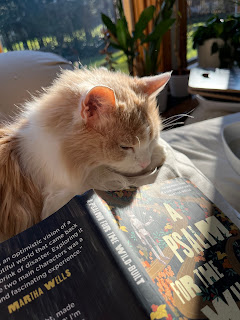
Photo is of Fluffy and my current read, A Psalm for the Wild Built by Becky Chambers. Monks, tea, robots, electric bikes, hermitages and pilgrimages. What makes a soul? It's a terrific read. 

Final list from NYT - To Kill a Mockingbird is on top.

Sunday, October 10, 2021

New Book: Prayer

It’s a book! I’m proud to announce that my latest has just launched from Liturgical Press. 

The book is designed to be used as a point of departure for reflection, either individually or in a group. I wrote it as a retreat, the questions for reflection in the margin mirroring my own reflections as I wrestled with the material.

In addition to the biblical wisdom, there is wisdom from the desert mothers and fathers (Amma Syncletica and Abba Poemen both have their moments and saints and blessed from Augustine to Ignatius of Loyola to Dorothy Day. I sought to pull in a diverse set of voices, women and men from many eras.

I have to thank my delightful editor, Amy Ekeh, whose deft surgery on my too-long manuscript managed to keep the structure intact and who was behind me all the way as we sought illustrations that would be in the budget, but still reflect the diversity of the People of God. Also, no blonde, blue-eyed Jesuses. My favorite image has to be the great doors to Sagrada Familia in Barcelona with the Our Father on them in 50 languages. 

I am grateful, too, to the spiritual directors and soul friends who have walked with me, literally and metaphorically, through the years. 

_______
Autocorrect tried to replace Poemen with  Pokémon. The desert mystics, catch them all?

Tuesday, May 04, 2021

Eat Sleep Sit


It arrived in the mail last week, an envelope with a single used book, carefully wrapped in brown paper, inside. Eat Sleep Sit, Kaoru Nonomura's account of a year of training at the Zen monastery Eiheiji. I had ordered a used copy weeks ago, though I could have gotten the electronic version in an instant.

I'm glad I waited, the physical book is beautifully bound, it lies open in my lap without the need to hold it. Printed in Japan in 2009, the typesetting is plain and spacious. It is a joy to read. Why are hardbacks so often glued rather than sewn? I know, money. But this is such a small and delightful luxury.

The book itself is reminding me of Nancy Maguire’s Infinity of Little Hours, which follows Carthusian novices through their first years and early training. 


Photo is of monk Thomas Yūhō Kirchner, in the old training hall at Tenryu-ji, in Kyoto. I visited with a class in 2016.

Friday, September 04, 2020

Books: Alchemy and poetry


Crash has returned to his own apartment, leaving us with a call board to plan the meals and organize the day and an (almost) up to date inventory of the chest freezer.  Much as I appreciate the latter ledger, I'm wishing I'd kept a ledger of the meals we made over the course of these months.

I have been dipping in and out of Jane Hirshfield's new book of poetry, Ledger, which opens with "Let Them Not Say":

Let them not say: we did not see it. 
We saw.

Let them not say: we did not hear it.
We heard.

When I read "Advice to Myself" about a file with that title (and presumably advice) created a decade ago, I felt very seen.

I pulled philosopher Harry Frankfurt's little book On Bullshit off the shelf and am glad to have done so. He references Augustine! The essay attempts to carefully delineate lies and liars from bullshit and bullshit artists. 

"For the bullshitter, however all these bets are off: he is neither on the side of the true nor on the side of the false. His eye is not on the facts at all, as the eyes of the honest man and of the liar are, except insofar as they may be pertinent to his interest in getting away with what he says. He does not care whether the things he says describe reality correctly. He just picks them out, or makes them up, to suit his purpose."

In this particular political moment, I highly commend On Bullshit to you. 

I've been captivated by Ainissa Ramirez's The Alchemy of Us. The opening vignette about traveling timekeepers was fascinating.

Anne Perry's Death in Focus is set in Europe during the rise of Hitler. It's a mystery, it's dark, and it's reminding me that we shouldn't close our eyes or ears. I have seen. I have heard. It's incumbent on my to speak. And to vote!


Tuesday, August 25, 2020

Bookmobile


Summer has meant reading books for as long as I can remember. Clearing out family papers from my desk last week I found this photo of me at age 5 looking longingly at the bookmobile. My sister is in the pram and my brother is also balancing on his trike. My mother is undoubtedly behind the camera (and probably pregnant with another brother).

I remember the bookmobile as being crammed with shelves. I can still hear the crinkle of the cellophane protective covers as my mother browsed the books. I suspect this photo was taken in September, I'm pretty sure I had that dress in kindergarten. 

There was no library in this small town in the middle of dairy country, so this is how new books made their way to us. 

By the time I was in fourth grade we had a library, set up in a house that also served as the police department and the municipal offices. I was already a science fiction addict (watching all those NASA launches fueled my desire to travel to the stars, at least in my imagination). The tiny library, roughly the size of my current living and dining room, seemed huge and such a luxury compared to the bookmobile. I would pedal my bike there, check out a book or maybe even two, ride home, devour it and repeat.

Now there are probably more books in my house than there were in that little library (and never mind what is in my office and my lab). And the little town has grown, and has a good sized library. One thing hasn't changed, my joy in devouring a good book.

Friday, August 21, 2020

Reading List: Let Us Now Praise Famous Men - or Not

As I'm slowly doing some writing about writing, I've been pulling books on the craft from my shelves. I rediscovered How the Light Gets In by Pat Schneider on my shelves in part because it turns out to be written by the mother of a colleague (which I hadn't realized when I bought the book, though on re-reading, I should have known!) Schneider's own poetry laces through the pages of this luminous book, and I cherish her fearless and tender takes on the challenges of writing about things that have entangled themselves in our souls. Perhaps my favorite is the section on tradition and writing, where she reflects on not surrendering her voice —"the unique Ozark twang, the flavor, the very originality of my voice." I hear in her poem, "Mama," a familiar litany of words, "Kerosene, gasoline, Maybelline, Vaseline..." I'm transported back to my paternal grandmother's house, where I too watched the lightning bugs, not the fireflies, dance in the heavy summer air, and wondered at the jars of Vaseline and Pond's on her dresser.

I quoted Sirach at the start of a chemistry essay, "Let us now praise famous men, and our fathers that begat us" [Sirach 44:1], which prompted me to pick up James Agee and Walker Evan's Let Us Now Praise Famous Men. Evan's photographs of these depression era sharecroppers are crystalline. As someone with a predilection for long sentences, I appreciated Agee's ability to have a sentence start on a page, continue through another, full page and finally finish on the third page, without, I think, ever technically running on. The book is often held up as a turning point in non-fiction. Still, I was too put off by the casual racism in the book and a vague sense of shame to be peering into these people's lives even at almost a century's remove to finish it.

I felt utterly seen by Anne Fadiman's essays on reading (Ex Libris: Confessions of a Common Reader). I also take pleasure in cook books speckled with eggs and cocoa, and hang on to beloved books that have been reduced to a loose collection of signatures. (My copy of Meyer and Meyer's Statistical Mechanics is held together with a ribbon.) If you love to read, read this.

Saturday, July 04, 2020

Books!

What's on the side table this week?  

Prayer: A history by Carol and Philip Zaleski. I'm heartened that someone was willing to tackle a subject like the history of prayer in one volume. So maybe I can say something worthwhile in a single book. 

Letters to Malcolm by C.S. Lewis. I'm still struck that it took me so many years (forty!) to discover C.S. Lewis' full name. Clive, it's Clive Staples Lewis. I'm also enjoying the layers of snark in these epistles on prayer to the fictional Malcolm. I also appreciate the genius of the little interjections that put flesh on Malcolm's bones. Seriously, I continue to worry that we take prayer both too seriously and not seriously enough.

Exhalation by Ted Chiang. A collection of SF shorts, the title story (which I've yet to read) dances around the 2nd Law of thermodynamics. I was riveted by "Dacey's Patent Automatic Nanny" and intrigued by the story about the digients and the life cycle of a software object. 

Tuesday, June 23, 2020

All the books

Books pulled for the prayer book project.
In some sense a sabbatical is a period of rest, like a field left fallow for one year, or one semester, in every seven. And after this last semester, I am truly longing for some time off the keyboard and away from Zoom. But in another sense, it's a time for planting, for tending new shoots, for testing new varieties. It's a time of growth.

A colleague asked me what I was most excited about reading, now that my sabbatical is here. Reading fuels my writing, it brings me into conversations I might otherwise never have, it's a launching pad.  A reader also wondered what I was reading these days, so herewith is a sampling of what's currently open, and some random thoughts. I'll try to post a weekly list.

The Psalms, a new translation from the Hebrew: arranged for singing to the psalmody of Joseph Gelineau. I'm working on a short book on prayer, meant to be used by individuals or in a parish or similar setting. Sort of a retreat in a box. Add time and perhaps someone to reflect with or a journal and voilà, a retreat.  The book kicks off with the Psalms, praying with them, plumbing their depths for advice on prayer. So I've been reading The Psalms, straight through, in the Grail translation that's currently used in the Liturgy of the Hours. One line, almost any line, drives me straight into the Hours. These are words that are etched deeply in mind, heart, soul and body. I can hear the voices of those I've prayed with over the last thirty years layered over the bare words.  I can hear the melodies and chant tones I've sung them to, the words nearly dancing on the page. I recall when the monk next to me used to breathe in a long verse. I can see the places where I've prayed them. My back stoop, my parents' garden, the Eastern cloister at Wernersville, the small chapel at the parish, airports and emergency rooms. Like Lewis' wardrobe, I open the book and am transported. I open any page and, to quote Buechner, am "riven by unbearable light."

The Tao of Ordinariness: Humility and Simplicity in a Narcissistic Age by Robert Wicks. I thought this might inspire me to organize my office. It's a challenging text, with whiffs of Johannes Baptiste Metz' Poverty of Spirit. To be humble, you cannot even hang on to the notion of humility as something to be attained. It tastes of St. Romuald — "Empty yourself completely and sit waiting, content with the grace of God, like the chick who tastes nothing and eats nothing but what his mother gives him." — but also like Catherine of Siena. “Be who God meant you to be and you will set the world on fire.” The text is rather heavy on male authorities.

The Collapsing Empire series by John Scalzi. Oh, this was a wild and fabulous read. I tore through all three books. I didn't (quite) see the end coming, or perhaps it wasn't the end I wanted to come, but in the end it was the ending that was right and true. Math Man, Crash and my youngest devoured the series as well. It features strong women characters, one of whom falls in love with a mathematician. So, you can see why it might appeal around here.

How to Be an Antiracist by Ibram X. Kendi A beautifully written book that is as challenging as the Metz' Poverty of Spirit and in many of the same ways. You are not the center. This is my second go round with this book, and it's very much worth the revisit.