Showing posts with label saints. Show all posts

Thursday, July 03, 2025

Drawn into the wounds: Feast of St. Thomas


It's the feast of the apostle Thomas today, and I'm reflecting on the readings for Give Us This Day. The piece was written last fall, while I was on the road in Scotland and Rome. We'd been to the National Gallery in Edinburgh (which has no Caravaggios in the collection, though it does have a portrait of Carravaggio) so visual art was on my mind. Some of my favorite churches in Rome have Caravaggios, but The Incredulity of Saint Thomas lives in Berlin.

I wrote that Caravaggio’s depiction of the scene from John's Gospel "pushes me to wonder if Jesus is seeking more than a simple “yes” or “no” in this encounter—hoping for yet more than the exclamation wrenched from Thomas’ heart, “my Lord and my God!"... [here] Jesus is shown with his head bent near Thomas’ head, his hand guiding Thomas to touch his wounds. It is an intimate moment as Jesus reaches out to draw Thomas deeply into his very self, into the woundedness that healed the world.

Perhaps this Gospel is also an invitation for to me to be drawn into the woundedness of the world, to believe that I can [ed. and do and must!] encounter Christ, bruised and pierced, at every turn."

Earlier this week I listened to an episode of a new podcast, The Spiritual Life, hosted by James Martin SJ and Maggie van Doren. This episode included an conversation between Fr. Martin and Timothy Cardinal Radcliffe which touched upon Cardinal Radcliffe's time as a patient after serious surgery. 

Fr. Martin referenced Joseph Cardinal Bernadin's little book, The Gift of Peace (completed just two weeks before he died).  It's short, so I pulled it off my shelf to read on Sunday. I was struck by Bernadin's view of his vocation to be present to people in his own illness. I was struck by the tangible, physical nature of his response. The handwritten note at the start of the book, the script titles to each chapter. The list of 700 names of people who had asked for his prayers, held in his hands at the altar.

What does prayer look like in our most difficult moments? Perhaps when we doubt we can find our way to prayer, Jesus takes our hands and says, "touch me, feel my wounds."

Friday, January 03, 2025

Portals

I have been thinking about Psalm 88 lately. The psalm is unusual in that no matter how dark other psalms get they tend to finish with images of redemption, glory, rescue. But not the 88th. It shows up every Friday at Compline (Night Prayer) in the Liturgy of the Hours. One might think it is not terribly consoling to pray such a desolate psalm just before bed. But to me it feels like a reality check, a reminder that I do not always find resolution at the end of each and every prayer, or closure at the end of every day. There are times in my life where I might despair of rescue, be unsure where God is in the darkness or in the waves that engulf me. Times when I must perforce sit with uncertainty.

I appreciated Sister Joan Chittester's wisdom in a reflection in Give Us This Day last fall. "Prayer is not an analgesic designed to protect us from life. It is, more times than not, part of the problem of life. One day we don't feel like praying. The next we pray but it doesn't make any difference… We try to pray but were far too distracted than we are soothed by the quiet or comforted by the sense of the presence of God." In his book, Into the Silent Land, Martin Laird, OSA, points out that when we go in search of peace in prayer, we often find instead what feels like chaos. But, he says, it is precisely in this meeting of confusion and peace that healing happens. Not by erasing our pain, but by offering a path for grace. 

So what are we to do? In her lovely book An Altar in the World, Episcopal priest Barbara Brown Taylor reflects on keeping an altar: “Since I am a failure at prayer, I keep an altar in my room. It is really an old vanity made of rosewood, with fancy scrollwork around the oval mirror and a small stack of drawers on either side. At worst I think of it as a piece of furniture that I offer God as a substitute for my prayers. At best, I think of it as a portal that stays open whether I go through it or not."

This makes me wonder about the altars that we keep, metaphorical and literal, that leave the door open to God, even when we think we are failures at prayer. Like a doorstop, keeping us from being locked out when our hands are too full to open the door, or when we need a breeze on a hot day. For me that might be Night Prayer at the end of the day, it might be the literal prayer space that I keep in my study upstairs, or the prayer rope I wear on my wrist. Sometimes it is my parish church, bathed in warm light. What portals do you keep propped open in your life?


This got its start as part of a homily I preached for the memorial of Saint Thérèse of Lisieux, whose last days were marked by spiritual darkness. The photo is of St. Thérèse on my home altar, along with a small first class relic of St. Thérèse. And of course, there are roses.


Sunday, August 12, 2018

Do you believe in miracles? Santa Maria on the way

The skull of St. Agnes is behind the small 
green circle of leaves above the tabernacle.
It was hot, hot, hot and humid in Rome yesterday. I took an early train into Rome from Albano, having finished up a couple of significant writing projects the day before and having checked on the weather, which suggested it was only going to get hotter over the weekend.

When I got off the Metro at Spagna just before ten in the morning, I was struck by how empty the piazza at the bottom of the Spanish steps was. After the bustle of Termini station, it was so deserted it was eerie.  As I walked across the middle of the empty plaza, feeling like I walked into a Fellini film,  I suddenly understood why there was no one else there.  The sun was already high enough for the entire center to be in the full sun, with the heat radiating off the black basalt Sampietrini pavement. In the two minutes it took me to cross I was drenched in sweat and wishing I'd had the sense to pop up my Japanese umbrella/sunshade.

An actual dome in Sant'Ignazio.
I meandered my way from the Spanish steps to Piazza Navona and back again, walking nearly 9 miles as I did so.  I had back-to-school shopping to do along the via del Corso, mostly shirts and pants for the guys.  I ducked into various churches over the course of the day - a miniature pilgrimage as a counterpoint to the shopping.  I lingered in Sant'Ignazio with its faux dome, prayed in Sant'Agnese in Agone, which has a magnificent dome which you are NOT allowed to photograph, but where the attraction for me is a closet-sized Eucharistic chapel in the back with the skull of the martyr in the altar for all to see.  At the end of the day, walking down one of Rome's serpentine alleyways, I was suddenly confronted by a trumpeting angel, bearing down on me from the roof of Sant' Antonio dei Portoghesi, into which I took an unplanned peek. A baroque jumble screamed at me as I walked through the door.  I back right out again.

Sant' Antonio dei Portoghesi
I hadn't planned on a visit to Santa Maria in Via — Mary of the way — either, but ducked in on a whim.  Built in the late 15th century and completed under Cardinal Robert Bellarmine, SJ in the 17th century, it sits on the site of a miraculous well. The story is told that on a September night in 1256, the well in the stables of Cardinal Pietro Capocci's residence overflowed.  An icon of Mary imprinted on a tile was found floating atop the waters.  Pope Alexander IV promptly ordered a chapel built over the top of the well. [Bonus - today is the feast of St. Clare, who was canonized by Pope Alexander IV.]

The church is full of anachronisms.  There is a Caravaggio tucked into the corner of a side chapel, in a spot so dark I could not make out the subject (the sign on the altar rail is the only way I knew the artist — and I can't find any such painting on the list of the Caravaggio's in Rome, I'll have to go back and double check).  Why is there an enormous teleprompter stuffed into yet another side chapel?  And the plumbing for the miraculous well would not be out of place in a fancy wet bar.

The holy well in Santa Maria in via, you can see the sink and
the faucet on the right hand side where the young man is 
filling up a cup, just like at the coffee bar.
Yes, the well is still there, and cups are set out for the steady stream of people who want to drink from the miraculous water.  I now have a bottle of this holy water for a friend, and another bit to take home.

I wonder if anoint my aching ankle and foot in the water from the well, it will be healed. I'm almost afraid to do so.  If it improves, will that increase my faith (the point of miracles.) I don't think so.  It it doesn't get better, then what?  I still believe.

I'm sorely tempted to make the holy water into a holy ice cube and ice my foot. That will definitely make it feel better, and to the people of Bellarmine's Rome, would look as much a miracle as the floating tile did. But I suspect that is cheating.
Seen in the window of some very chic
shop by the  Spanish steps.
Ankle or no, I adored these flaming shoes. Just what I need to lecture about thermodynamics in. They'd be perfect for the combustion of organic compounds lab — except of course, no open toed shoes in the lab!  Pink or black? Black, I imagine!

Monday, April 02, 2018

ISO Patron saint of mansplaining

Catherine of Siena/Franceschini via Wikimedia
I'm well into the second week of a run of mansplaining.  I've had quantum mechanics explained to me — twice.  I've had the liturgical rubrics for the Easter Vigil explained to me.  I've had the context of the photo that illustrates my recent essay in Nature Chemistry explained to me.  I've had the lectionary (incorrectly) explained to me.  I've had Marie Curie explained to me. She's fragile (probably as a result of her zombie status), and I must be careful not to suggest that men dominate science, because Marie might be diminished.  I've had chemistry explained to me, repeatedly.  Many men have explained things to me.

Enough. I need a saint to light a candle to that I might have patience.  A patroness for the patronized.  Some ideas!  Others?


  • Mary Magdalene
  • Catherine of Siena
  • Hildegarde of Bingen
  • Marie Curie (how not?)

Tuesday, August 02, 2016

Column: Mary Magdalene and talking to the Pope

St. Mary Magdalene - scientist?
Domenico Fetti, Maddalena penitente
About that time I made Pope Francis laugh, and why the feast of Mary Magdalene is so important to me.

This column appeared at CatholicPhilly.com on 22 July 2016.

What would you say if you met the pope? I had a chance to think about that question last fall when I was asked to write an account of an imaginary conversation between myself and Pope Francis about science and faith. It was tough to write, not only because it was hard to imagine any circumstances where I would speak with the Holy Father, but because, well, what would you say?

Little did I know that less than a year later, I would be standing in a garden in Vatican City, waiting for an audience with Pope Francis, once again wondering what I would say if I had the extraordinary privilege of speaking with him.

How did I end up here? In March of this year, I was honored to be appointed an adjunct scholar of the Vatican Observatory, to be in this way a part of the Church’s mission to seek God in the created universe, and to be witness to the ways in which science and faith can work together to help us grapple with the ultimate mysteries of creation.

Fast forward to June, when the students and faculty of who were attending Vatican Observatory’s biannual summer school and those members of the Observatory staff who could, had a private audience with Pope Francis.

So what did I say to Pope Francis? “¡Gracias!” Thank you for elevating St. Mary Magdalene’s day to be a feast. He looked puzzled for a moment, in part because I had so badly mangled the Spanish for Magdalene, and just perhaps because this wasn’t quite what he was expecting someone from the Observatory to say after his remarks to us about science. Then he laughed aloud, grasped my hands and said, “Bueno.” It is a good thing.

Why was I so grateful for this change to the Church’s liturgical calendar that that’s the one thing I would choose to say to the pope? Timing, they say, is everything, and the official announcement of the elevation of Mary Magdalene’s feast to be of the same import as the 12 apostles she had been sent to, had been made the day before.

But in truth it was because this feast is to me a potent reminder that nature is a place to encounter God, not only as the creator, but as the risen Christ. Mary Magdalene met Jesus after the resurrection in the garden, a space hollowed out within a city to let people come closer to nature.

I can meet God, and indeed Christ, in my scientific research, in the depths of the atoms as well as in the breadth of the stars. Science, too, is sacred ground, a meeting place for the everyday and the extraordinary.

Christ sent Mary Magdalene as the first witness to his resurrection, a reminder that anyone and everyone is called to announce the Gospel’s good news. The new preface written for Mary Magdalene’s feast reminds us it is our duty “to preach the Gospel to everyone.” It nudges me, too, to remember to listen for Christ in the unexpected corners, in the ordinary people I meet as well as in the extraordinary. It’s a good thing.

Friday, July 22, 2016

Mary, Mary, I'm going to be contrary

In working on a piece about Mary Magdalene I did I quick search for the collect for the feast (because I was too lazy to walk downstairs and get my breviary).  This page from Fisheaters came up, and while it didn't have the collect on it, it did have some recipes for ointments on it, as something traditional to do for the feast of Mary Magdalene.  I put it aside, and came back to it after a day of writing thinking to stash the material for a possible retreat.

Alas I read it.  It starts out by trying to straighten out any "agenda-driven obfuscation" about the good saint.  Great.  If only it did.  Instead the author suggests any attempt to unwind St. Gregory the Great's conflation of three women into one is not careful exegesis, but an attempt to "undermine the authority of the Church and paint Her hierarchs as 'woman-haters'".

It is barely possible to connect Mary of Bethany, who is identified in John's gospel as the woman who anointed Jesus' feet [Jn 11:1-2], with the unnamed woman who comes to the house of the Pharisee and anoints Jesus' feet in Luke [Luke 7:37-50], by assuming this was a one time event and the same event described in Matthew and Mark [Mt 26:7-13; Mk 14:3-9], and that the Mary who had chosen the better part, living with her brother and her sister was also a notorious sinner.  We could all argue the point until kingdom come (at which point surely we can just ask Mary of Bethany).

But to say that Mary of Bethany is without a doubt Mary of Magdala stretches credulity. Fisheaters explains that because Luke mention a Mary of Magdala a few lines after his account of the sinful woman who anoints Jesus, she must be the sinner.  Really?  Do we think Luke just suddenly remembered her name after penning the previous story?  Why isn't Susanna the sinner?  Or Joanna?  By this logic, we must assume that Simon Peter is the demoniac of Luke's chapter 4.  Because that story follows directly, in the same style.  Possible? Sure.  Probable.  No.

And why is the sin committed by the woman Luke describes necessarily sexual?  The stated agenda of Fisheaters here is to keep the most prominent female figure in the Gospels (after Mary the Mother of God) associated with sexual sin.  If we did not associate Mary Magdalene with sexual sin, we would be "keeping them out of mind, ignoring the need of repentance for such acts." And if she were not, no one would ever think of them?  never repent?  Um.

As an aside, I'm puzzled by the assertions here and in other places that the Talmud use "Magdala" (see figure for what shows up in the old Catholic encyclopedia) to mean "curling women's hair" which is a euphemism for adulteress, and that is used as further support to assign Mary Magdalene the role of sexual sinner.  The Gospels refer to her in Greek as Mary of Magdala, suggesting a place name, which itself means "tower."

So here's the scoop:  Mary Magdalene was the first witness to the resurrection, remanded by Jesus to bring the Good News to the apostles. She remained faithfully at the foot of the cross.  She supported Jesus and his disciples in their travels. She was the embodiment of fidelity.  She was a tower of strength, as her name might suggest, while Peter was having a rocky time.  Was she a sinner?  Of course, aren't we all?


Thursday, March 17, 2016

St. Patrick's Tooth

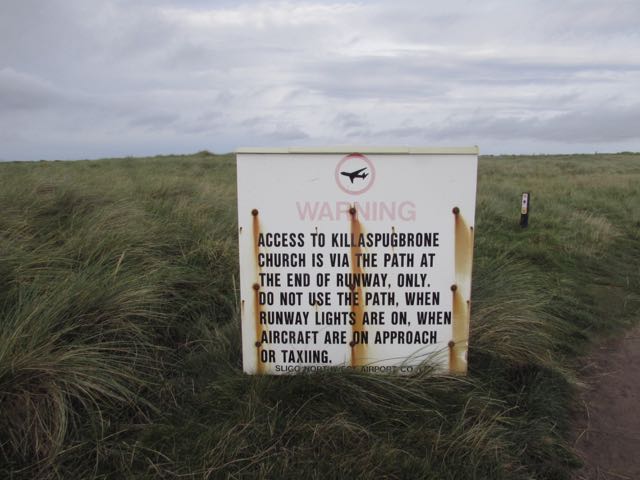
Last fall, while Math Man played a round of golf on the Irish coast, I took a walk along the water, then across the runway of the small airport to the ruins of an 11th century church, Cill Easpaig Bhroin (Bishop Bron's church).  There has been a church here since the 5th century, on the site where St. Patrick came for a visit, lost a tooth and left it with his dear friend St. Bron.

The tooth eventually became an important relic of Patrick, the reliquary is still extant, in collection of the National Museum of Ireland in Dublin.

These coastal churches, seats of bishops or not, are tiny, and I kept trying to imagine what they looked like on a Sunday morning, when people crossed from the islands in the bay at low tide.  It was raw and cold, even on this October day, and I suspect a packed church was one way to stay warm.

The sign giving the history of the area noted that the cemetery was used until 1961, then officially closed, but there were grave markers as recent as 2015.

Walking across the end of the runway was an experience.  I watched a couple of planes take off from a distance while I was out clambering around the ruins, but didn't have to wait to cross either time!


Monday, December 14, 2015

Advent 3: John of the Cross

Santa Maria sopre Minerva in
Rome.  St. Catherine of Siena
is entombed here

I'm always momentarily taken aback when the feast of St. John of the Cross appears in Advent — as it does almost every year (well, not last year, and not in 2025, or any other year the 14th of December falls on a Sunday).  The feast of St. Lucy which precedes it by a day, with its candle adorned maidens, seems like a better fit for this season of light and birth than John of the Cross, consigned to a dungeon by his Carmelite confreres, mired in a darkness both literal and spiritual.

I pulled out a copy of his poetry, written during those months of confinement, this afternoon to read.   I had forgotten about his triad of poems on the incarnation (maybe because most scholars diss them as "perfunctory") but today found them again, tucked into the appendix.

The last poem of the cycle plays with the tension that I always feel around the incarnation, or at least the current celebration of it, between the sweet, warm scene at the manger and the cold reality of it all.  Mary, stripped of God's presence within her.  Her son, the Word, left wordless.  Maybe John of the Cross' dark nights are not so far off the mark.
Pero Dios en el pesebre
allí lloraba y gemía,
que eran joyas que la esposa
al desposorio traía. 
Y la Madre estaba en pasmo
de que tal trueque veía:
el llanto del hombre en Dios,
y en el hombre la alegría,
lo cual del uno y del otro
tan ajeno ser solía.
But God-in-the-manger
wept and moaned
His tears, jewels
brought to this marriage-bed. 
His mother wonders
at the exchange:
God laments as man
while man rejoices in God;
Each tastes what
was once the other's
sole domain.
Read the whole thing here.

Sunday, November 08, 2015

Walking with saints

On Inis Caoil

Math Man and I have been away for the last month, on holiday first and then some work related travel for me interspersed with a bit more tourist time, hence the light posting for October.

This lengthy time on the road, so far from home, and the many miles of walking I did most days, had me thinking about the difference between going on pilgrimage and taking a holiday.

Pilgrimages have some spiritual destination attached to them, and holidays are meant to amuse, and divert (as long it's not your plane that's being diverted!).  But for me at least, the fabric of this trip, while certainly having as its warp vacation, had pilgrimage as its weft, weaving over and under the threads of rest and diversion.

We spent the first two weeks of the trip in Ireland where Math Man experimented with hard sphere trajectories (golf) and I walked.  One day I walked at low tide across tidal flats to an island with the ruins of a small chapel on it.

Ruins of St. Connell's chapel
There was a small church and monastic house, along with a cemetery with graves dating back to at least the mid 18th century. The church was dry stacked stone, with a few beautifully arched windows. Someone had numbered the stones in the apse, I suspect some reconstruction had taken place.   I said morning prayer sitting on the altar base, an altar stone lying a top it.  

I walked back along the shoreline, then climbed over a stile into the far pasture (no bull to be seen despite the signs, but I stuck to the path next to the cliff, in case I needed a quick escape route).  I walked to the far end of the island, maybe a mile or out, and stood at a little point and looked out over the Atlantic. The rocks were a deep, deep black, against the brilliant green grass and some bright green-yellow seaweed.  The ocean was calm, and deep blue out here; shading from turquoise through light bluegreen to deepest cobalt blue in the bay.  The contrasts between white foam on the waves and the black rocks and that grass was pretty incredible.  There were the remains of at least one other house in the middle of the island.  I had pretty serious hermitage envy. 

Wading back from Inis Caoil
The monastic ruins are said to be where St. Connell had a monastery in the late 6th century; St. Dallen and St. Connell are buried under the walls of the church.  St. Dallen was killed by pirates who stormed the abbey in 596 or 598.  Dallen was said to be a poet, and his severed head, tossed into the ocean by the marauders, was miraculously returned to his body and reattached, Connell then buried him under the walls of the church, where he himself would be buried a few years later.

I was very aware of the sacred history under my feet as I walked the ruins, and the rest of the island.  To pray atop the tombs of saints was an extraordinary experience, but to me the real miracle of the place was not Dallen's reattached head, but the courage of those who waded out here to celebrate Mass when it was forbidden, and those who worked to live out there in the 7th and 8th centuries.  I may fantasize about a hermitage, but it would not have been an easy life then.

If a pilgrimage is travel that moves your soul to new places, this day's walk was indeed a pilgrimage.

Thursday, March 19, 2015

Feast of St. Joseph

"Joseph and Joachim" by Albrecht
Dürer via Wikimedia Commons 
Today is the feast of St. Joseph. For years I've sat on the side of the daily chapel for the Hours which faces a statue of St. Joseph. He holds the iconic lily and carpenter's square, but what draws me in is the look on his face and tenderness with which he holds a young -- but not infant -- Jesus in his arms. When I was contemplating the Hidden Years in the Exercises, this was the face I saw.

The traditions in East and West diverge early on St. Joseph. Augustine and Jerome postulating perpetual virginity for Joseph, the East sticking to the apocrypha and considering him a widower. So far no one has succeeded in making either position dogma, so I'm free to disagree.

This reflection first appeared in the print edition of the Catholic Standard & Times on 18 March 2010.

When his mother Mary was betrothed to Joseph, but before they lived together, she was found with child through the Holy Spirit. Joseph her husband, since he was a righteous man, yet unwilling to expose her to shame, decided to divorce her quietly. — Mt. 1:18-19

“Do not speculate beyond the text. Do not require of it more than it simply says,” advised St. John Chrysostom, preaching in the fourth century on this fragment from Matthew’s Gospel. It was advice that had long been unheeded, at least when it came to St. Joseph. Though nearly all that we know of Joseph, the husband of Mary, is here — he was a righteous man — speculation about Joseph’s life had been rampant for at least 200 years by the time St. John offered his counsel.

Was Joseph a widower? Did he have other children? Was he old or young? When did he die?

It’s hard not to be curious about the man who would have known Jesus so well, his foster-father. A few lines later, in fact, John Chrysostom himself would ignore his own advice, asking his congregation to imagine Joseph’s virtues, “Do you not see here a man of great self-restraint? ...”

From the canonical Gospels we know only that he was a “righteous man” and a carpenter. My father is a carpenter, and as long as I can remember I’ve been in awe of what he can fashion from wood. Under his hands awkwardly shaped and seemingly unyielding pieces of wood become beautifully turned spindles for my nephew’s crib and carefully crafted shelves for my books.

The smell of sawdust is the smell of wonder and creation. So I’m not surprised that God, Creator of all, would choose to dwell in the house of a carpenter, to live surrounded by these small mysteries of creation.

Sources such as the apocryphal Protevangelium of James, which dates to the second century or earlier, and the fifth century “History of Joseph the Carpenter” suggest St. Joseph was a widower and the father of four sons and two daughters. Contemporaries of John Chrysostom, Saints Augustine and Jerome, had different ideas about Joseph’s earlier life, thinking it was fitting that he was not a widower, but like Mary, ever virgin.

I hesitate to disagree with the great doctors Augustine and Jerome, but having been widowed and remarried myself, I wonder if it is not more reasonable that Joseph had been married once before his betrothal to Mary.

To marry again you are risking being widowed again, now knowing full well the pain that brings. It takes a different kind of courage to submit yourself again to the possibility of such a loss.

Christ, having once emptied Himself to become man, will surrender His life once again on the cross. How much might a widowed Joseph’s willingness to love and cherish Mary, in the face of potential pain and loss, have strengthened Jesus in the garden at Gethsemane as he surrendered to suffering, for love of us?

I require nothing more of the text than to know that Joseph was an upright man, who heard the voice of God, who cherished wife and Son, but I do yearn to go beyond it, not so much to know St. Joseph, but through him, to better learn what it is like to live with the Son of God in your home and in your heart.


Tuesday, November 13, 2012

Feast of All Saints of the Order

The order in question would be the Order of St. Augustine, and today, the birthday of Augustine of Hippo, the Augustinians celebrate all the saints and blesseds of the Augustinian family.   In recent years, this day has also been one to pray for vocations to the Augustinian orders.


At Morning Prayer, we pray daily for vocations:
All glory and praise are yours
God of truth, light of our hearts,
for you guide your people
in the ways of holiness.
Help those who follow
in the footsteps of Augustine
to seek you through mutual love and worship
and to be servants of your Church
as examples that others may follow.
Enlighten men and women
to see the beauty of common life
in the spirit of Saint Augustine,
and strengthen them in your service
so that the work you have begun in them
may be brought to fulfillment.
We ask this through Christ our Lord.  Amen.
I'm not an Augustinian, but after praying the Office with them for more than a quarter century, I'm Augustinian.  I am grateful to all the friars over the years who have shown me, in the beauty of their common life, and in their worship, the ways of holiness.  I have been supported and strengthened in my own work by their steadfast prayer.


For my take on what it means to be follow in the footsteps of Augustine, you could read what I wrote about Augustinians when Robin and I began our discussion of Marty Laird OSA's beautiful book, Into the Silent Land.

Photo is of Augustine giving the rule, the stained glass window on the north wall of the main sanctuary of my parish church.

Thursday, February 09, 2012

The Jesuit Bell in the Zen Temple: Interfaith grounds


Monday was the feast of Paul Miki and companions, martyrs for the faith in 16th century Japan. The Jesuit homilist gave a brief description of the group, who were marched hundreds of miles from Kyoto to Nagasaki in the winter. In addition to Paul Miki and two other Jesuits, six Franciscan priests and a number of lay people, including some children (altar servers according to one account I read) were crucified on February 6th in Nagasaki, preaching and praying up to the last. Catholicism went underground in Japan for the next two centuries, there were several hundred thousand Catholics still practicing their faith when the Church officially returned in 1867.

I knew the story, but for the first time had a visceral connection. When I was in Kyoto last fall, we visited Shunko-in, a Zen Buddhist temple founded in 1590. The temple has the bell that hung in the first Catholic Church in Japan, Nanban-ji founded in 1576 by the Jesuits. The temple kept the bell safe not only through this first persecution, but the abbot (the grandfather of the current vice-abbot) hid it again when the authorities would have confiscated it to melt down for weapons in WW II.

The vice-abbot showed us the bell and rang it for us after we told him that our first trip had been to a Jesuit retreat house. He also showed us some of the hidden Christian symbols in the gardens and on some of the screens. We often tend to think of interfaith relations as trying to find common ground or trying to convince the ground on one side or the other to shift. Here one faith enfolded and protected the other, giving ground for a seed to remain rooted.

Wednesday, January 25, 2012

Column: Expansive blessings


I really was terrified of choking on a fish bone when I was little. I ate fish reluctantly in those days and only once it had been smothered in bright orange Kraft French dressing.

The spelling of Blaise here is not the spelling that is used in either Butler's lives on the saints (I have all 5 volumes on my iPad, is that at all eccentric?) or in the Roman breviary - both of which use "Blase"...

This column appeared in the February 2012 issue of the Catholic Standard & Times.

With the crossed candles touched to the throat of each person, the celebrant says immediately: Through the intercession of Saint Blaise, bishop and martyr, may God deliver you from every disease of the throat and from every other illness. — From the Book of Blessings

Difficult to come by in my tiny landlocked Midwest town, and not within the grocery budget when it was, fresh fish was not often on the menu when I was a young girl. Instead Friday dinners alternated between tuna casseroles and macaroni and cheese. My mother, raised on the East Coast, missed fresh fish, and she couldn't figure out why I didn't share her enthusiasm when it made a rare appearance on our table. For this, I blame St. Blaise.

My childhood memories of the feast of St. Blaise are ones of damp wool and beeswax, of a warmly lit church and cold dark winds that sullenly shook the windows, hoping to find a way in. But it was the story of the fishbone that really stuck.

Little is known of St. Blaise's life, he was perhaps the bishop of Sebaste in the 4th century, who died a martyr for the faith. The story of St. Blaise that captured my imagination was of a mother brought her son to the bishop with a fish bone stuck in his throat. St. Blaise prayed and the young boy was healed.

When I was five, the enduring message of the story of St. Blaise (alas) seemed to be, "watch out for bones when you eat fish." Almost five decades later, it reminds me that the stories we tell of the saints and blesseds have an enduring power to them, a way of engaging our imaginations. St. Augustine wrote that we remember the particular deeds of the saints and martyrs "to excite us to imitate them and to obtain a share in their merits, and the assistance of their prayers."

St. Augustine's commentary challenges me to think beyond the assistance that St. Blaise may offer me or what merits he might be inclined to share with me, and to wonder in what way a suburban mother of teen-agers might be moved to imitate a 4th century bishop. What is there in St. Blaise's life that could excite me to similar feats of virtue?

In the many miracle tales told of St. Blaise, from the healing of the young boy to the return of a widow's stolen pig, he looks for help from God not only for the situation in front of him, but for the broader world. His prayers were always simultaneously for the here and now and the people of God in difficulties in every place and time. I'm quick to pray for the safety of my children each night, but do I remember to pray for other mothers' children? In asking for healing for my father, do I think to pray for the elderly who suffer with chronic pain?

I still get my throat blessed each February 3rd. No longer terrified of choking on a fish bone -- hoping that St. Blaise would notice the prayers of one small girl in a town far away in time and space — I find now in the crossed candles and Triune blessing more than an assurance that God is concerned with our worries (even if they are as irrational as mine over stray fish bones). God's grace spills over, reaching beyond the needs of one to all His people until the end of time.


Hear, O Lord, the supplications your people make,
under the patronage of the martyr Saint Blaise,
and grant that they may rejoice in peace in this present life,
and find help for life eternal. Amen. – From the closing prayer for the feast of St. Blaise.

Thursday, August 25, 2011

Column: Some share in the fellowship of the saints


For the record, all my sibs are saints, not the least for putting up with me as their oldest sister all these years! Photos are of The Boy, The Artiste and The Little Princess cooking one night (when there were only (!) a dozen plus one for dinner) and of the eggs for Sunday breakfast (three dozen eggs, and just about that many people).

This column appeared in the Catholic Standard & Times on 25 August 2011.

For ourselves, too, we ask some share in the fellowship of your apostles and martyrs, John the Baptist, Stephen, Barnabas, Matthias, and all the saints. - from Eucharistic Prayer IV

As my oldest son lifted high the cross in the back of the church, I began to chant the Litany of the Saints. The procession accompanying my great-uncle Norb’s body moved slowly up the aisle. Three generations of nieces and nephews were altar servers, readers, cantors, and pallbearers.

The family that gathered to pray for Uncle Norb was large. It was a challenge finding beds for thirty plus people at the farm, and feeding them tested the limits of my father’s kitchen. It seemed like there was always a pot of coffee brewing and at least one batch of dough rising for bread — sixteen loaves kneaded, baked and eaten over the week. But his family was far larger than it appeared to casual visitors.

When Fr. Ray came the morning Uncle Norb died, we prayed the Litany of the Saints, people spilling out of his tiny room into the hallway. “St. James, pray for him." I imagined those who had gone before him, likewise spilling through the gates of heaven.

"St. Phillip, pray for him.” I was comforted by the thought of all of these holy men and women praying for Uncle Norb. “St. Anthony, ora pro eo.” The family of God, gathered on both sides of heaven, prayed together.

I find challenge as well as comfort in this roll call of the saints. In “Faith of our Fathers” Eamon Duffy asks, “What do we want from the saints?” He suggests that we treasure the saints not only for their prayers for us when we are in difficulty, but also for their ability to “domesticate the holy,” helping us understand that holiness is not out of reach, but possible for us all. Saints could be our neighbors, friends, family — even perhaps ourselves.
For all that saints may walk unremarked among us, Duffy points out we should not let the ordinary aspects of a saint’s life blind us to the miraculous, to the “God of surprises who can shake our lives open” in ways we could not expect or fathom. The stories of the saints remind us to be alert to the reality of God at work among us in the everyday things, but they also tell of God for whom nothing is impossible, no situation beyond help.

When we gather to celebrate the Eucharist, we ask God for some share in the fellowship of His saints. I admit that while I find it difficult to imagine any way in which my life could compare to that of St. John the Baptist or St. Monica, I can catch glimpses of saintliness in those around me. In my sister's patience with her troubled students, in my goddaughter's gift of a year to work with the poor. They give me hope that with God's grace, I too, might have a moment of heroic virtue.

It's the miraculous aspects of this prayer for sanctity that I struggle with. Am I truly willing to pray for my life to be shaken open by God, in ways that I might neither expect nor fully understand? Am I willing to let God work through me in inexplicable ways?

Yet this is precisely what we offer when we pray at each Eucharist for some share in that fellowship of saints. For the sake of the Kingdom, we agree to welcome into our lives the unexpected, the shatteringly different. I find it far easier to believe in miracles in principle, than I do to believe that I could be a part of one of God's unfathomable surprises.

What do I want from the saints? Their prayers. Their example. And from God? The courage and grace to ask for a share in that fellowship, whatever surprises that might bring.


O God, whose word burns like a fire within us, grant us a bold and faithful spirit, that in your strength we may be unafraid to speak your word and follow where you lead. Amen. – from the Opening Prayer for the 22nd Sunday in Ordinary Time Year A


Monday, August 23, 2010

Column: Sensible of Conditions

The full quote from Annie Dillard's Expedition to the Poles is
On the whole, I do not find Christians, outside the catacombs, sufficiently sensible of the conditions. Does anyone have the foggiest idea what sort of power we so blithely invoke? Or, as I suspect, does no one believe a word of it? The churches are children playing on the floor with their chemistry sets, mixing up a batch of TNT to kill a Sunday morning. It is madness to wear ladies' straw hats and velvet hats to church; we should all be wearing crash helmets. Ushers should issue life preservers and signal flares; they should lash us to our pews. For the sleeping god may wake some day and take offense, or the waking god may draw us out to where we can never return.
It's a fascinating essay on liturgy and life.

Meanwhile, this article about technology and the national parks, which notes that the National Parks Service has added a category to their list of contributing factors to accidents (in addition to "darkness" and "animals"): “inattention to surroundings”

And this essay by Dennis Hamm SJ remains my favorite introduction to the Examen.

This column appeared in the Catholic Standard & Times 19 August 2010.

Keep a close watch on yourself, my son, in everything you do, and discipline yourself in all your conduct. — Tobit 4:14b

We left before the sun reached the top of the ridge, hoping to make the four-mile loop before the heat became unbearable. Trooping up the mountainside after Victor’s brother, we were headed for a couple of rock formations at the top, all that can be seen of ancient mountains that once scratched the stratosphere.

Reaching the top, freed from the confines of the trail, the boys were enjoying exploring the rocks. Watching their long strides easily spanning narrow crevasses that reached 20 or more feet into the mountain, I relaxed my vigilance and sat to savor the breeze, still touched with the cool dampness of the night.

Suddenly Mike called out, “look at the snake skin!” A closer look revealed the snake was still very much inside of its skin — and a venomous copperhead to boot. Both Mike and Chris had stepped over the snake napping in the cleft of the rock before noticing its deadly coils. Those were our last carefree steps of the hike!

In her essay on liturgy, prayer and life, Expedition to the Poles, Annie Dillard muses that we are often “insufficiently sensible of conditions.” We can be easily distracted by what is around us, particularly the superficial, and fail to watch where we are stepping, or imagine what might be hidden just below the surface or around the corner.

Tobit urges his son to watch where he is going, but also to let such watchfulness teach him how to go forward. The early Christian monastics, too, understood the discipline of vigilance, the need to be “sensible of conditions” with respect to their souls. Bessarion, a fourth century desert monk, taught, “A monk ought to be like the Cherubim and Seraphim, all eye.”

How can we become “all eye?” St. Ignatius of Loyola’s discipline of the Examen is one practice of vigilance. The Examen begins by recalling that God is present and then, gratefully, reviews the day. Where did I encounter God today? What drew me closer to God? What did not? The point is to become sensible of conditions, sensitive to where God is calling me. The Examen closes by looking forward, learning from the experiences of today.

The trick on our hike was not to let the threat of snakes lurking underfoot blunt our awareness of other dangers or, perhaps more importantly, blind us to other marvels. We hiked to a second, similar set of rocks, clambered (carefully) to the top to see spread out in the distance layer after layer of blue shaded ridges. A reward for being vigilant.

The Examen seeks to work a similar balancing act for my life’s journey. Day by day I learn where I can reliably put my spiritual feet and where the footing is less sure. I grow gradually more sensible of conditions.


Let your Word, Father, be a lamp for our feet and a light to our path, so that we may understand what you wish to teach us and follow the path your light marks out for us. — from Daytime Prayer, Wednesday, Week III

Thursday, March 18, 2010

Column: St. Joseph

Tomorrow is the feast of St. Joseph. For years I've sat on the side of the daily chapel for the Hours which faces a statue of St. Joseph. He holds the iconic lily and carpenter's square, but what draws me in is the look on his face and tenderness with which he holds a young -- but not infant -- Jesus in his arms. When I was contemplating the Hidden Years in the Exercises, this was the face I saw.

The traditions in East and West diverge early on St. Joseph. Augustine and Jerome postulating perpetual virginity for Joseph, the East sticking to the apocrypha and considering him a widower. So far no one has succeeded in making either position dogma, so I'm free to disagree.

This column appeared in the Catholic Standard & Times on 18 March 2010.

When his mother Mary was betrothed to Joseph, but before they lived together, she was found with child through the Holy Spirit. Joseph her husband, since he was a righteous man, yet unwilling to expose her to shame, decided to divorce her quietly. — Mt. 1:18-19


“Do not speculate beyond the text. Do not require of it more than it simply says,” advised St. John Chrysostom, preaching in the fourth century on this fragment from Matthew’s Gospel. It was advice that had long been unheeded, at least when it came to St. Joseph. Though nearly all that we know of Joseph, the husband of Mary, is here — he was a righteous man — speculation about Joseph’s life had been rampant for at least 200 years by the time St. John offered his counsel.

Was Joseph a widower? Did he have other children? Was he old or young? When did he die?

It’s hard not to be curious about the man who would have known Jesus so well, his foster-father. A few lines later, in fact, John Chrysostom himself would ignore his own advice, asking his congregation to imagine Joseph’s virtues, “Do you not see here a man of great self-restraint? ...”

From the canonical Gospels we know only that he was a “righteous man” and a carpenter. My father is a carpenter, and as long as I can remember I’ve been in awe of what he can fashion from wood. Under his hands awkwardly shaped and seemingly unyielding pieces of wood become beautifully turned spindles for my nephew’s crib and carefully crafted shelves for my books.

The smell of sawdust is the smell of wonder and creation. So I’m not surprised that God, Creator of all, would choose to dwell in the house of a carpenter, to live surrounded by these small mysteries of creation.

Sources such as the apocryphal Protevangelium of James, which dates to the second century or earlier, and the fifth century “History of Joseph the Carpenter” suggest St. Joseph was a widower and the father of four sons and two daughters. Contemporaries of John Chrysostom, Saints Augustine and Jerome, had different ideas about Joseph’s earlier life, thinking it was fitting that he was not a widower, but like Mary, ever virgin.

I hesitate to disagree with the great doctors Augustine and Jerome, but having been widowed and remarried myself, I wonder if it is not more reasonable that Joseph had been married once before his betrothal to Mary.

To marry again you are risking being widowed again, now knowing full well the pain that brings. It takes a different kind of courage to submit yourself again to the possibility of such a loss.

Christ, having once emptied Himself to become man, will surrender His life once again on the cross. How much might a widowed Joseph’s willingness to love and cherish Mary, in the face of potential pain and loss, have strengthened Jesus in the garden at Gethsemane as he surrendered to suffering, for love of us?

I require nothing more of the text than to know that Joseph was an upright man, who heard the voice of God, who cherished wife and Son, but I do yearn to go beyond it, not so much to know St. Joseph, but through him, to better learn what it is like to live with the Son of God in your home and in your heart.


He is that just man, that wise and loyal servant, whom you placed at the head of your family. With a husband’s love he cherished Mary, the virgin Mother of God. With fatherly care he watched over Jesus Christ your Son, conceived by the power of the Holy Spirit. — From the Preface for Joseph, Husband of Mary

Thursday, January 28, 2010

Column: Lost and Found in the Spiritual Exercises

If this column sounds familiar, it's because it had its genesis in this post.

The column appeared in the Catholic Standard & Times on 28 January 2010.

Ask, and it will be given to you; search, and you will find; knock and the door will be opened to you. For everyone who asks receives; everyone who searches finds; everyone who knocks will have the door opened.
— Lk. 11:9-10

Si quaeris miracula... “If thou seekest miracles...” So starts the responsary for St. Anthony of Padua, the patron saint of lost things. Earlier last week, I was searching, not for a miracle per se, but for something I’d lost: the handwritten outline of the book I’m writing.

No, I didn’t re-file it. No, I didn’t accidentally clip it to any of my research notes. Yes, I really should have made a copy. I momentarily contemplated tearing my study apart in search of the missing sheets but mustered whatever self-discipline I possessed and gave it up. It would either resurface or not, but my time was better spent writing rather than rummaging.

As I headed out to an appointment late that afternoon, abandoning the debris of the day on my desk, I thought of my mother. She would have said, “pray to St. Anthony.” Part of me thought it silly to pray to find the outline, its loss surely an inconvenience, but not a tragedy. It hardly seemed to merit saintly intercession — or divine intervention.

A recent conversation with a Jesuit friend about praying for one’s own needs, as well as the needs of others, came to mind. Any grace that I might receive, he pointed out, was not depriving anyone else. God’s love was infinite. Perhaps I could practice what was preached.

So, before I headed out the door, I briefly turned my thoughts to St. Anthony and asked that he intercede with the Lord on my behalf in retrieving the outline from whatever alternate dimension it might have fallen into.

An hour later, I was back in my study, tidying up. As I picked up the folder with my notes for the current chapter, what did I find neatly placed underneath it? The outline. Surely it had been stuck to the bottom of the folder all along ... but I offered heartfelt thanks to God and Anthony for this tiny miracle nonetheless!

I was glad to have the outline back, but the experience made me wonder why I seem to reserve prayer for the huge things, turning to God only for the needs I think are truly desperate? I start each day at my desk with St. Ignatius’ Suscipe, praying, “Whatsoever I have or hold, You have given me, I give it all back to You” but suspect at one level I’ve been missing what Ignatius has in mind when he recommends this prayer to those seeking God. It’s not just the important things, not just the big gifts, that I’m offering with those words, it’s everything.

Praying for what might seem on the surface to be inconsequential serves a deeper purpose, reminding me that all I have comes from God, from every breath to book outlines.

Why is St. Anthony the patron of lost items? It would seem a disgruntled novice left Anthony’s monastery, taking with him the saint’s psalter. Not only was the book itself valuable, but its margins contained St. Anthony’s handwritten notes for his conferences and sermons (sound familiar?). After Anthony’s impassioned prayer for the psalter’s return, the contrite novice brought it back.

My prayer might not have been quite as fervent as Anthony’s was, but his intercession returned to me not only what I was seeking, but something more — a renewed sense of all that God has given me. “Treasures lost are found again, when young or old his help implore.” More treasures than I had imagined.


Receive, O Lord, all my liberty. Take my memory, my understanding and my entire will. Whatsoever I have or hold, You have given me. I give it all back to you to and surrender it wholly to be governed by your will. Give me only Your love and Your grace and I am rich enough and ask for nothing more. Amen.— St. Ignatius, from the Spiritual Exercises

Tuesday, January 12, 2010

Si quaeris miracula

Si quaeris miracula...

"If thou seekest miracles
..." So starts the responsary for St. Anthony of Padua, invoked by Catholics for 700 years as the saint who could see that lost things were found. I like the traditional prayer -- composed by a contemporary of the good friar -- far better than the bouncy rhyming versions that seem more popular in this century:
Tony, Tony,
look around.
Something's lost
and must be found!
This morning, when I sat down to work on the book, I went to pull out the current version of the outline for the book, which I've scribbled notes all over and which I did NOT have a copy of. (Yes, I know. There are two kinds of users, those who've lost data, and those who will. Back-up.) No, I didn't re-file it. No, I didn't accidently clip it to any of the research notes I'd been working on on Friday. (Can you hear me getting more frantic?) After I found myself searching the recycling bin, I got a grip and decided that it would either resurface or not, but that I could better spend this time writing rather than rummaging. If it didn't resurface, the jottings were all in my brain, I shouldn't worry. (Right.)

I settled down to write, and did have a productive day. But as I headed out to a doctor's appointment late this afternoon, abandoning the debris of the day on my desk, I thought of my mother, who would have said, "pray to St. Anthony." (She, too, did not favor the rhymes.) Part of me thought it silly to pray to find the outline, by no measure -- even in my own life -- is it a tragedy or rises to the level of necessitating divine intervention. Still, when last I met with Patient Spiritual Director, we had a conversation about praying for one's own needs, as well as the needs of others. Any grace that might come my way as a result, was not depriving anyone else. Perhaps I could practice what was preached. So I briefly turned my thoughts to St. Anthony and asked that he might intercede with the Lord God in retrieving the outline from whatever dimension it might have fallen into, and headed out the door to see my doctor.

An hour later, I'm back in my study, shifting gears from writing to course prep. As I pick up the folder with my notes for the current chapter, what do I find neatly placed underneath it? The outline. I swear I picked that folder up multiple times. All I can think is that it must have been stuck to the bottom of the folder...but I offered a brief thanks to Anthony nonetheless!

And today is Tuesday - which is the traditional day to petition St. Anthony in Padua (not that I knew that before I sat down to write this....).


Why is St. Anthony the patron of lost items? It would seem a disgruntled novice left the monastery, taking with him St. Anthony's psalter. Not only was the book itself valuable, but it contained St. Anthony's handwritten notes for his conferences and sermons (sound familiar). After fervent prayer for the psalter's return, the contrite novice brought it back.

And while I'm at it -- why Tuesday? It's the day they brought his body back to Padua, where he had wanted to be.

Responsary of St. Anthony

If, then, thou seekest miracles,
Death, error, all calamities,
The leprosy and demons flee,
The sick, by him made whole, arise.

Ant: The sea withdraws and fetters break,
And withered limbs he doth restore,
While treasures lost are found again,
When young or old his help implore.

All dangers vanish from our path,
Our direst needs do quickly flee:
Let those who know repeat the theme:
Let Paduans praise St. Anthony. (repeat antiphon)

Glory be to the Father, and to the Son, and to the Holy Spirit. (repeat antiphon)

V. Pray for us, O blessed Anthony,
R. That we may be made worthy of the promises of Christ.

Thursday, December 03, 2009

Column: We ask some share in the fellowship

The picture is Ruben's St. Cecilia...the saints in the list? my choice!

This column appeared in the Catholic Standard & Times on 3 December 2009.

For ourselves, too, we ask some share in the fellowship of your apostles and martyrs, with John the Baptist, Stephen, Matthias, Ignatius, Augustine, Monica, Felicity, Perpetua and all the saints. — From the Roman Canon


“Whoa, what is this?” wonders one of the teen-aged invaders in my study. Invited into my sanctum sanctorum to hunt through my yarn collection for a Christmas project, they were enjoying checking out what other treasures I kept hidden from them up here. Family photos are strung across one wall, outlines of essays are scratched on the blackboard and, sharing a shelf with the Mathematical Tables for the Handbook of Chemistry and Physics, is the 100-year-old, worn leather bound volume that had caught Lindsay’s eye: Breviarum Romanum. The Latin version of the Divine Office — the Liturgy of the Hours.

I opened it to the page for the day: 22 Nov. — Sanctae Caecilae was written in red across the top. For the feast of St. Cecilia I explained to my (non-Catholic) visitor, “There are prayers for every day of the year, for different hours of the day, for the saints and for their feasts.” Her first impression? “That’s intense.” I certainly find it intense, but not quite in the same way.

The modern version of the Hours offers us “some share in the fellowship of [the] apostles and martyrs” as we ask in Eucharistic Prayer I. The Office of Readings, which opens with a triad of psalms, sets out a feast of readings drawn both from Sacred Scripture and from the depths of the Church’s archives. Letters from saints, accounts of their lives, homilies by priests and popes, excerpts from the documents of Church councils, a rich chorus of voices from the first century through to the last can be heard.

The saints have ceased in my mind to be stone statues tucked into alcoves or images — albeit colorful ones — caught in the glass of church windows. Instead, Thomas More springs off the page as he writes to his daughter from prison of his struggles to keep on the path God has set him upon, “I will not mistrust him, Meg…”

I feel a sudden kinship with St. Jerome when I hear him bring a bit of physics into his reflections on the interpretation of Scripture, “it was not the air vibrating with the human voice that reached their ears, but rather it was God…” Like the family stories that breathe life into the ragged black and white photos of relatives you never met, the Liturgy of the Hours keeps these saints alive.

On days when I can’t find a second to spare in my day for the Office of Readings, the structure of the Hours still let me peek through a window into the lives of the saints. Ernest Hemingway once wrote, perhaps in jest, that his best story was written in six words: “For sale: baby shoes, never worn.”

The prayers proper to each saint, that close morning and evening prayer, have a brevity of narrative that Hemingway would appreciate. “God our Father, you called St. Bruno to serve you in a life of solitude…” begins the prayer for the founder of the reclusive Carthusian order. St. Jane Frances de Chantal, I learn, is “renowned for her outstanding merits in two different walks of life” — she was both wife and nun. Like Hemingway’s tantalizing piece of prose, these prayers give me something small enough to hold onto during a busy day, but intriguing enough to feed my contemplations.

When my family gathers, we tell our stories — the long one of my parents’ courtship, the ones that with a mere six words can make us laugh until we cry: “Remember John and the turkey leg?” And when I gather with the Church family, I cherish those stories even more — most of all the one-liners.


God, the rock of our salvation, whose gifts can never fail, deepen the faith you have already bestowed and let its power be seen in your servants. We make our prayer through our Lord Jesus Christ, your Son, who lives and reigns with you in the unity of the Holy Spirit, God for ever and ever. Amen

Thursday, September 10, 2009

Column: The Communion of Saints

I was in DC for the American Chemical Society national meeting. The humidity was around 80%, the temperature in the 90s. Ugh. St. Patrick's was definitely a haven (once I found it). Part of my joy in finding the saints in the apse came from the contemplations I did during the Exercises that invoked the communion of saints. Not as an abstract construct, but as enduring reality.

This column appeared in the Catholic Standard & Times on 10 September 2009.


Clutching my map, gone damp with sweat on this early August morning in Washington, D.C., I finally realized I’d gone too far. The church I was headed for was two long blocks back. I turned around, hoping to find sanctuary before I melted from the heat.

The church’s cool, pale interior was a blessing. I knelt in a pew toward the back, feeling suddenly lonely. I missed my family and my parish community; there was no one here I knew. Or was there?

I looked up to see at least a dozen faces that I recognized, high on the wall of the apse encircling the sanctuary: Isaac Jogues, Kateri Tekawitha, Junipero Serra, Elizabeth Ann Seton. Icons of the saints and blesseds of the Americas surrounded the altar, looking down on those gathered here to celebrate the Eucharistic feast. The words of the Apostles’ Creed leapt to mind: “I believe…in the communion of saints.”

It was a vivid reminder of a truth so much a part of the early Church that historically it was the last article of faith to be folded into the Apostles’ Creed. In this moment of encounter with the Mystical Body of Christ of which we, the beati and “all those who have gone before us marked with the sign of faith” are an integral part, suddenly I felt very much at home.

The Church understands the communion of saints to be both a communion in holy things and of holy ones — sancti and sancta. In a very real sense it is who we are, and who we wish to become. Creeds are not formulas to be recited or a checklist for baptismal candidates, but realities of faith that the words allow us to embrace.

I believe in the communion of saints. And so, I believe in the reality of the saints interceding for us. I turn to St. Thomas Aquinas when my clarity of thought is failing, that he might ask the Holy Spirit to again “grant me a penetrating mind to understand.” I hope that St. Maud is seeking heavenly patience on my behalf when my sons bicker over the last Klondike bar in the freezer. Particularly at the Eucharist I am aware of the support of those who have gone before me, perhaps most especially my first husband and my mother.

A dying friend said to me that when she imagined the communion of saints, she saw all those she had loved and who had loved her in this life coming forth to greet her at heaven’s gate. It’s an image I continue to treasure.

When I got off the train at Bryn Mawr on my return from Washington, I was expecting to walk the mile and bit home in the heat and humidity, dragging my suitcase along behind. As the train pulled out, I looked up to see two tall young men standing on the platform.

Mike and Chris had sleuthed out what train I would be on and ridden their bikes to meet me. The weight of my luggage was taken on their strong shoulders, and we all rejoiced in their surprise, eager to bring me home. I have seen the communion of saints — and I believe.


Credo in Spiritum Sanctum, sanctam Ecclesiam catholicam, sanctorum communionem, remissionem peccatorum, carnis resurrectionem, vitam aeternam.

I believe in the Holy Spirit, the holy Catholic Church, the communion of saints, the forgiveness of sins, the resurrection of the body, and the life everlasting.

— From the Apostles’ Creed