Showing posts with label Vatican Observatory. Show all posts

Friday, October 16, 2026

Inescapable Grace

I wrote the reflection for today's readings for Give Us This Day. I was drawn as much to the collect as I was to the images in the psalm and gospel:

May your grace, O Lord, we pray, 
at all times go before us and follow after
and make us always determined
to carry out good works.
Through our Lord Jesus Christ, your Son,
who lives and reigns with you in the unity of the Holy Spirit, God, for ever and ever. Amen.

The full quote from Teilhard de Chardin is: "By means of all created things, without exception, the divine assails us, penetrates us, and molds us. We imagine it as distant and inaccessible, whereas in fact, we live steeped in its burning layers."


Despite all my years of scientific training, I have a hard time seeing the stars whirling above my head at night not as little twinkling jewels set into a firmament, but rather as enormous, unimaginably fiery suns, their warmth bathing planets millions of miles away. They are so distant, so inaccessible, can I truly believe such a thing possible?

I confess to having the same trouble with grace. I can’t quite grasp the enormity or the power of God’s grace. All too often I imagine it as distant. Inaccessible. Or at least it seems improbable that my sinful self should be able to draw upon that divine warmth. But grace, pointed out Jesuit paleontologist and theologian Pierre Teilhard de Chardin, SJ, is inescapable: We live steeped in its burning layers. Every way we turn, in everything we touch and that touches us, God’s grace assails us, penetrates us, molds us.

The psalmist sings of the earth, full of the kindness of the Lord—full of grace. The sparrows outside my window chirping irrepressibly at dawn, the wind sweeping down the hill, the warm splashes of color streaming through the stained-glass windows of my parish church—always and ever touching and touched by the divine. As am I.

The Collect, too, reminds us that at every moment grace goes before us, grace trails after us, grace propels us outside ourselves to work for the Gospel. Christ above us, Christ beside us, Christ underneath our feet. Every hair on our heads counted, every breath vouchsafed. As improbable as it seems, God is with us. Now and always, inescapable.

Michelle Francl-Donnay

Michelle Francl-Donnay is a wife and mother, a retired professor of chemistry, and an adjunct scholar atthe Vatican Observatory. 

[CREDIT] From the October 2026 issue of Give Us This Day, www.giveusthisday.org (Collegeville, MN: Liturgical Press, 2026). Used with permission.

Sunday, May 11, 2025

Little changes: papal flower pots

I am thinking of all the little things that will change in Rome, after this big change. In the papal gardens at Castel Gandolfo the terra cotta pots all bear the coat of arms of the pope who reigned when they were made. New pots are made in house (or in-garden?). When a pot breaks now, the gardeners will replace it with one with Pope Leo XIV’s coat of arms.

I try to spot the oldest one when I walk there. This one is for Pope John Paul II. Looking forward to spotting one for Pope Leo when next I am back!

Tuesday, October 29, 2024

Gritty grace

A version of this op-ed appeared in the Philadelphia Inquirer a few weeks ago and in these last few days before the election I thought to share it again. Gaudium et spes means “joys and hopes”, which can be difficult to find when tensions run high, but which I believe are signposts worth following. And please, if you are eligible in this US election - vote! 

_________

So is it madness to hope — or conceit, or cowardice, or grace?” That is the question Jesuit priest Alfred Delp asked as he sat in a Nazi prison cell in January of 1945 awaiting execution. How could he hope? It seemed illogical to entertain hope, he wrote, yet he could not stop returning to the question.

 As the presidential campaign enters its final weeks many of us are refereeing an internal wrestling match between hope and despair. How can we risk hoping when fear and chaos threaten to engulf us?

St. Paul famously said in a letter to the Corinthians of the virtues faith, hope, and love, that the greatest was love. What he didn’t say is that the hardest of these is hope. Love we can experience, faith we can cling to in the moment, but hope? Hope is always about what is just out of reach, always about a future we cannot predict with certainty, despite all the polls and statistical models.  

It’s not just the election that has me grappling with questions about hope. In July of this year, I sat in a doctor’s office in downtown Philly and listened to her say, “I know this is not the news you hoped to hear.” She went on to tell me I had an incurable and progressive neurodegenerative disease whose course is unpredictable. For now treatment is working, but the future is uncertain. So believe me when I say I know something of the dance between despair and hope.

Five years ago I wrote a book titled Living in Joyful Hope. Like Delp, whose story opens the book, my personal path toward hope — whether about the outcome of the election or my own health — takes its cues from a lifelong Roman Catholic faith and theological training. Pope Benedict XVI wrote in his 2007 encyclical Spe Salvi (Saved in Hope) that “[t]he one who has hope lives differently.”

 To live in hope is to thirst. To thirst for justice, for mercy, for healing, for welcome, for peace. To hope is to build up, not tear apart. St. Augustine wrote that the courage to challenge injustice was a daughter of hope. To live in hope, then, is to stretch my heart wide enough to encompass the needs of my neighbors as my own, to feed the hungry, house the homeless and welcome the refugee. “We are workers,” said St. Oscar Romero, “We are prophets of a future not our own.” 

Fear is the antithesis of hope. Fear seethes and rails. It preaches ruin and destruction, it deafens us to reality. Fear is a failure to see what is possible, a failure to see the worth and dignity of everyone I encounter. Yet fear clings like tar, I confess I cannot easily shake it off.  There is a reason, I suspect, that the phrase “Do not be afraid!” appears again and again in the Gospels. To live in hope is to turn down the volume on the rhetoric that demonizes others and tune in to the voices that call us to companion each other, as Jesus has promised to accompany us.

Gaudium et spes, Vatican II’s Pastoral Constitution on the Church in the Modern World, reminded believers that we have our feet simultaneously planted in two cities, our earthly dwelling and the divine one. The Kingdom of God, then, is not for me a distant dream but part of my present reality. And if joy is the surest sign of the presence of God, then to have a foot in that kingdom is to have access to joy. So I cherish the small joys offered to me — chocolate, the cheerful conductor on the crowded SEPTA train — and strive to offer them in return. (Yes, I absolutely keep chocolate for students and colleagues in my office.) To live in hope is to be mindful of the joy that is here now and for which I believe we are destined in eternity.

So is it madness or conceit or cowardice or grace to hope as we come to vote in this election? Perhaps it is a touch of holy madness. Certainly it takes a gritty grace. It may be conceit or even cowardice, but given the choice between hope and despair, I choose to live in joyful hope. 

_______

Photo is of fountain in the courtyard outside the apartment I am staying in Vatican City. Hope springs forth.


Thursday, April 27, 2023

Lodging in Wisdom's branches


Happy those who meditate on Wisdom,
and fix their gaze on knowledge;
Who ponder her ways in their heart,
and understand her paths;

Who pursue her like a scout,
and watch at her entry way;
Who peep through her windows,
and listen at her doors;

Who encamp near her house
and fasten their tent pegs next to her walls;
Who pitch their tent beside her,
and dwell in a good place;

Who build their nest in her leaves,
and lodge in her branches;
Who take refuge from the heat in her shade
and dwell in her home. - Sirach 14:21-27

Yesterday was the feast of Our Mother of Good Counsel, the titular feast of my parish and the patroness of the Vatican Observatory. And by some miracle, perhaps the intervention of our Lady, my early morning meeting was canceled and so I found myself at the 8 AM mass, where the scent of the pastor's homemade sticky buns was creeping in the door.  There was breakfast for all comers afterwards!

The readings were taken from the Augustinian lectionary for the feast, rather than the Easter season, for we are an Augustinian parish. The first reading was this pericope from Sirach. Though I have heard it before, I was struck yesterday by this description of those who seek Wisdom, the Holy Spirit. So like the scientist that I am and the scientists who are my colleagues at the Observatory. We pursue the mysteries of the universe like scouts, we peep through the windows and listen at the doors. We encamp, settle in, willing to take our time dwelling with God's created world.

As I write this, I'm sitting in my study. The green leaves of the oak trees that surround the house have come out and I truly feel as if I have a nest in Wisdom's leaves and am firmly lodged in her branches.


Photo is of a painting of Our Mother of Good Counsel (the original is a fresco at Genazzano, Italy) in the entryway of the Vatican Observatory outside Rome.

Tuesday, October 11, 2022

An open window

It's the 60th anniversary of the opening of the Second Vatican Council today. I don't remember the opening of the council, unsurprisingly as I was 4 1/2 (almost to the day).  

The late John W. O'Malley, SJ, who was Crash’s undergraduate thesis advisor, summed up the effect of Vatican II as a move from "commands to invitations, from laws to ideals, from definition to mystery, from threats to persuasion, from coercion to conscience, from monologue to dialogue, from ruling to serving, from withdrawn to integrated, from vertical to horizontal, from exclusion to inclusion, from hostility to friendship, from rivalry to partnership, from suspicion to trust, from static to ongoing, from passive acceptances to active engagement, from fault-finding to appreciation, from prescriptive to principles, from behavior modification to inner appropriation." I sometimes scroll through #CatholicTwitter and think how far we still have to go.              

I look at the photograph from the opening and see so many men — all men at the opening. But Pope Paul insisted on adding women auditors to the Council. And now the Secretary General of Vatican City is a woman, Sr. Raffaella Petrini. I got to meet her a few days ago, she oversees the Vatican Observatory. And for a few minutes I felt the stirrings of the Spirit, and the hope that Fr. O’Malley expressed so vividly flared into fire.


Tuesday, June 08, 2021

But what about Galileo?


The Vatican Observatory foundation has a newly redesigned website. There is an ever growing set of resources on the intersection of science and faith (including a ton on the whole Galileo affair), and NPR did an interview did an interview with Guy Consolmagno SJ about it, which included a description of a drive through the gardens at Castelgandolfo and a shout out to the papal cows. I have enjoyed yogurt from those cows’ milk! I caught the last lines of the interview in the car, fun to unexpectedly hear a friend’s voice coming out of the speakers.

Predictably, NPR’s tweet about the piece attracted a number of people saying, “But what about Galileo?”  Which led me to have an exchange of the following sort:

Troll: Galileo. Therefore the Church has always ignored and denigrated scientists.

Me: Aquinas. No.

Troll: One counterexample is not enough.

Me: (List of five Catholic scientists and mathematicians, mostly women.)

Troll: That’s not enough either.

Me: I recorded a 12 part audio series covering a 1000 years of Catholic science. Mostly the Church is an enthusiastic supporter of science and scientists, Galileo notwithstanding.  

Troll: “A completely unverifiable claim based on conjecture and blind faith in the righteousness of your own position…’

Me: 

I did wonder what claim he thought was unverifiable. That I’d recorded the series? That you can’t take an inventory of Catholic scientists and see how many have had their science suppressed by the Catholic Church? I don’t merely have a conjecture, I have a spreadsheet of data. Also, an audio series. 


Want to know more about the Galileo affair? The Observatory has a two part series here.

The Thomas Aquinas quote: “The truth of our faith becomes a matter of ridicule…if any Catholic, not gifted with the necessary scientific learning, presents as dogma what scientific scrutiny shows to be false.” 


Wednesday, July 24, 2019

A short Roman archeological expedition

Termini Station at midmorning

I got an early train into Rome on Monday, headed to the physics library at Sapienza to look at a copy of the proceedings from the first conference on the periodic table, held in 1969 in Rome (and Vatican City) and Turin. I was hoping to find a photo of the conference attendees, or barring that a list of participants, but was destined to be disappointed.

Smaller than Bryn Mawr geology van, but a sign that I was
in the science zone.
Sapienza is about a 10 minute walk from Termini Station in Rome, so an easy trip. I had no trouble finding the physics buildings, I just followed the physicists. I can spot them anywhere (I think). The stacks are closed, but the student at the desk was delighted that I'd brought all the information he needed to pull it for me. I was surprised to find the book was for the most unopened, that is it had come with the folded pages uncut. The reader was supposed to cut them with the paper knife that surely lay on the little side table next to the comfortable leather wing chair. Unsupplied with a paper knife (and trying to imagine the reaction of the desk staff to my taking out such a knife and slicing into the book given that I was scolded for trying to scan with my phone a single paper from the volume), I was glad the one paper I really wanted, along with the lists of contributors and table of contents, had been opened.

I was interested to discover that this meeting on the periodic table was attended mostly by physicists, or at least the contributors to the proceedings were physicists, and eminent physicists at that: Emilio Segré, John Wheeler, spectroscopist Charlotte Moore from the National Bureau of Standards (who discovered technetium (element 43) in nature, after it had been produced artificially) and Georgy Flerov (for whom flerovium (element 114) would be named).

One of Fermi's early accelerators.
The best tidbit that I won't use in the talk is from Segré's paper, where he starts imagining that there might be worlds made of anti-matter in some remote corner of the universe, where anti-chemists would be doing anti-chemistry. But of course, that anti-chemistry would be anticlimactic, or at least uninteresting, as it would be the same as as the chemistry here. Somehow positing the existence of alien civilizations doesn't strike me an uninteresting (even if their chemistry mirrors ours)!

I arrived back to chaos at Termini. A fire had been deliberately set at a main junction north of the city and every long distance train was delayed 3 hours or outright cancelled. The place was filled with anxious travelers and long lines. Thankfully the train to Albano was running on time, and I walked the quarter mile out to the platform and an hour later was sitting at my desk in the Specola.

Saturday, July 20, 2019

The ancient and the inaccessible: the moon and the periodic table


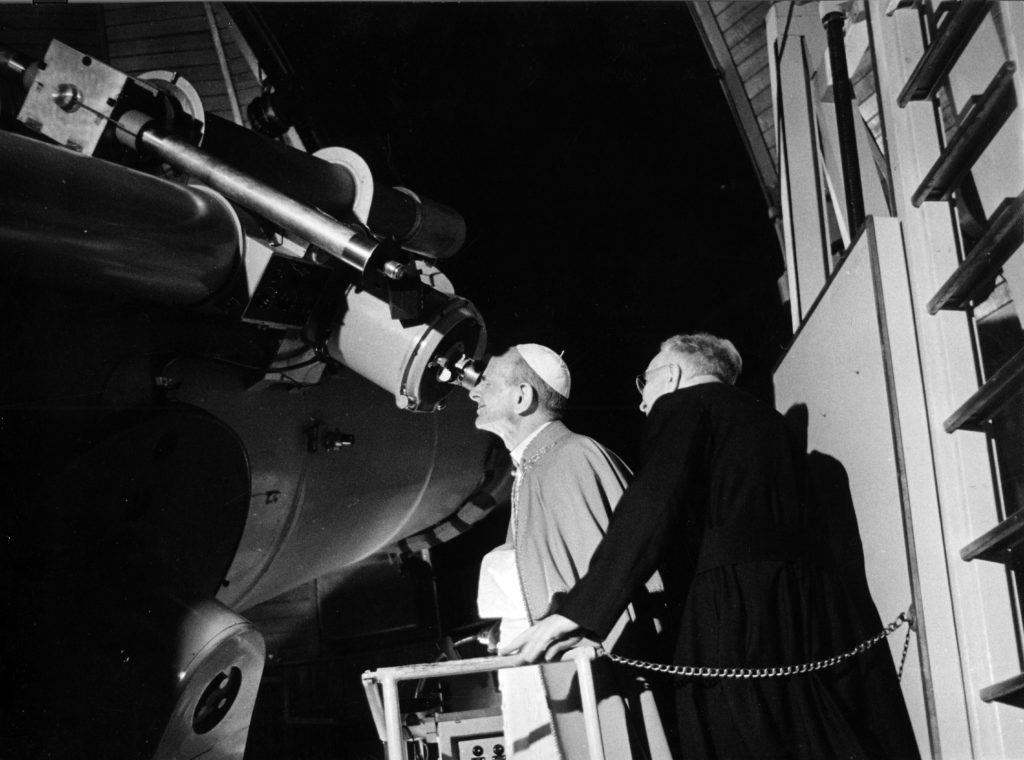
Pope Paul VI looks at the moon through a telescope at the
Vatican Observatory in July 1969. The then director of the
Observatory, Fr. Daniel O'Connell SJ, stands at his side. 
Next week I am off to St. Petersburg (Russia, not Florida) to give an invited lecture at the 4th International Conference on the Periodic Table — a celebration of the 150th anniversary of Dmitri Mendeleev's proposal that the chemical elements could be laid out in a table where elements in each row (now columns) shared many properties. This periodicity of properties led this method of organization to be called a "periodic table."

Pope Paul VI in one of the Vatican Observatory's domes
reading a message to the Apollo 11 astronauts.
The lecture I've been asked to give is based on an essay I wrote for Nature Chemistry earlier this year, "Isotopic Enrichment" (Isotopes are variants on elements. For example, carbon-14 dating tracks the radioactive decay of a heavier than normal variant of a carbon atom.  Most carbon is carbon-12, where the number indicates the mass of a single atom,) The title of this blog post comes from an article ten years ago in Science by Frank Poitrasson on what the distribution of the isotopes of iron can tell us about the history of the earth and the moon. (He describes events so cataclysmic as to be unimaginable. Think two planets colliding and some of the iron on earth vaporizing off into space.) History has a literal weight.

Bob Macke SJ  (left) and Guy Consolmagno SJ (attired for
the occasion) in front of a display of ephemera from Apollo
missions at the Vatican Observatory outside Rome.
When I was 11 or 12, a touring moon rock (I presume from Apollo 11 or 12) was on display at the Museum of Science and Industry in Chicago. I was long space obsessed and having devoured Heinlein's Have Space Suit Will Travel, anxious to go traipsing across the surface of the moon myself. (That's also the book where I first learned about isotopes, half-lives and their use as clocks to measure huge stretches of time.  The same potassium you find in a banana contains an isotopic "clock" — potassium-40 — that ticks off time on the billion year time scale, back to the birth of the universe.) So I was anxious to see this off-world connection.


A lunar sample collected by Apollo 17 astronauts Gene Cernan
and Harrison Schmitt, sealed in acrylic. I was |<- -="" this="">| close!
There was a field trip to the museum. I rode the yellow school bus in from the tiny Illinois town I lived in. I stashed my lunch in its wrinkled brown bag along with the rest of my groups' lunches to be picked up at our set time. Then I made a mad dash to the moon rock display. There was already a long line, which inched forward. Finally I was close enough to see the case — a Star Trek-esque dias, from which a light glowed in the dim room.  People passed the case, oohing and aahing. At last I was there. To discover there was nothing I could see. Even standing on my tiptoes, all I could see was the very top of the glass dome over the sample. The moon was as inaccessible to me as ever.

When I came to Bryn Mawr, I was excited to discover that one of  my new colleagues, Weecha Crawford, had been one of the first geologists to study the lunar specimens, which had to be handled as if they were precious jewels (which they are). But still, I had yet to see a moon rock.

Fast forward to yesterday, where Bob Macke, the Jesuit brother who is the curator of meteorites for the Vatican Observatory, assembled the observatory's collection of Apollo ephemera for us to enjoy at the morning coffee. One piece of which is a moon rock from Apollo 17, along with a small Vatican City State flag that went to the moon and returned! (Samples and country flags from that mission were given to each sovereign state at the time, including the Holy See.)

At last, I have been as close to (a piece of) the moon as I will get. Like St. Thomas, I didn't need to touch it, to know it was real. Unlike Thomas, I didn't even need to have seen to have believed.  Happy anniversary to Apollo 11!


Read about the goodwill moon rocks here.
A wonderful piece by Bob Macke SJ about what it is like to do the scientific research that continues on the lunar specimens is here, "Moon Rocks and Me".
There is a front page story at the Vatican paper L'Osservatore Romano by my colleague, the director of the Specola, Guy Consolmagno: Pallida luce dei nostri sogni (it's in Italian, but click to translate and read the memories of one of the Jesuits who was in the gardens the night Pope Paul VI came to watch the moon landing and read a message to the astronauts. More about that night is at the Vatican Observatory's Sacred Space blog.)


Friday, July 19, 2019

Vignettes via Vignetta

There are saints on every corner here.
The weather in the Alban Hills has been pleasant (unlike the East Coast), so I've enjoyed walking around the town — as it seems others are doing as well. There is the clutch of small children who have been filling a seemingly endless supply of water balloon at the fountain at the end of the street. They have been out there every day since I arrived. They offered to deluge me one afternoon, when I appeared hot and sweaty from my in-lieu-of-riposo walk.  I opted for the regular shower.

There was the lady walking down the side walk, lab goggles on her face. The man walking a duo of dachshunds. They left a perfect emoji shaped pile of poop on the street (I'm always watching where I'm walking), then tried to harass the large cat that polices the warehouse across the street. She outweighed the pair of them, and was having none of their nonsense. She hissed once and regally walked away.  Still, I wonder if the eviscerated mouse she left on the street later is a warning to them.  And then there was the scene from the early morning bus I took to catch a train into the city: an elderly man on his balcony, stark naked, except for a towel around his neck.

And yes, I've walked to Arricia.

Thursday, July 18, 2019

Plugged in

I showed up at the Vatican Observatory yesterday, wrung out and exhausted by jet lag and more. I'd spent part of a night sleeping on a plane between the US and Rome. The next night my sleep was broken by a fierce 3 am thunderstorm, the thunder echoing oddly in Lake Albano's crater. But last night I'd been awakened in the middle of the night by a text from a colleague's husband: She was dying. Please let my colleagues know.

It was still waking hours in the US, so I got up and sent emails and texts to those who would want to know. I crept back to bed about four in the morning, dragging myself out of bed four hours later, still bleary, but determined to make 10 am coffee at the Specola where I could plug in to electrons and wi-fi and restorative collegial conversation.

By late afternoon I was desperate for a nap, un riposo, but more desperate to pray. I went up to the small chapel with the tabernacle by mosaicist Marko Rupnik SJ to pray in the hour my colleague was being taken off life support 4400 miles and six time zones away.  A Jesuit chapel seemed the right spot to sit prayerfully present to the dying, to be pulled back into the meditations of the third week of the Exercises. Somewhere in the midst of this, I noticed an electrical outlet at the very bottom of the nearly floor to ceiling tabernacle. Not in the wall next to it, but in the base of the tabernacle itself.

What on earth was an outlet doing in this work of art? My mind wandered not to the pragmatic, but to the metaphorical. I could pray anywhere — at my desk, in the apartment, on a walk in the gardens, in any of the three churches within a five minute walk or the cathedral basilica across the piazza —but had been pulled here, to this tiny chapel where I could draw close to Christ crucified, Christ in truth. I wanted to be plugged in to Christ.

These days we look for outlets to pull electrons from for our phones, to bring them back to life. Do we equally have eyes for the places where we can recharge our spiritual life?


A day later, I realize that it is likely that when the tabernacle was installed, there was an outlet located in the wall that was rerouted to the base. Though why not to the wall next to it? There must be a reason.

Tuesday, June 04, 2019

Sacred space


Yesterday I went down to Georgetown, to give a talk for the annual Vatican Observatory Foundation seminar. Before the talks, we got a tour of the old Georgetown astronomical observatory, which might be the oldest observatories in the US still in its original location and with its vintage equipment. (The Mt. Holyoke telescope is from 1881 which predates this scope from 1888, but this building is older).

The astronomy department was closed in 1972, one of my colleagues at the Observatory, Rich Boyle, SJ, was one of the last Ph.D.'s from that program.

Both building and telescope are in need of work: the dome moves, but not 360o; the gears on the telescope mount are frozen (perhaps), so you can't change the angle of the scope; and the top of the stairwell, with no railing, is downright terrifying. But there is an active group of student astronomers who gather there, to see what can be seen past Washington DC's lights and to talk space and stars with each other. Given Crash Kid's experience at Georgetown working with the student theater group, I can see the same kind of enthusiasm in this group.

The observatory building is on the National Register of Historic Places and is surrounded by a conservation garden, replete with ponds and native flora and fauna, used by the biology department.


The photo to the left is of Br. Guy Consolmagno SJ, the current director of the Vatican Observatory. It looks to me like a set up for a 19th century painting (minus the camping chair!).

The evening went well, I enjoyed hearing Paul Mueller, SJ  talk about pastoral approaches to the perceived conflicts between science and religion, along with some background about the Catholic tradition vis a vis science. Both Paul and I quoted Thomas Aquinas. David Brown, SJ, talked about the collaboration between the Vatican Observatory and a group from Potsdam to get high resolution spectra of stars about which there may be planets. As he summed up his talk, "it's an exciting time to be an astronomer."

Saturday, April 20, 2019

Overflowing with glory

In the beginning there was God.  And there was chaos and confusion, a universe unshaped and restless, smoldering in the darkness.  The Spirit hovered over the waters, living and breathing above the abyss.  With a word, there was light, or so we read in the book of Genesis.

To hear the astrophysicists tell the tale, when the universe was one millionth of a second old, it was the size of a grapefruit. I could set it on my desk, cup it in my hands. Everything that would be was contained in that unimaginably hot, inconceivably dark, dense sphere. Matter was so tangled in its depths that even light could not wriggle its way out.  A quarter of a million years later, unable to bear the strain, the universe unfurls into the emptiness.  So now we have light.

Sometimes I imagine God cradling this rough-hewn and snarling mass of darkness in his hands, turning the inchoate universe over and around, pondering what will be.  Perhaps he set it on the desk for a while, leaning back in his chair with a creak to get a new perspective.  And when the time came, with a breath and a prayer—Spirit and Word— God’s hands opened and let what was within spill into the emptiness. God from God, Light from Light.

Humankind once held, all unknowing, the entirety of the universe, and more, in our hands. Inconceivable energy pushed into an impossibly small space.  The all-powerful, ever-living God contained in the body of a man, come to unravel the chaos. Perhaps the strain on the universe was again unbearable, for we hung God-become-man on a tree, and watched as he strained for breath and died. All that is, was and will be, pulled from the cross and cradled in his mother’s lap. We wrapped his body in linen, and set it aside. Only to have Light once more spill forth from the emptiness, washing out the darkness.

“Human kind cannot bear very much reality,” said T. S. Eliot. Certainly I cannot. I can contemplate with delight the small ball that was the universe in God’s hand. I will fall on my knees before Christ, who emptied himself out on that cross. But when again and again I cradle in my hands the Body of Christ, take the cup that bears God's very blood, I can’t bear to imagine the immensity of what is contained within.

I say, far too quickly, “Amen.”  I believe.  I assent.  But will I become? In receiving the Eucharistic, St. Augustine observed, “You are saying 'Amen' to what you are.” Can I stop, wait, and contemplate that in receiving this gift, those unimaginable forces have come to reside in me? What have I become?  And if I can bear that, can I imagine my neighbors holding such power in their hands, overflowing with God’s glory?

Perhaps what I really cannot bear is what this means I must do.  For what should come forth from my hands when I open them, if not light from Light.  What should I see in my neighbor, then, if not God? If I truly understood who I had become, would I not pour myself out for the kingdom of God?

Christus Resurrexit! 
Vere Resurrexit! 
Alleluia, Alleluia! 

From an essay in Give Us This Day, April 2017


Monday, December 24, 2018

Prayers!

A couple of Sundays ago I was sitting next to a family with two young boys at Mass, one an infant, the other about two. They reminded me of those days when Mass was a full body workout, as we juggled babies in arms and toddlers at our feet.  (If you think distractions in prayer are a problem, try praying with a toddler and a three-year old, then we can talk distractions.)

Last week as we prayed the universal prayers for the needs of the world, to which the assembly responded, "Lord, hear our prayer," the two-year old suddenly burst out, "Prayers!"  I turned to his mother who moved quickly to shush him and whispered, "Lest we think they aren't listening!"

I'd written those prayers, and I always worry that I'm missing the little ones, that these prayers go straight over their heads. But apparently not entirely. "Prayers!"

It reminded me of my summer visit to the Specola, where Mass was celebrated with the three or four of us who were around.  There was no haste in these celebrations of the Eucharist, and when it came time for the universal prayers, they came in fits and starts, in English and Italian from all present. For those from the community traveling, for those in ill health, for local difficulties, for our families, for the world, the Church.  Prayers, we cried again and again. As we proceeded with the liturgy, I imagined those prayers piled on the altar, spilling over, offered up with the gifts, the whole to be sanctified, to be made whole in what was broken.

So many people in my life right now have asked for prayers, friends and family both. I pile the prayers at the foot of the altar - for my dad, who is struggling with serious health challenges, for my sister-in-law who is hospitalized with meningitis, for a young friend undergoing surgery. For the nation, for the Church, both in difficulties...for peace on earth. The needs are great and small alike. "Prayers!" indeed, I think.

What will my community pray for tonight?
For the People of God, to whom God has chosen to come close… 
For those who long for light, for those whose lives are overshadowed by war, economic unrest, or violence in their neighborhoods and homes…
For the safety of those who must travel, for pilgrims, immigrants and refugees… 
For the homeless, for children and families who will not have a roof over their heads tonight… 
For the sick, for children who are ill and for their parents... 
For our dead, those in need of our prayers and those now singing joyfully before the Lord…
Prayers!


Wednesday, September 05, 2018

A murmuration of starlings

Over the wall from the Specola, I could just see the vines growing up the sides of the Poor Clares' cloister next door.  One afternoon, when it was cool enough to have the window open, I could hear the nuns chanting, a low murmur burbling like the fountain in the courtyard.  I stood up to stretch and out the window I could see a murmuration of starlings, a dark wing against the sky, swirling up and out of the cloister, then diving back in, always staying with the bounds of the enclosure. A visual chant.

Wednesday, August 15, 2018

Buon ferragosto!

Statue of Mary in the papal gardens, a favorite spot for Popes
to pray.

It's the Feast of the Assumption, a holy day of obligation in the US and of course, here in Italy. Here, however, it is also a major holiday - ferragosto. Stores are closed, many for the whole week.  Even the supermarket with 'orario continuato' — continuous open hours, they don't close for the mid-afternoon rest — is closed today.  You could definitely feel the anticipation in the air yesterday afternoon as people ran last errands around town.  Me, too.  I bought melon and tomatoes and herbs from the farmer's market in the square and some salumi at the supermercato. Everyone was wishing each other a cheery "Buon ferragosto!" 

Bit of mosaic in floor at San Pietro.
This morning when the bells from San Pietro started to ring at 8 to nudge people planning on going to the 8:30, I grabbed my bag and headed out to church. It's a two minute walk to this 6th century church, named for St. Peter the Apostle (who apparently evangelized the Romans living here back in the day). The church was already half full, the Eucharist is on the altar almost all day for those who want to come in and sit.  I sat.  Mass at 8:30 was full, but I should have paid attention to the seating pattern. Sit nearest the open door that overlooks the plain below. The breeze is delightful, as I discovered when I went up to communion.

San Pietro after Mass. The sisters are in the 
prime spot.
There is a clear sense of celebration in the town. Local restaurants are doing a set "ferragosto" menu and I went out with the Jesuit community here across the square for a two-hour pranzo, the main meal of the day.  Pace yourself, I was warned. Two types of antipasti, bread, wine, water, lasagna al forno, crispy calamari and shrimp. Another pasta and fish dish: paccheri di scoglio. That last translates literally as "slaps of rocks" - actually pasta with clams, shrimp and mussels in the shell; paccheri is large tubes of pasta that apparently make a slapping noise when they hit the plate. Finally, watermelon for dessert and an espresso so you don't (quite) fall asleep at the table.

I went back to the apartment to change for my afternoon walk, dodging kids with squirt guns and enjoying watching the women of my age dressed in their best out walking. I don't have the panache to wear some of the shoes (or the willingness to risk my ankles) - so much gold lame and so many glittery sequins. Though you have to admit, it absolutely goes with the feast:  Risplende la regina, Signore, alla tua destra. (or in the US, The queen stands at your right hand, arrayed in gold.)

Now, of course, it's afternoon thunderstorms, so I'm waiting it out, the local weather suggests we'll get a break soon.  Meanwhile, the papal roosters are annoyed at the changing light, the thunder and the ringing bells to announce Mass at one of the five churches within a few minutes walk. They are crowing up a storm!


Sunday, August 12, 2018

Do you believe in miracles? Santa Maria on the way

The skull of St. Agnes is behind the small 
green circle of leaves above the tabernacle.
It was hot, hot, hot and humid in Rome yesterday. I took an early train into Rome from Albano, having finished up a couple of significant writing projects the day before and having checked on the weather, which suggested it was only going to get hotter over the weekend.

When I got off the Metro at Spagna just before ten in the morning, I was struck by how empty the piazza at the bottom of the Spanish steps was. After the bustle of Termini station, it was so deserted it was eerie.  As I walked across the middle of the empty plaza, feeling like I walked into a Fellini film,  I suddenly understood why there was no one else there.  The sun was already high enough for the entire center to be in the full sun, with the heat radiating off the black basalt Sampietrini pavement. In the two minutes it took me to cross I was drenched in sweat and wishing I'd had the sense to pop up my Japanese umbrella/sunshade.

An actual dome in Sant'Ignazio.
I meandered my way from the Spanish steps to Piazza Navona and back again, walking nearly 9 miles as I did so.  I had back-to-school shopping to do along the via del Corso, mostly shirts and pants for the guys.  I ducked into various churches over the course of the day - a miniature pilgrimage as a counterpoint to the shopping.  I lingered in Sant'Ignazio with its faux dome, prayed in Sant'Agnese in Agone, which has a magnificent dome which you are NOT allowed to photograph, but where the attraction for me is a closet-sized Eucharistic chapel in the back with the skull of the martyr in the altar for all to see.  At the end of the day, walking down one of Rome's serpentine alleyways, I was suddenly confronted by a trumpeting angel, bearing down on me from the roof of Sant' Antonio dei Portoghesi, into which I took an unplanned peek. A baroque jumble screamed at me as I walked through the door.  I back right out again.

Sant' Antonio dei Portoghesi
I hadn't planned on a visit to Santa Maria in Via — Mary of the way — either, but ducked in on a whim.  Built in the late 15th century and completed under Cardinal Robert Bellarmine, SJ in the 17th century, it sits on the site of a miraculous well. The story is told that on a September night in 1256, the well in the stables of Cardinal Pietro Capocci's residence overflowed.  An icon of Mary imprinted on a tile was found floating atop the waters.  Pope Alexander IV promptly ordered a chapel built over the top of the well. [Bonus - today is the feast of St. Clare, who was canonized by Pope Alexander IV.]

The church is full of anachronisms.  There is a Caravaggio tucked into the corner of a side chapel, in a spot so dark I could not make out the subject (the sign on the altar rail is the only way I knew the artist — and I can't find any such painting on the list of the Caravaggio's in Rome, I'll have to go back and double check).  Why is there an enormous teleprompter stuffed into yet another side chapel?  And the plumbing for the miraculous well would not be out of place in a fancy wet bar.

The holy well in Santa Maria in via, you can see the sink and
the faucet on the right hand side where the young man is 
filling up a cup, just like at the coffee bar.
Yes, the well is still there, and cups are set out for the steady stream of people who want to drink from the miraculous water.  I now have a bottle of this holy water for a friend, and another bit to take home.

I wonder if anoint my aching ankle and foot in the water from the well, it will be healed. I'm almost afraid to do so.  If it improves, will that increase my faith (the point of miracles.) I don't think so.  It it doesn't get better, then what?  I still believe.

I'm sorely tempted to make the holy water into a holy ice cube and ice my foot. That will definitely make it feel better, and to the people of Bellarmine's Rome, would look as much a miracle as the floating tile did. But I suspect that is cheating.
Seen in the window of some very chic
shop by the  Spanish steps.
Ankle or no, I adored these flaming shoes. Just what I need to lecture about thermodynamics in. They'd be perfect for the combustion of organic compounds lab — except of course, no open toed shoes in the lab!  Pink or black? Black, I imagine!

Wednesday, August 08, 2018

Ghosts of elements, spectres of the universe: Angelo Secchi SJ's stellar spectra

A plate of Secchi's spectra.

This year marks the 200th anniversary of the birth of astronomer Angelo Secchi, SJ, the pioneer behind stellar spectroscopy, which opened the door to our understanding of what makes up a star.  I'm spending a couple of weeks at the Specola Vaticana outside Rome, of which Secchi is arguably one of its founders, though the official founding of the current incarnation of the Specola would come nearly 15 years after his death.

[A version of this post is cross posted at the Vatican Observatory Foundation blog, The Catholic Astronomer]

If you’ve seen the flash of yellow-orange flames when a pot boils over on a gas stove, you’ve gotten a glimpse of the ghost of an atom, specifically sodium.  The color is part of the atom’s spectrum, which shows which types or frequencies of light are absorbed by that particular atom.

In the late 17th century, Isaac Newton used the Latin word for ghost, spectrum, to describe the bands of colors he saw when light shone through a prism. In 1814 Joseph von Fraunhofer noticed he could see bright lines instead of the bands of colors when looking at certain flames through a prism.  He went on to develop an instrument to measure these spectral lines, called a spectroscope.

Fraunhofer noticed a series of missing colors, dark lines, when looking at the sun’s light through the spectroscope, and went on to characterize the light from several stars as well.  Fifty years later  Jesuit polymath Angelo Secchi invented a series of spectroscopic instruments specifically for examining the patterns of colors in the light from stars and the sun and used it to build a catalog of more than 4000 stars.  Secchi classified the stars by recurring patterns in the light, which were a clue to the star’s composition.

Around the same time Secchi was building his catalog of stellar spectra, Gustav Kirchhoff and Robert Bunsen (the inventor of the ubiquitous Bunsen burner) were involved in a more down-to-earth scheme. Kirchhoff and Bunsen teamed up to create a spectroscope that used Bunsen’s new hotter, gas burner to ignite samples.  They noted that that when they combusted a pure element it produced a characteristic set of lines, a spectral fingerprint, that could be used to identify it.

In October of 1860, Kirchhoff and Bunsen announced they had used their spectroscope to discover a new chemical element, which they named cesium, for the blue color of its principal line.  Chemists quickly began to use Bunsen’s spectroscope to find new elements.  A few months later Kirchhoff and Bunsen found two bright ruby red lines in an extract of a silicate mineral lepidolite, the spectral traces of another new element, rubidium.

Thallium’s ghostly green emanations were first observed by William Crookes, indium, ironically named for its violet lines by its color blind discoverer Ferdinand Reich.  Paul-Émile Lecoq de Boisbaudran spectroscopically painstakingly identified element 66 in a sample extracted from his marble hearth, and instead of naming it for the colors of the lines, called it dysprosium, from the Greek for “hard to get” — because it was.

Hunting for new elements spectroscopically meant you didn’t actually need to have any of it in your lab or even on your planet, as long as you could observe the light from a burning sample.  In 1868 several chemists and astronomers independently observed a faint line in the spectrum of the sun, and assigned it to a new element, helium, which as far as they knew did not exist on earth.  It would take nearly 30 years for two Swedish chemists to confirm that it was present on earth — by matching the spectrum with that of a gas found in a uranium ore.  (All the helium found on earth comes from radioactive decay.)

These ghostly lines produced by elements helped fuel yet another critical discovery that would have far reaching consequences for chemists’ understanding of the periodic table:  quantum mechanics.  Niels Bohr’s quantum mechanical model of the atom opened the door to explaining the line spectra of chemical elements. Though more accurate and sophisticated quantum mechanical models of the atom now exist, Bohr’s model showed the relationship between the lines and an atom’s electron by insisting that the electrons’ energies were quantized, that is, they could only have certain energies.

So why do atoms have ghosts?  When an atom is heated to high temperatures, as in a flame or a star, the energy it absorbs excites its electrons.  You can think of the electrons in an atom as being on an energy ladder. (this isn’t quite correct as far as the quantum mechanics goes, but it is a reasonable approximation and easier to visualize.)  They can only have energies that match the rungs of the ladder, and each type of atom has a unique arrangement of the rungs.

When an atom absorbs energy, its electrons move to higher rungs.  Excited electrons are unstable. They quickly return to their original arrangement, giving off some their excess energy in the form of light as they fall back to their original rung.  The color (the wavelength) of the light emitted depends on the difference in energy between the rungs.  The colors of light emitted are the ghosts of the energy rungs.  Since each element has a unique pattern of rungs, it will have a unique spectrum of emitted light and so revealing their presence to the sharp eyes of spectroscopists.

The spectra that Secchi so carefully observed (and hand drew!) were not just a way to identify a particular star, but clues to its chemical composition and even more critically to its evolution. Chemists and astrophysicists still use the light emitted and absorbed by atoms and molecules to identify their presence.  We hunt for the structure of the universe in its ghosts.


If you want a way to see the ghosts of atoms for yourself, try this inexpensive DIY folding spectroscope you can attach to your phone. Use it to check out the light from a neon sign or from a street light!

For a wonderful description of the elements, including stories of how they were first discovered, read John Emsley’s Nature’s Building Blocks.

Want to read more about Angelo Secchi, SJ? Try Adam Hincks SJ's piece in American Magazine or my colleague at the Specola Bob Macke SJ's piece about Secchi's more terrestrial scientific pursuits.

This post is a version of an essay written for a collection commissioned for the UN’s International Year of Light in 2015.  


Tuesday, August 07, 2018

Walking in the heat

Public gardens in Albano.
The sensible thing to do when it is 96o F out is to take a nap. Truly.  Instead I have been walking. Yesterday I walked across the bridge at the far end of town which spans the valley separating Albano from Arricia. Today I walked the gardens in Albano, just below the Specola.

The views have been spectacular, towns and small orchards spread out below like toys. But part of the joy of the walking is what I can see at this pace. The discovery of the grotto underneath the plaza where I cross the street most days to pick up a loaf of bread.  The doorknockers and door stops, lion's heads and horses' hooves. And my favorite, which reminds me of Thing in the Addams Family (the hand in the box on the table).

It's also interesting to experience these towns as they were when foot travel was the only choice. I can walk from the center of historic Albano to Castel Gandolfo in under 30 minutes. The same can be said for the walk to Ariccia. Many of my walks parallel the Appian Way, or follow it for short periods. These are well worn paths, Ariccia has been settled for almost 3000 years, Albano, in this location at least, for 2000 years.

Though the walk from Albano to Arricia is much faster now that the bridge spans the valley, before the bridge was built in the mid 19th century by Pope Pius IX...well, not with his own hands...you had to walk down and up a very steep slope The country here is steep, I think twice before walking down a street, knowing I'll have to walk up it to get back.

The bridge is not the original bridge, but was destroyed by retreating German Army at the end of World War II, was rebuilt and then collapsed abruptly in 1967 (which created such wonderful ruins that they inspired Fellini to film there). I think I was glad not to know about the collapse as I walk across the once-again-rebuilt span.

Sunday, August 05, 2018

Glooo-ri-a! Gloria!

The lights in the street outside the church. The St. Rita's
Triduum at my parish definitely could learn from this event!
Not Gloria in excelsis Deo! but a cover of Laura Branigan's "Gloria!" was ringing through the square in front of the 11th century church of Santa Maria della Rotunda as I walked home through it last night.  It's part of a three day celebration in Albano Laziale to mark the deliverance of the city from a cholera epidemic in 1867. The people came to this church to pray in front of what is traditionally considered to be a very early Syrian Christian icon of the Theotokos: Mary in her role as Christ-bearer, mother of God, Dei Genetrix as it is inlaid in the wall of the church. 

The celebration includes Masses and prayer times, but also nightly concerts of secular music and pop-up restaurants in the blocked off streets nearby. There are flashing lights arching overhead. 

As I threaded my way through the crowd in the square, I thought how strange it was to be walking the streets of this ancient Italian town and seeing the streets of Pittsburgh in my mind's eye. (This morning, I still have the tune stuck in my ear).  But it turns out that the version made famous by Flashdance isn't the original, it's a late 70s pop song by Italian pop star Umberto Tozzi! (Listen here.) So definitely Italian.

This morning I went to one of the closing Masses (there are three today), enjoying the way the small congregation's responses were amplified by the round church (which is in an old Roman temple or bath).  There might have been fewer than a hundred people in there, but I have rarely felt so engulfed by the liturgy, so firmly grounded in the faith proclaimed. 


Tuesday, July 31, 2018

Take One Tunic

My second tunic/sweatshirt and lots more stuff.
I'm off to Rome, or more precisely, Albano Laziale, the small town just outside of Rome where the Vatican Observatory is situated, just behind the gates to the papal gardens.  As I packed, my mind kept drifting back to the Gospel from two Sundays back. 
He instructed them to take nothing for the journey
but a walking stick—
no food, no sack, no money in their belts.
They were, however, to wear sandals
but not a second tunic.  (Mark 6:8-9)
Yes.  Well.  I have packed a snack, have a checked bag and a carry on, stashed my miscellaneous euros in my wallet.  I definitely packed a second tunic (and a third and a fourth...).  I'm not wearing sandals, though I did pack a pair.  It sounds like an all around fail, new evangelization or old, even before you consider my electronics.

It got me thinking about what the modern version of sandals and a walking stick might be?  Or that second tunic that Matthew suggests might be allowed.  Walking shoes?  A phone? What reminds me of my origin and my destination, of the source of what I have?

If I could take just one thing, and trust that the rest would be provided, what would it be?  My laptop. A virtual tunnel to almost anywhere, to information, to communications, to clothes and food. A battery for electronics.  Though  the more I think about it,  perhaps my laptop is not a sign of radical dependence, but of stubborn independence.