Showing posts with label Catholic Standard and Times. Show all posts

Sunday, September 20, 2015

Column: Inconvenient Truths

Refugee tents at Budapest Station
Victor was in Hungary a couple of weeks ago, while the refugee crisis at the train station in Budapest was at its peak.  He felt he needed to respond in some way to those bereft of home.  I'm proud of how he stretched to do so.

In writing this, I read many of the recent Catholic Church documents on migrants and refugees. They speak powerfully of how we ought to respond.  The line that I'm still thinking about comes from Pope John Paul II at 3rd World Congress on the Pastoral Care of Migrants and Refugees:   "It will be necessary to abandon a mentality in which the poor – as individuals and as peoples – are considered a burden, as irksome intruders..."

Given the news from our own country and from abroad, this is a line worth contemplating.

A version of this column appeared at CatholicPhilly on 18 September 2015.

When they were few in number, a handful, and strangers there,
Wandering from nation to nation, from one kingdom to another people,
He let no one oppress them; for their sake he rebuked kings:
“Do not touch my anointed ones, to my prophets do no harm.” — Psalm 105:12-15

“Be prepared to walk three to four miles to your event,” advises one brochure on the papal visit. There are lists of things not to bring: no coolers, no shelters, no large signs. “Grounds open at 6 am.” For an event that will not begin until after noon.

Refugee children at coloring station in
Budapest station
I am immeasurably grateful; I have a ticket to hear Pope Francis talk about immigration on Saturday, and one that lets me stand on the parkway for Mass on Sunday. Yet the more I read about the events, the more challenging the weekend sounds. How long can I stand? How far can I walk? Will I be able to bring an umbrella in case of rain?

While I began to make plans for the World Meeting of Families and the Pope’s visit last week, my husband, Victor, was in Budapest to give a series of talks on mathematics. His pictures of the small dome tents housing Syrian refugees in the train station square made me pause. So, too, did Facebook posts from friends in California, watching worriedly as fires envelope nearby communities. I’m planning for a weekend of wandering about Philadelphia with my oldest son, I’m not fleeing a war or wildfires, young children, pets and my elderly father in tow.

In 2013, under Pope Benedict XVI, the Church offered a reflection on our pastoral and spiritual response to refugees, those driven from their homes by forces beyond their control.

We are reminded that migrants and refugees are first and foremost not inconvenient company, but are a way God points to both our own status as pilgrims in this world and to Christ: “The ‘foreigner’ is God’s messenger who surprises us and interrupts the regularity and logic of daily life, bringing near those who are far away. In ‘foreigners’ the Church sees Christ who ‘pitches His tent among us’.”

The document goes on to remind us that everyone is called to respond personally to the needs of those who have been displaced by disasters. Victor visited with the refugees at the station, joining a group of students helping parents entertain their children, sitting on the ground as they colored, blowing huge bubbles for them to chase. He bought small toys for these children — carefully chosen to be easy to carry and not noisy so as not to add to their parents’ burdens!

It’s harder to see what I am called to do from this side of the ocean, but I can pray. I can allow my own wanderings to sharpen my eyes for the displaced. I can offer up long lines and long walks for those who stand at the borders, hoping for a place of safety.

The pope’s visit will interrupt the regularity of our daily lives in so many ways, even if we are not able to go to any of the events. For a brief moment our lives will manifest aspects of the uncertainty and anxiety of those fleeing catastrophes.Can this temporary disruption remind us of the Gospel’s demand to be ever attentive to the needs of those driven from their homes? Welcome, the Church tells us, is not just a task, but a way of living.

Friday, September 11, 2015

Column: Martha, Mary and the one thing

Pieter de Bloot (circa 1601/1602–1658) via Wikimedia Commons
What I like about this version of the scene is the chaos in the kitchen, the gritty reality of the cracks in the walls, and perhaps, the cat which in all the commotion has managed to snag one of the fish.

This column appeared at CatholicPhilly.com on 11 September 2015.

As they continued their journey he entered a village where a woman whose name was Martha welcomed him. She had a sister named Mary who sat beside the Lord at his feet listening to him speak.

Martha, burdened with much serving, came to him and said, “Lord, do you not care that my sister has left me by myself to do the serving? Tell her to help me.”

The Lord said to her in reply, “Martha, Martha, you are anxious and worried about many things. There is need of only one thing. Mary has chosen the better part and it will not be taken from her.” — Luke 10:38-42

Help! Pope Francis is coming to Philadelphia and like Martha in Luke’s Gospel, we are all anxious and worried about many things. Traffic boxes and train passes. Will we be able to get to work or to the events? Tickets. Will we be able to see the Pope?

Work. How many people will be sleeping on cots in cafeterias and offices so that the sick will be cared for and people kept fed and safe?

Extra work, extra people, extra hassle. We are all Martha at the moment — wishing it was our turn to be Mary. To have the choice to sit, and enjoy whatever those days might bring.

I always struggle with this Gospel, with a literal reading that suggests the women working in Martha’s kitchen in Bethany should have known better, abandoned dinner and come to sit with Jesus — and that when faced with the necessary tasks of life, or preparing for a papal visit, we should all go on strike, find a church and sit with God. As if we could.

St. Augustine once said that miracles “have a tongue of their own … let us not only be delighted with (their) surface, but let us also seek to know (their) depth.” Augustine, preaching on the story of Martha and Mary, reminds us that Jesus was not only God, but man, and so needed to eat and drink. Martha “with deep concern” prepared the food that strengthened Jesus’ body to do the work he was sent to do.

It was not work that could be ignored, said Augustine. Nor can we all ignore the work that must be done to feed and care for not only the pope, but the many visitors to the city.

As I read through the story of Martha and Mary again this morning, trying to hear what simmers under the surface of the story, I found myself hearing Jesus saying to Martha, “there is need of only one thing.” What, I wonder, is the “one thing” we ought not to lose sight of right now, in the midst of the many things we are anxious about?

In his book Reimagining the Ignatian Examen, Mark Thibodeaux, S.J., suggests a way of looking at your day that I am finding helpful as I seek that “one thing” in the midst of all the chaos and uncertainty of the preparations for Pope Francis’ visit.

At the end of each day, ask God three things: “Who wore your face for me today?” “In what person did I fail to find your presence?” and “Was there some person I encountered today who needed me to be your presence?” These questions remind me that always and everywhere the one thing I should be looking for is Jesus, in the people I encounter — troublesome and otherwise — in the people who are helped by the work I do, visible or not.

The pope’s visit has a tongue of its own, reminding us that we are all the Body of Christ, and it is here, in the kitchens and in our office and in the work we do, that we get next to Jesus, to hear what he has to teach us. Over these next three weeks, and beyond, that is the better part — the one thing — we are called to do.  May we do it with Martha's "deep concern" for the Lord, in all his countless incarnations.

Monday, March 30, 2015

Column: A Church warmed by mercy

This column is the seventh in a series on the readings from the Easter Vigil for CatholicPhilly.  The reading is Ezekiel 36:16-17a,18-28.  You can find all of CatholicPhilly's Lenten material here, including editor Matt Gambino's reflection on the collects for the Sundays in Lent. This piece appeared at CatholicPhilly on 17 March 2015. 

For I will take you away from among the nations, gather you from all the foreign lands, and bring you back to your own land. Ezekiel 36:24

No matter how early or late Easter falls, it’s never as warm as I think it is going to be on the Easter Vigil. I shiver outside in the growing darkness, my coat piled with the rest of the choirs’ in the daily chapel, a candle and my music clutched in my hand. We light the fire, the deacon and acolyte brush past, the Easter Candle held high, and we come streaming into the church, out of Lent’s cold and into Easter’s warmth.

We are coming home, those of us who were here the previous afternoon, and those who have not been through these doors in weeks or months. Among them my oldest son, back from college to celebrate this great feast with the community who first welcomed him in baptism 21 years ago; a parishioner, hospitalized for weeks, steadied by his wife, makes his way to a pew. All of us are gathered by God into this church, drawn by the warmth we find within, literally and metaphorically. We are pulled into Easter’s light by God’s merciful Word.

For the last five years, I have sung the psalm response to this reading, Psalm 51, the Miserere. “A clean heart create for me, O God, put a steadfast spirit within me.” Mercy is ours, Ezekiel tells us in this reading, no matter what we have done, or failed to do. This is the night, the Exsultet proclaims, that “a pillar of fire banished the darkness of sin.” And yet still I stand in front of the church, shrouded in darkness, surrounded by the assembly and beg for mercy, that God might not cast me out from his presence, that I — that all of us gathered within these walls — might again know the joy of God’s Spirit dwelling within us, sustaining us.

Two weeks ago Pope Francis announced the opening of an extraordinary Jubilee Year. The pope called for this year of mercy, set to begin on Dec. 8, that we might grow in our understand of what it means to be a church of mercy, in particular that we might be “merciful as our Father is merciful.”

Here, on the cusp of the proclamation of Easter’s good news, we hear once again of the enormity of God’s mercy. Not only are our sins forgiven, but we are renewed from within, God’s own spirit placed within us. To guard us and guide us.

Surely it will be cold when the year of mercy begins next December, but I’m hoping that my thoughts will return to the warmth found within the walls of the church, and to this reading in particular, which speaks of the depths of mercy and forgiveness. That I might grasp more profoundly that God has placed his spirit within me, to sustain me, to burn brightly, to warm not only my heart, but those of all I meet.


If you are curious as to the missing half-verse (17b) in this pericope, it's here.

Thursday, March 19, 2015

Feast of St. Joseph

"Joseph and Joachim" by Albrecht
Dürer via Wikimedia Commons 
Today is the feast of St. Joseph. For years I've sat on the side of the daily chapel for the Hours which faces a statue of St. Joseph. He holds the iconic lily and carpenter's square, but what draws me in is the look on his face and tenderness with which he holds a young -- but not infant -- Jesus in his arms. When I was contemplating the Hidden Years in the Exercises, this was the face I saw.

The traditions in East and West diverge early on St. Joseph. Augustine and Jerome postulating perpetual virginity for Joseph, the East sticking to the apocrypha and considering him a widower. So far no one has succeeded in making either position dogma, so I'm free to disagree.

This reflection first appeared in the print edition of the Catholic Standard & Times on 18 March 2010.

When his mother Mary was betrothed to Joseph, but before they lived together, she was found with child through the Holy Spirit. Joseph her husband, since he was a righteous man, yet unwilling to expose her to shame, decided to divorce her quietly. — Mt. 1:18-19

“Do not speculate beyond the text. Do not require of it more than it simply says,” advised St. John Chrysostom, preaching in the fourth century on this fragment from Matthew’s Gospel. It was advice that had long been unheeded, at least when it came to St. Joseph. Though nearly all that we know of Joseph, the husband of Mary, is here — he was a righteous man — speculation about Joseph’s life had been rampant for at least 200 years by the time St. John offered his counsel.

Was Joseph a widower? Did he have other children? Was he old or young? When did he die?

It’s hard not to be curious about the man who would have known Jesus so well, his foster-father. A few lines later, in fact, John Chrysostom himself would ignore his own advice, asking his congregation to imagine Joseph’s virtues, “Do you not see here a man of great self-restraint? ...”

From the canonical Gospels we know only that he was a “righteous man” and a carpenter. My father is a carpenter, and as long as I can remember I’ve been in awe of what he can fashion from wood. Under his hands awkwardly shaped and seemingly unyielding pieces of wood become beautifully turned spindles for my nephew’s crib and carefully crafted shelves for my books.

The smell of sawdust is the smell of wonder and creation. So I’m not surprised that God, Creator of all, would choose to dwell in the house of a carpenter, to live surrounded by these small mysteries of creation.

Sources such as the apocryphal Protevangelium of James, which dates to the second century or earlier, and the fifth century “History of Joseph the Carpenter” suggest St. Joseph was a widower and the father of four sons and two daughters. Contemporaries of John Chrysostom, Saints Augustine and Jerome, had different ideas about Joseph’s earlier life, thinking it was fitting that he was not a widower, but like Mary, ever virgin.

I hesitate to disagree with the great doctors Augustine and Jerome, but having been widowed and remarried myself, I wonder if it is not more reasonable that Joseph had been married once before his betrothal to Mary.

To marry again you are risking being widowed again, now knowing full well the pain that brings. It takes a different kind of courage to submit yourself again to the possibility of such a loss.

Christ, having once emptied Himself to become man, will surrender His life once again on the cross. How much might a widowed Joseph’s willingness to love and cherish Mary, in the face of potential pain and loss, have strengthened Jesus in the garden at Gethsemane as he surrendered to suffering, for love of us?

I require nothing more of the text than to know that Joseph was an upright man, who heard the voice of God, who cherished wife and Son, but I do yearn to go beyond it, not so much to know St. Joseph, but through him, to better learn what it is like to live with the Son of God in your home and in your heart.


Tuesday, March 03, 2015

Column: Rising Waters, Raising Walls


This column is the third in a series on the readings from the Easter Vigil for CatholicPhilly.  The reading is Isaiah 54:5-14.  You can find all of CatholicPhilly's Lenten material here, including editor Matt Gambino's reflection on the collects for the Sundays in Lent. This piece appeared at CatholicPhilly on 18 February 2015. 

When the water was thus divided, the Israelites marched into the midst of the sea on dry land, with the water like a wall to their right and to their left (Exodus 14:21b-22).

A few weeks ago I drove through the Fort McHenry tunnel on I-95, coming back from visiting my oldest son at college. The GPS showed our path entering the harbor, as if we were driving across the surface of the water, rather than underneath it.

The tunnel was dry and bright, a stark contrast to the dark night and sleet above. I was struck by how safe we felt in that tunnel, sheltered for the moment from the vile weather, yet staggeringly aware of the weight of more than 100 feet of water above us.

I wonder if the Israelites experienced this same unsettling mix of safety and fear as they gathered their children and belongings and walked between the walls of water across the bottom of the sea. Was it a quiet refuge like the tunnel under Baltimore’s harbor, guiding a steady stream of people across the sea? Or did the east wind sent to separate the waters howl, and the water rage against the boundaries God had imposed on it?

Origen, a third century theologian and Father of the Church, wondered, too, how much courage it might take to walk between walls of water, even knowing they are held back by the hand of God. Our souls, he imagined, at times much traverse similarly perilous waters, where it is easy to be distracted by the great waves mounding up on either side.

Keep your eyes fixed, says Origen, on God’s law. Hold it close, as Moses did.

The desert fathers and mothers, it is said, hurled snippets of the psalms like spears at what hounded them in the night. On a bitter dark night in February, with sleet lashing against the windows, I sat awake, worried about a child growing ever more ill on the other side of the country. I found myself reaching for the psalms as well. Not to hurl back at the fears that banged at the windows, but to draw up on either side of me, to hold back the waters that threatened to engulf me, to keep my eyes fixed on the Morning Star.

“I will walk in the presence of the Lord,” rang Psalm 116 in my ear. No matter how high the waters and how rough the seas, I wade into the water, singing to the Lord, ever present, ever triumphant over evil.

Friday, December 28, 2012

Column: A different kind of Christmas meditation - Coffee with Jesus

You can read all of Coffee with Jesus here, or follow them on Facebook.  For all that I love the smell of a Christmas tree, and adore walking around to see the holiday lights in my neighborhood, my view of the Incarnation sheers off from the romantic rather quickly.

This column was posted at CatholicPhilly.com on 28 December 2012. 

For a child is born to us, a son is given to us; upon his shoulder dominion rests. They name him Wonder-Counselor, God-Hero, Father-Forever, Prince of Peace. — Isaiah 9:5

My regular spiritual reading list is almost impossibly eclectic. At the top of my stack at the moment are fourth century Father of the Church John Chrysostom’s reflections on Christmas, 20th century Christian apologist C.S. Lewis’ essay The Weight of Glory, theologian Karl Rahner S.J.’s Advent homilies — and Radio Free Babylon’s edgy (and occasionally over the edge) cartoon strip, Coffee with Jesus.

In the strip, Jesus wears a suit and tie, and cradles a steaming mug of coffee as he talks to a cast of characters that could come straight from my local Starbucks: a mother in a hurry, a local pastor, a salesman between calls. And when it appears in my Facebook feed, it always jars me out of my complacency.

The cartoon strip and St. John Chrysostom have more in common than you might think. They share an unflinching perspective on the lived Christian life. “And what about His hunger, cold, chains, nakedness and sickness? What about His homelessness? Are these sufferings not sufficient to overcome your alienation?” comes the voice of the golden-tongued preacher across the centuries. Can I be attentive to the suffering of the mentally ill woman across from me in the ER waiting room? Or do I look away, pretend I don’t hear her?

Radio Free Babylon’s Jesus, responding to a character’s decision to donate to a canned food drive, minces no words either: “And by ‘some stuff,’ you mean some rusty cans of turnip greens and other things you were never going to eat?” Ouch. How generous is my heart, I wonder?

As I put out the manger scene at home this week, I thought about how many times I have contemplated Jesus, like the shepherds, silent in his crib, and been consoled by the thought of God made man, present with us. I wonder if I find this moment in the Gospel so consoling because Jesus is an infant and can’t yet talk. Would I find it as reassuring to sit down with Jesus and have a cup of coffee?

In his Spiritual Exercises, St. Ignatius of Loyola suggests trying just that. Talk to Jesus, Ignatius urges, as one friend might to another; use your imagination to set the stage for this kind of prayerful reflection with God; don’t let historical detail overly constrain you.

This Christmas season, when I take my cup of tea to sit by the nativity scene on the windowsill to contemplate the Incarnation, instead adoring the infant Savior, I’m imagining that the adult Jesus has stopped by for coffee on His birthday. Could I manage not to fuss about with getting out the good china and warming the teapot, and instead grab two mugs and pour us both a cup of what I have already made? What would He ask me? How would I respond? Could I hear what He had to say to me? The challenging as well as the consoling?

Would I have the courage to listen, rather than speak? To imagine not falling on my knees in adoration when the angels sing, but instead to turn down the Christmas music, pick up my cup, sit down and listen to He who we call Wonder-Counselor and Prince of Peace. Jesus. The Word made flesh.


May God, the Lord, bless us and make us perfect and holy in his sight. May the riches of his glory abound in us. May he instruct us with the word of truth, inform us with the gospel of salvation, and enrich us with his love; through Christ our Lord. Amen. — From the Gelasian Sacramentary

Sunday, November 18, 2012

Phaith: Exercising gratitude

In these darkling days, even when there isn't a hurricane, I'm grateful for light.  The photo show my desk mid-hurricane.  No electricity, but a great LED lantern designed by Chris illuminated my grading. (You take two stacking plastic cups, half fill the bottom one with water, put the second one on top and insert a brace of LEDs inside.  The water diffuses the LEDs light nicely.)

The November issue of Phaith magazine is up and online. My post-hurricane column is on gratitude. Not only for the lights and heat of the present moment, but for gifts given throughout the years. In return? I'm committing random acts of gratitude. In the moment deprivation is a potent tool for discerning the difference between needs and wants.
...As I dressed in the dark and cold each morning, I was grateful to have clean and warm clothes to wear, even if I went to had to teach class in an outfit that was a bit more casual than my wont. (Next time my hurricane preparations will include not only finding the hand pump for the basement, but ironing a couple of pairs of pants for work!)
But memory fades quickly, even when the circumstances have been far more difficult than our brief return to the pre-electric age. Stranded on drifting ice for months after his expedition’s boat had been crushed, Antarctic explorer Ernest Shackleton wrote in his journal that, if he were rescued, he would never again complain of being too hot. After a harrowing trip through a hurricane in an open boat, Shackleton found himself overheated — and complaining about it — as he hiked over an island mountain pass in search of help.
I thought of Shackleton this afternoon when I reached into the (newly cleaned out) fridge and was momentarily annoyed that we had no milk. Until it hit me that I now had light by which to see that!
St. Ignatius of Loyola felt that ingratitude was at the root of sin...
Read the rest here....

Friday, November 02, 2012

Column: Feasts of Quiet Remembering

This column appeared at CatholicPhilly.com on 29 October 2012.

Lift your eyes and look. Who made these stars if not he who drills them like an army, calling each one by name? So mighty is his power, so great his strength, that no one fails to answer. Isaiah 40:26

 “…and we remember James Collins, who died on this day in 1893.” Every day at Morning Prayer, we remember members of the local Augustinian province who died on that date. Here we are gathered, briefly holding in prayer a young Augustinian priest, who died a more than a century ago, just a year after his ordination by Archbishop Patrick Ryan of Philadelphia. There is no one left alive who knew him. But we pray, regardless.

Every time I hear those prayers, I am struck by our community’s fidelity to prayer for the dead. For those we knew and those we did not. Not only this tiny community that prays the Liturgy of the Hours, or even the parish, but the entire Church who each time she gathers to celebrate the Eucharist remembers all those who have gone before us, marked with the sign of faith, even when no one living remembers them — or their names.

 Still, our names are important to us. Our names are the words that can cut through almost any din and grab our attention. When I hear someone call, “Michelle,” even if it is a voice I do not recognize, I turn to look. “Who here knows me?” I wonder. It is hard not to respond, not to search for the friend I imagine and hope is present. Our names are wound into who we are in Christ. They are bestowed on us when we are baptized, elected when we are confirmed, taken up when we profess vows. They are who our community says we are, who we say we are, and above all who God calls us to be.

The fourth century bishop of Cyr, Theodoret, reflecting on this passage from Isaiah, uses this image of God’s calling the stars by name, to remind us that God see us with extraordinary clarity, he knows our strengths and weaknesses, our loves, our hopes, our desires. We cannot help but respond to the call of someone who knows us — all the generations upon generations of His children — so well that He recalls each of our names.

But God calls us in ways that go deeper than even our names. In a homily for All Saints, Karl Rahner, S.J. calls the twin celebrations of All Saints and All Souls feasts of “quiet remembering.” God dwells in the silence and stillness of our hearts, and in that silence dwells, too, those who loved us whose life is now entirely enfolded in our living God. Rahner suggests that here, God calls out to us, not with shouted orders, like a drill master, but “through his silence, and [our dead], by their silence, summon us into God’s life.” We listen hard for the voices of those we love, and in that emptied silence deep in our hearts, they call our names, to invite us into the union they share with God, here and now.

In these days going forward from the Feasts of All Saints and All Souls, I pray for all those have gone before me, known and unknown, who dwell in my heart, inviting me to live and move and have my being in God. I walk through the Jesuit cemetery at Wernersville, looking for the grave of the young novice who died in his first year, where I stop and pray for him and for his mother. I pray for my great-grandmother whose wedding ring I wear, for the ten children she lost in a diphtheria epidemic, great uncles and great aunts who I never met and whose names I never knew. And I listen in the stillness for the voices of those I know and love, drawing me into the length and depth and breadth of God’s love.


May the Creator’s power protect you, The Savior’s care enfold you The Spirit’s life renew you. May you walk in the fragrant clasp of the Three of limitless love now and forever. — From a Celtic blessing for the dying (in Celtic Blessings by Ray Simpson)

Photo is of the Jesuit cemetery at Wernersville, showing the grave of the young novice.

Wednesday, July 04, 2012

Column: Out of the depths


The venerable
Catholic Standard & Times' last issue was published at the beginning of June, and with it, perforce, my last column. (You can read about the challenges the paper faced here.) The CatholicPhilly web site continues the paper's mission to inform Philly area Catholics about what is going on in the Church local and global. My next column, intended for the Standard's July issue is posted there, and God willing, I will continue to write regular reflections for them.

Out of the depths I cry to you, O Lord,
Lord, hear my voice!
— Psalm 130:1

I huddled in my sweatshirt in the garden of my tiny hermitage, as the dawn cautiously crept over the Santa Lucia Mountains behind me. Steam swirled over the cup of tea cradled in my hands, a tiny mirror of the roiling mass of gray fog that lay before me, cupped in the basin formed by cliffs that dropped a precipitous 1,400 feet down to the Pacific.

Echoes of the opening words of the final psalm from last night’s prayer rose up from the mist, “Out of the depths I cry to you, O Lord ….” Suddenly I had a sense of just how deep are the depths that stretch out before me, down to the water, and beneath — almost 7,000 feet.

That God could hear my voice from such a distance, could find me in the darkness that holds sway so deep in the abyss, hidden even from the rising sun, took my breath away.

In his commentary on this psalm, St. Augustine reassures us that God’s ear is truly in the hearts of those who pray. God is never far from us in these interior depths, even in the darkest of spaces and times. Still, he says, “we ought to understand from what deep we cry unto the Lord.”

From my aerie, I can barely hear the crash of the waves on the rocks a quarter mile below me. Yet Augustine says that our prayers can penetrate anything, burst through any barrier, pierce depths of sin or despair greater than any I can imagine. Somehow God, in His mercy, lends His strength to my voice.

Part of what gives a laser beam its ability to penetrate unlikely targets is the way in which the waves of light are pulled into step with each other. The psalmist sings of God’s mercy and redemption, which similarly pulls us into step with Him, giving a sharp strength to our pleas. Much like the photons in the laser, we don’t fall into step by what we do, but by how we are created and by the community in which we dwell.

The psalmist counts on this strength, longs for it, as for the dawn: “My soul is longing for the Lord more than those who watch for daybreak.” In these days where I can have light with the flick of a finger, I admit that I sometimes greet dawn with a groan, rather than waiting gratefully upon a light that is not wrung from hard-hewn wood or precious pressed oil, as my great-grandmother did.

So in these days of retreat, I am surprised to find myself aligned with the psalmist, a dawn-watcher. I am drawn from my bed before sunrise, awakened not by the monastery bells, but by a longing to join my voice to the psalms arising from the depths of our tradition, to offer my very self to God’s Being. As Robert Alter’s powerfully spare translation of this line cries, “My being for the Master — more than the dawn-watchers watch for the dawn.”


In the chapel, a monk in his white habit stands at the ambo for the first reading, a glimmer of light against the profound darkness of the sanctuary. Our voices, still creaky from the night’s silence, slowly find their way into step with each other, as we pour psalm after psalm into the abyss before us.

The second reading follows and I look up to find that the dawn has come, the walls of the sanctuary glow with its warmth, the cross hidden from sight moments before is now clearly visible before us. From the depths I can see what my being longs for more than the dawn — my God.

Lord, hearken to me, and have mercy on me, O Lord my God, at once light of the blind and light of those who see, so too, strength of the weak and strength of those who are strong. Give ear to my soul. Hear me as I cry out of the depths. Amen. — St. Augustine in
The Confessions


The photos are from the back of my hermitage, just after dawn. For a photo of the chapel rotunda in the brilliant light of day - see this photo at Flickr.

Thursday, June 21, 2012

Standard and Times folds


The Catholic Standard & Times has been reporting the news of the Roman Catholic Archdiocese of Philadelphia for 117 years. Today the paper announced it is folding, effective immediately, as part of a painful financial restructuring of the archdiocese. The details are here; many programs are gone or remanded to more local control, offices are shuttering or coalescing. And more than forty people have lost their jobs.

I hurt for those who have lost their jobs. I pray fiercely for their well-being and the well-being of their families.

The paper is not a person, but I will mourn its demise nonetheless. This is the newsroom that the late legendary Cardinal Foley inhabited, his desk — complete with a pull-out table on the front perfectly sized to hold a copy of the paper for perusal by the editor and a guest — is still used by the current editor. Fr. Paul Quinter, who taught me not only moral theology and bioethics in graduate school, but also how to write an op-ed piece (and published my first one in the Standard) ably shepherded the paper until he landed in Rome to edit the English language version of L'osservatore Romano.

I began writing regularly about prayer and spirituality for the Standard just after Easter 2008, (my first column is here), invited by the managing editor and the auxiliary bishop whose office oversaw the paper (another former professor from my graduate school days). I'd been writing on the blog for four years and in a few other venues, but more than anything else it was writing these weekly columns that helped me find my voice as a writer. My editors Matt, Sabrina and Elena polished my prose and patiently taught me everything I know about how a small newspaper works (which is not much, but far more than I knew when I started). Msgr. Fran Meehan encouraged me to keep writing from the only perspective I had - of faithful lay person, wife and mother, reminding me that each of us brings something unique to to the table from our experience of God and that the gift of sharing it was not meant to be tucked under a bushel.

Too, the columns were a way for me to struggle with living faithfully, prayerfully and contemplatively in a space inhabited by teens, hamsters, cats, students, and a husband. As one of my Jesuit friends says, "first we preach to ourselves."

It's too soon to know quite what will happen with the online presence of the paper, or with Phaith magazine (currently on hold). I write in other spaces these days, and God willing, will continue to do so, but I will miss seeing the masthead of the paper sticking out of my mailbox, its physical presence a reminder of the deeper realities of how the Word becomes flesh in our lives, and the discipline of the regular writing for them.

And if you can, please pray, as I am, for those who are suddenly unemployed, and for all those served by ministries and office that have vanished or shrunk.


Saturday, June 09, 2012

Phaith: Become what you receive - Corpus Christi


Corpus Christi is celebrated this week (the date depends on your local diocese, the traditional Thursday or translated to Sunday). My column in this month's Phaith, on how meals shape our communities, large and small. Full disclosure: The table at my house rarely rises to the level in the (stock)photo that is shown with the article. Trust me on this one. And the conversation is not always, shall we say, elevated in tone. But there is much laughter and love....
"Dinner was almost cleaned up, the last dishes were stuffed into the dishwasher, and Chris was at the kitchen table neatly packing the leftovers while chatting up our guest. A cherry red apron over his jeans, Mike was sifting powdered sugar over the top of a chocolate cake. Kaitlyn bet him a cake that he'd get into Georgetown, and acceptance letter in hand, he's making good on the wager.

As he presents his creation with a flourish to Kaitlyn, wrapped and ready for her to take home, I notice that he's put it on my best cake plate, a wedding gift from a good friend. "Nice choice," I tell him. He grins.

The china cabinet isn't off limits to the kids at my house, so I'm neither surprised nor bothered that Mike has gone rummaging in it for just the right platter. He knows, too, that I believe in using the good dishes not only for big holidays, but also to mark somewhat less momentous occasions -- such as the end of semester breakfast with my students, where guests are perched on chairs, and parked on the carpet.

My kids have learned that meals are about more than refueling. It's a time set aside for us to be together, to hear how the day has gone, to laugh together."

Read the rest in Phaith.


Photo is of Mission San Miguel's sanctuary. My parent's parish.

Monday, May 07, 2012

Column: A dayspring to our dimness

I wrote a bit about this video here, the photo is from an early summer walk at the Jesuit Center in Wernersville.

This column appeared in the May 2012 issue of the Catholic Standard & Times.

Let your every creature serve you; for you spoke, and they were made. You sent forth your spirit, and they were created; no one can resist your word. — Judith 16:14

 “Happy 17th day of Eastertide!” began the e-mail from my friend, Father Bill Sneck, S.J. He enclosed the link to a short video with the note, “You’ll want to replay it.” Father Sneck, a spiritual director at the Jesuit Center in nearby Wernersville, often has good advice for me about contemplation, and this was no exception. I watched it a half dozen times.

Set to the music of briskly bowing violins, the time-lapse video shows a virtual bouquet of flowers blooming. Pansies wriggle their way up, opening their faces, finishing with a graceful bow. A flock of vibrantly orange marigolds push free from their buds and a bright yellow hibiscus shakes out into its full shimmering glory.

Each time I watch it I am struck anew by the strength that these fragile blossoms exude. I can almost feel God’s hands on the plants, His face close, insistently breathing them into bloom. They respond with vigorous delight.

Watching the clip, I couldn’t help but think of this snippet from the Canticle of Judith recited just once in the four-week cycle of the Liturgy of the Hours: no one can resist your word. Judith sings forcefully of what God has wrought in Israel’s entirely unexpected victory over Assyrian general Holofernes, of the salvation that could not fail.

Each time I pray that canticle, I think of the unimaginable, irresistible strength that God’s voice carries. It insists on working within me, hoping that I will respond with vigor and delight.

At the very end of his epic poem, The Wreck of the Deutschland, poet Gerard Manley Hopkins hopes that we might let Christ “easter in us, be a dayspring to the dimness of us…” Hopkins’ use of easter as a verb evokes for me the same images of insistent strength as Judith’s song, as the swift and sure kindling of the flowers. Easter becomes not a historical moment, or a liturgical season, but what is growing strongly here and now in our souls. We cannot resist this Life, this Word that was, is and will forever be.

The trees here are now clothed in green; tulips and daffodils have spent themselves and we await the rich glories of summer’s roses. The first flush of Easter is past as well. Where after Lent’s parched days we drank deeply of alleluias in churches resplendent with white and gold, we no longer thirst quite so desperately. The joyful music still sounds, but it no longer startles us, we are well settled again into the celebration of the Resurrection, reborn from the ashes of Lent. The eastering in us may be almost imperceptible; a slowly unfolding reality, but it is an irresistible reality nonetheless.

God breathes His Word in me, as well as all of creation. If I could but see myself on God’s time scale, would I rise up swiftly from the dust, push free from what binds me, shake into fullness and bend my face low in homage?

Fragile as I might be, I can no more resist the Word than the flowers. His command breathes strength into my soul, a dayspring to my dimness, an insistent call to bloom and bear Easter’s fruit.


O God, you graft us on to Christ, the true vine, and, with tireless care, you nurture our growth in knowledge and reverence. Tend the vineyard of your Church, that in Christ each branch may bring forth to the glory of your name abundant fruits of faith and love. Amen.
— From a collect for the Fifth Sunday of Easter

Tuesday, April 10, 2012

Column: Before dawn - Mary of Magdala


I generally prefer the night hours for prayer, perhaps as a hold over from the days when I wrote papers on the dining room table after the rest of the family had retired for the night, perhaps because even now it's a time when I'm unlikely to be interrupted by anyone but the Holy Spirit and the cat. When I made the Spiritual Exercises, I was such a night owl that I was sometimes turning in just as my spiritual director was headed to the dining room to make the first pot of coffee for the morning.

The description is of the Easter vigil at which my first husband, Tom, converted to Roman Catholicism. It was a holy and graced time.

Photo is of an early dawn on Eastern Point, taken on retreat in 2010.

This column appeared in the April edition of the Catholic Standard & Times

It was very early on the first day of the week and still dark, when Mary of Magdala came to the tomb. She saw that the stone had been moved away from the tomb. — Jn. 20:1

Twenty-nine years ago, near midnight, I walked out the door of my campus apartment. One by one, we gathered on a windswept hillside. The moon had not yet risen, far below us wisps of light wound through the parking lots and puddled around the campus buildings.

Under a vast shower of stars, rank upon rank of darkling hills arrayed before us, we tramped in a thin, almost invisible line, up to the top of the ridge. There, shivering in the cold breeze, we kindled a fire and we prayed, “The light of Christ. Thanks be to God.” The great vigil of Easter had begun, as that first Easter, in the still, dark hours before the dawn.

Easter is a feast of light. A festival of dancing fire, sparkling water and dazzling white garments. Yet it begins not under the blazing midday sun, or even amid the crimson and gold fury of a sunset, but in the stumbling murkiness of a night not quite spent, in a dim, cold cavern hewn of rock.

It was still dark. I hear in St. John’s account of Mary Magdalene’s discovery of the empty tomb echoes of Jesus’ own prayer. St. Mark’s Gospel tells of Jesus going off to pray, alone, “in the morning, long before dawn.” I think, too, of my own preference for prayer in these still and mysterious hours before the sun bursts over the horizon.

Why these night hours? Anthony Horneck, a chaplain at Oxford College in the 17th century, thought “midnight prayers strangely incline God’s favor.” For then, he said, was the soul “nimbler, subtler, quicker, fitter to behold things sublime and great.” In his Spiritual Exercise, St. Ignatius, too, advised prayer after midnight, when body and soul were rested and receptive.

In was in this liminal time, when the regular demands of the day had not yet crept from their beds, that Jesus met Mary in the quiet of the garden, and opened her eyes to see Him as He is, risen and glorified. He came, not striding down the streets of Jerusalem accompanied by a chorus of seraphim, but in the midnight hours when Mary Magdalene’s soul was better able to grasp the mystery of our salvation.

Seeds are planted and nourished in the darkness, reaching toward the light as they grow. Though St. John reports that Mary thought Jesus at first to be the gardener, St. Gregory the Great suggested in a homily on this Gospel, that she was not perhaps as confused as we might think: “Was He not a spiritual gardener for her?” The seeds planted in this long-ago encounter in the darkness of the garden have grown over the centuries to encompass the whole world.

We sing in the Exsultet, the great Proclamation of Easter, “This is the night of which it is written: The night shall be as bright as day, dazzling is the night for me, and full of gladness.” We learn that night is not a time to fear, or one that obscures the truth, but the place from which joy and salvation erupt.

As I watch the Easter fire kindled again this year, not in the bleak darkness of a California hillside, but as night edges into being a block from Lancaster Avenue, I will wonder what seeds the Gardener will plant within my soul, within the souls of His faithful, that will be nourished in the Eucharist, and bear fruit in our churches and communities. What favors will God shower upon us in these midnight prayers? What will erupt with joy from this holiest of nights?


Redeeming God, source of life and light, bless this new fire, and grant that we who are warmed by the celebration of this Easter feast, may share in the everlasting festival of your radiance, through Jesus Christ, the light of the world. Amen.

— A blessing for the Easter fire (1985 edition of the US Sacramentary)

Friday, April 06, 2012

Via Crucis XIV: How can we enclose what cannot be contained?


Jesus is laid in the tomb. We struggle to hold on to what cannot be grasped, to enclose what cannot be contained. God with us. God within us. God gone forth to save us.


"But this moment we are now suspended in, the empty time between Holy Friday and the Great Easter Vigil, demands more of us than a passing acknowledgement of the grievous sufferings Christ endured on our behalf. St. Augustine’s advice on contemplating the Passion is difficult to hear:
“You suppose that having said ‘I cried out to you,’ you are somehow done with crying out. But even though you have cried out, you must not expect relief to come quickly. The agony of the Church and of the Body of Christ will last until the end of time.”

It’s a harrowing grace I seek on this day, to sit with the knowledge that Jesus has died, but not yet risen. All too often in my journey through the Triduum I have contemplated the Crucifixion while watching the Resurrection out of the corner of my eye - singing O Sacred Head Surrounded one moment, rehearsing Easter alleluias the next.

This year, I’ve thrown my lot in with Augustine, momentarily open to an experience of a world truly empty of Jesus’ physical presence. Hoping to sharpen my awareness of the depths to which I am loved, the lengths to which God has gone to redeem me. Hoping to know more fully the joy of the dawning light of Christ." — From a reflection given at Our Mother of Good Counsel on Holy Saturday, 2010.


Meditation is from the feature published in the March issue of the Catholic Standard & Times. Follow the meditations under the tab above: Via Crucis: Meditation on the Passion.

Via Crucis XIII: A Raw, Gaping Hope


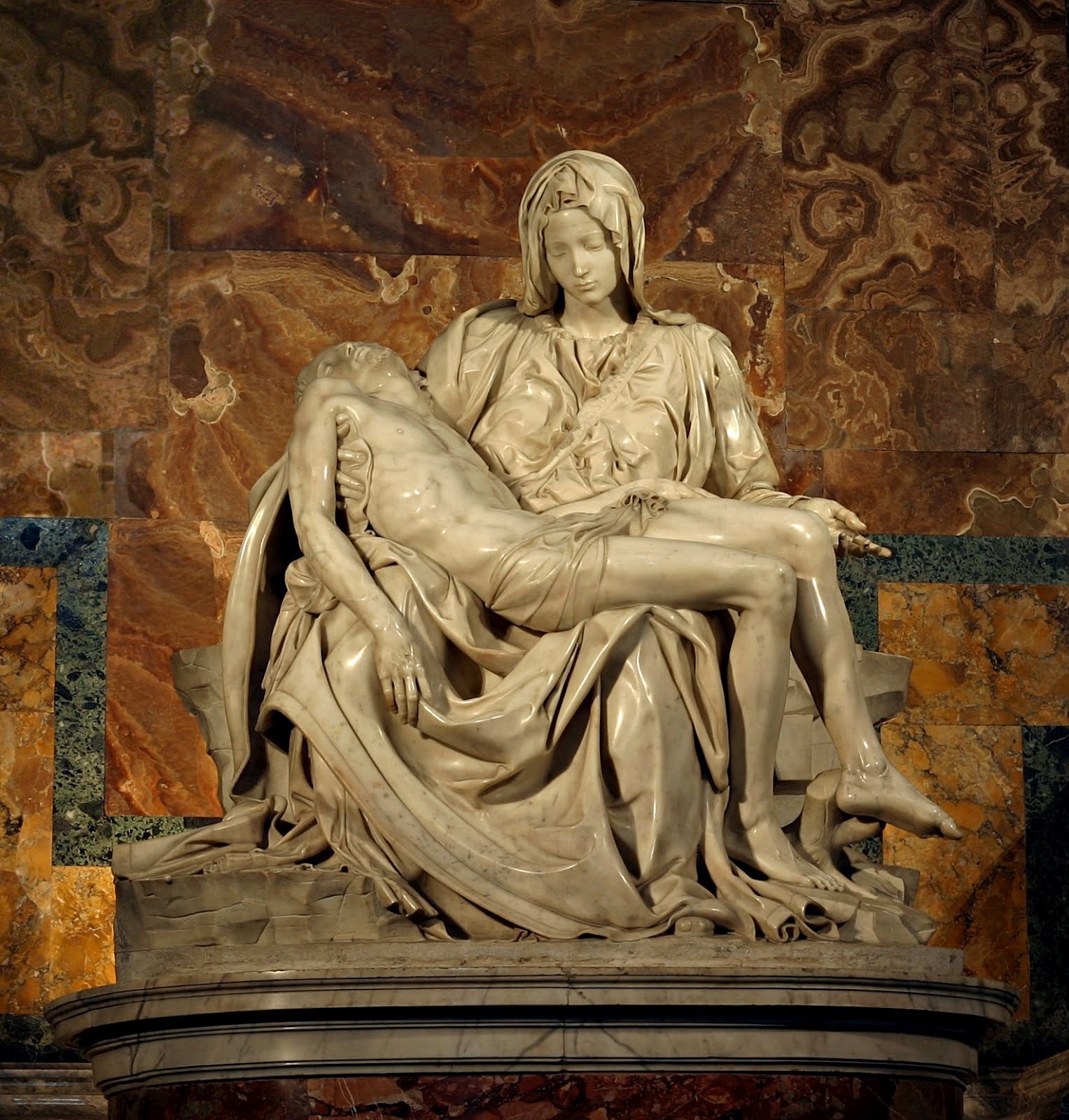
Jesus is taken from the cross. He lies over his mother's lap, a weight pulling her off balance as in the last days before his birth. She who held God within her is left holding only hope in her raw, gaping heart.


The Passion never fails to pull me off balance. Eighteen Easter's ago I was enormously pregnant, unbalanced, unwieldy, unsure. We eagerly hold up hope in the Incarnation, gazing on the child lifted from his mother's womb, but to see hope in this weight Mary balances for us is a pure, unadulterated grace, one we can hardly bear to pray for, for it is a sight we can hardly bear to behold.


Meditation is from the feature published in the March issue of the Catholic Standard & Times. Follow the meditations under the tab above: Via Crucis: Meditation on the Passion.

Image is from Wikimedia. Used under a Creative Commons license.

Thursday, April 05, 2012

Via Crucis XII: The Word is silent


Jesus dies. The same breath that rippled over the waters at Creation ceases. The earth heaves, the heavens turn away their face, all creation groans.


In a comment here, Robin writes of the dissonance many who mourn feel around Easter. Twenty-five years ago, my Lenten fast slid directly into Easter. In a dining room abuzz with laughter and packed with pastel clad Easter outfits, I struggled to swallow the bowl of strawberries my sister had brought back from the buffet for me. I couldn't hold both realities in my mind — death and resurrection — and so my response to the spiritual discord was physical. If it was still Lent, if I were still fasting, maybe none of this had happened.

In this moment of extraordinary dissonance: the Word that brought the world into being, that sustained it with the breath of the Spirit, has died, is silent for this unendurable moment. Jesus is dead. Yet God stands firm from eternity. Rock and fortress, immutable. I cannot help but think the response was physical. The very earth heaved, the universe convulsed, unable to bear the distance between the two realities.


Meditation is from the feature published in the March issue of the Catholic Standard & Times. Follow the meditations under the tab above: Via Crucis: Meditation on the Passion.

Photo is from carulmare at Flickr. Used under a Creative Commons license.

Wednesday, April 04, 2012

Via Crucis XI: Terrible Grace


Jesus is crucified. Can I beg for the terrible grace to see the hammer I hold ready in my hands? Can I bear the awful knowledge that what is poured out here, washes me clean?


Clarity can be a terrible grace. To see ourselves as we are, to appreciate the wonder of our being, and the ravages wreaked by sin, both can be difficult graces to seek. Walter Wangerin writes evocatively of the dangerous and difficult mirror the Passion holds up for us. There is the obvious sense in which we see in the Passion how the damage sin has wrought spreads out to encompass even the most innocent. Sin and death intertwined, cruelly and bluntly staked out for all to see on a hill in Jerusalem.

If we can scrape off the grime that clouds our eyes when we look at Jesus' death, we might comprehend that the best of ourselves also hangs before us. Frightened, seemingly abandoned by the Father, taunted, Jesus — fully God — could have at any point declared an end to the proceedings. Walked off the cross in a blaze of glory, in a miracle that might have brought all of Jerusalem to its knees. Instead, fully human, he showed us what we could be, what we could endure, and why. That in powerlessness lies our ultimate strength.

Can I endure the knowledge, not only that I have sinned, but that I am so cherished, so wondrously made, that God-made-man would walk into the torrents of the passion as a man, endure such a death as one of us, so that I might be fully alive? So that each of us might live?


Meditation is from the feature published in the March issue of the Catholic Standard & Times. Follow the meditations under the tab above: Via Crucis: Meditation on the Passion.

Friday, March 30, 2012

Via Crucis X: There is nothing left to us


Jesus is stripped of his garments. There is nothing left to us but our naked faith that this is the Son of Man, the King of Glory, the Savior of the World.


I was struck in listening to the Passion today by the line in Mark's account: "And when they had mocked him, they stripped him of the purple cloak, dressed him in his own clothes, and led him out to crucify him." I came home this week from giving a talk, dressed in good clothes and nice shoes, and couldn't wait to get back into 'my own clothes' — my comfortable cords and a turtleneck, my feet cuddled in warm socks and clogs. Somehow this line brought out the dissonance of the crucifixion, following so close upon the triumphal entry into Jerusalem, and the joy of the Passover celebration. They dressed him in his clothes, which brought not comfort, but pain.

Twenty-five years ago on Palm Sunday, I turned 29. Spring was bursting forth, the weather unseasonably warm, and Tom dragged me out to play tennis and to enjoy the day. Hope, security, joy, warmth, life welling up and out. But I was about to be stripped of all these comforts, of any illusion of safety and left clinging to God by my fingernails.


Photo of the 10th station is from St. John the Baptist in Bennington, Vermont.


Meditation is from the feature published in the March issue of the Catholic Standard & Times. Follow the meditations under the tab above: Via Crucis: Meditation on the Passion.

Tuesday, March 27, 2012

Via Crucis IX: The taste of dust


Jesus falls the third time. The taste of dust, the dry taste of death, the very stuff of life. God-made-man lies stretched out in the dirt from which we were fashioned, that we might be created anew.


Meditation is from the feature published in the March issue of the Catholic Standard & Times. Follow the meditations under the tab above: Via Crucis: Meditation on the Passion.


Image is of a watercolor of the Ninth Station of the Cross, © Carolyn Gates. Used with permission. More information about Carolyn Gates and her work.

Saturday, March 24, 2012

Via Crucis VIII: That our tears might soak the ground


Jesus meets the daughters of Jerusalem. Weep; weep that our tears might soak the ground until this dry and barren land can once again sustain life.

The gift of tears in prayer was one that the desert fathers cherished and that the Eastern tradition continues to acknowledge (the purpose of the tassel on the end of an Orthodox prayer rope is to soak up the tears of one's prayer, for instance). In Ignatius' day, ardent Jesuits hoped for the gift of tears, though as Ignatius, graced at times with this gift, notes in a letter, be careful what you pray for, it might more difficult than you anticipate. Modern mystics who, as Ignatius puts it, "melt into tears," might be a bit more disconcerted than their medieval counterparts. Gabriel Bunge OSB writes beautifully about this gift, set into the context of the desert fathers and mothers, in In Earthern Vessels, while Mike Hayes of Googling God reflects on his open experiences here.

Meditation is from the feature published in the March issue of the Catholic Standard & Times. Follow the meditations under the tab above: Via Crucis: Meditation on the Passion.


To see a detail from the luminous Stations of the Cross at St. Basil's Chapel at the University of Houston, see here.