Midnight prayers strangely incline God's favor. I admit to an affinity for prayer in the middle of the night, in the hours that are still and quiet. A monastic enclosure of time, rather than space, bounded by the light and the darkness.
We are without power after Hurricane Sandy swept through last night, and expect to be for a couple of days more. We are lucky; there is no damage to the house, and we have food, a way to cook and the enormous blessing of hot water. I am writing this by the light of a flashlight, diffused through a glass of water, in a house bereft of the hum of the refrigerator, or the whirring of the furnace fan. The winds have ceased and even the rain is so quiet I cannot hear it on the roof. It's the gift of a temporary hermitage.
Still and silent as these night times of prayer may be, it does not necessarily follow that they are always serene. Jacob isn't the only one who wrestles with angels in the night. Last week I spent a night of prayer that was anything but serene. What does it mean to pray on the sharp edge of "now" -- not of what has been, not of what might be, but present to this very moment? The Boy was missing (or at least I thought he was, turns out he was in his bed), and I prayed, in that painful space of uncertainty.
I was hugely relieved when Chris called at 6:40 am to let me know he was fine, but relief notwithstanding, the experience — along with Robin's sermons on Job — has permeated my prayer since. You can read some of what I'm thinking in this piece posted at This Ignatian Life, or better yet, you can do as I did in prayer last night, contemplate Marilyn Nelson's poem Matins (2:30 am) which explores these same landscapes of anxiety and poverty of spirit.
I love the ambiguity of her penultimate lines:
...
or how to spell relief.
Jesus. I must be the smallest
grain of the salt of the earth.
Tenet insanabile multo scribendi cacoethes
An inveterate and incurable itch for writing besets many
Tuesday, October 30, 2012
Sunday, October 28, 2012
Grateful to be seated
I did the exercise that was suggested, then set to preparing for a talk that was I giving to celebrate my appointment to a named chair. I made the usual acknowledgements slide — a formal list of collaborators and funding sources for the projects I'd spoken about. But as I looked at it, it seemed like not quite enough for this occasion. And so I started typing. A list of everyone I could think of who had encouraged and supported my work as a scholar of chemistry and as a writer. Family and friends and teachers and editors and readers and collaborators. A litany of gratitude....
Saturday, October 27, 2012
The Perfect Storm
Friday morning, between meeting one and meeting two, one of my colleagues (who is teaching the other section of the intro chemistry course) casually inquires, "So what are you going to do about the hurricane and your class on Monday?"
"The WHAT?"
Somehow I had completely missed the news that Hurricane Sandy is headed our way. The current track is expected to put the eye of the storm directly over us sometime Monday night.
Time to practice looking up again?
1. The wall here is metaphorical. Unlike last week where the wall was literally the floor. My knee has turned amazing colors, my face did not (for which I am quite grateful!). The knee may need a consultation with my orthopedist, but as long as I'm judicious about it, it works. And as of yesterday, I have my glasses back, repaired and beautiful. The guys at the little optical shop are amazing. No charge.
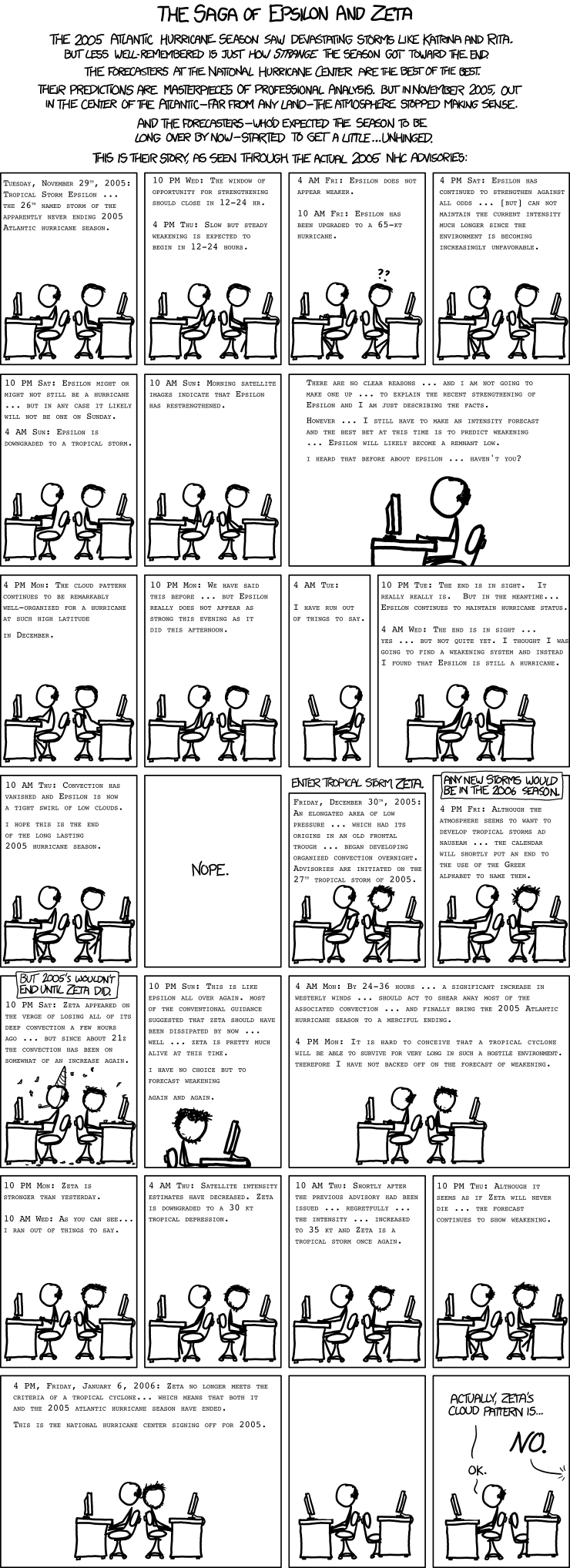
The type is too small to read in this form, but you can read this XKCD here which recounts (via acutal quotes from the NWS forecast discussions) the life cycles of two late season hurricanes. Best line: "There are no clear reasons...and I'm not going to make one up...to explain the recent strengthening of Epsilon and I am just giving the facts...However, I still have to give an intensity forecast...and the best best is that Epsilon will become a remnant low. I've heard that before about Epsilon, haven't you?"
I'm enough of a weather junky (if you haven't discovered the forecast discussions, where the weather wizards let down their hair, might I recommend them?) to remember reading these updates on Epsilon and Zeta.
Wednesday, October 17, 2012
Fall break
I had a fall. My glasses broke (but I think nothing else). It's fall break. And I had other plans.
I was headed out to run an errand, and wanted to pop my head into Math Man's study to tell him that I'd be back in 30 minutes or so and then we could go for a walk on this gloriously crisp fall day. I was thinking of a walk years before, one of our first dates, on a day much like this one.
Distracted, I somehow caught my foot on the step up from the sunroom and lost my balance. Suddenly I was falling and falling hard. In the brief moment before I hit I thought about two friends, one who'd fallen hard on her wrist and another who'd just had her hip replaced. And pulled my hands in and tried to roll. My knee slammed into the step, then my face hit the floor.
Math Man is now crouched on the floor next to me. My veteran-of-five-surgeries knee is shrieking in panic. I have no desire to get up. None. I don't even want to entertain the notion of looking at the damages. I think I'll just wait until the pain subsides. Except it doesn't. I finally figure we should look at the damages. Math Man hands my glasses to me, and I put them on, and the world tilts. Why can't I see out of my left eye? Panic rises until my slightly rattled brain figures out that the frame had broken and the lens had fallen out.
So I spent the remains of the afternoon with my leg propped up and ice on my face and foot and knee. The Boy drove me to our wonderful optical shop where they allowed they could probably fix my spectacles given a couple of days. I dug out a back up pair and I can see clearly again. The rest of the damages might take a bit longer to mend.
Oh...and Monday? I'm giving a lecture at the college to celebrate an award I got in May. Various friends are coming from off campus. The black eye that looks to be blossoming will be just the accessory I was looking for...
Sunday, October 14, 2012
The texture of a silence
A couple of weeks ago, PrayTell had a thought-provoking post on cognitive engagement and liturgy, based on a comparison between an experience of a Dominican rite liturgy in Latin and the current ordinary Roman Rite. Fritz Bauerschmidt's final questions offer, at least in my opinion, an implicit definition of excellent liturgy: "Can we craft liturgy that is clearly both something we do and something that sweeps us up in a movement quite independent of our efforts? Can our liturgy be intelligible without being mentally taxing? Can it be mysterious without being mystifying? Or is the quest for such a liturgy just tilting at windmills. I, for one, certainly hope not."
There was some suggestions in the comments that the old Latin masses (what these days is called the extraordinary form) were inherently more reverent and perhaps more silent. I responded to one such with by noting what I see as a tendency to conflate “contemplative/mystical” with the extraordinary form and “noisy/didactic” with the ordinary Roman rite.
Fr. Allen McDonald replied that "The silence of the EF Mass is different than the silences that should be observed in the OF such as before the penitential act, after the readings, the homily and Holy Communion." These are "silences just for the sake of silence"1 rather than silences which emerge from a properly prepared congregation contemplating "official prayers of the Church being prayed in a silent way."
I'm going to admit that I'm a bit put off by his characterization of the Eucharist as a contemplation (by the properly disposed) of someone else praying and gesturing in prayer. I say this even in the face of a memorable retreat where my own prayer was certainly sustained by meditating on the stalwart prayer of the sisters around me in the chapel.
That said, I'm grateful as his comments have made me attentive to the nature of the silence during Mass in my parish over the last two weeks. Silence is not what my community does because we should, it is our default stance in the celebration of the Eucharist, you can hear it (or rather not hear it) even between the words of the prayers. It's a silence that feels, in fact, not of our doing at all, but part and parcel of our being. Be still — let go your grasp — and know that I am God. (Ps 46:10) Here, at the Eucharistic table, we find ourselves in such intimate communion with God we cannot help but know that, and respond in kind. I think this might be what Fritz Bauerschmidt is getting at with his description of being swept into a mystery, where our own responses swell into the stillness and fade, where the presider's prayers cascade down the altar steps and wash over us, the chant swirls up and out, but all of it, ever and always pouring into a silence whose depth and breadth and height knows no bounds. Be still — be silent — and know that I am God.
1. Sacred silence in the Roman Missal, according to the GIRM, is not just for the sake of silence, but has a variety of purposes: "For in the Penitential Act and again after the invitation to pray, individuals recollect themselves; whereas after a reading or after the Homily, all meditate briefly on what they have heard; then after Communion, they praise God in their hearts and pray to him."
Photo is of the door to the chapel at the old Jesuit novitiate. A place that has held within its share of silent prayer and more...
Subscribe to:
Posts (Atom)