Showing posts with label Japan. Show all posts

Tuesday, May 04, 2021

Eat Sleep Sit


It arrived in the mail last week, an envelope with a single used book, carefully wrapped in brown paper, inside. Eat Sleep Sit, Kaoru Nonomura's account of a year of training at the Zen monastery Eiheiji. I had ordered a used copy weeks ago, though I could have gotten the electronic version in an instant.

I'm glad I waited, the physical book is beautifully bound, it lies open in my lap without the need to hold it. Printed in Japan in 2009, the typesetting is plain and spacious. It is a joy to read. Why are hardbacks so often glued rather than sewn? I know, money. But this is such a small and delightful luxury.

The book itself is reminding me of Nancy Maguire’s Infinity of Little Hours, which follows Carthusian novices through their first years and early training. 


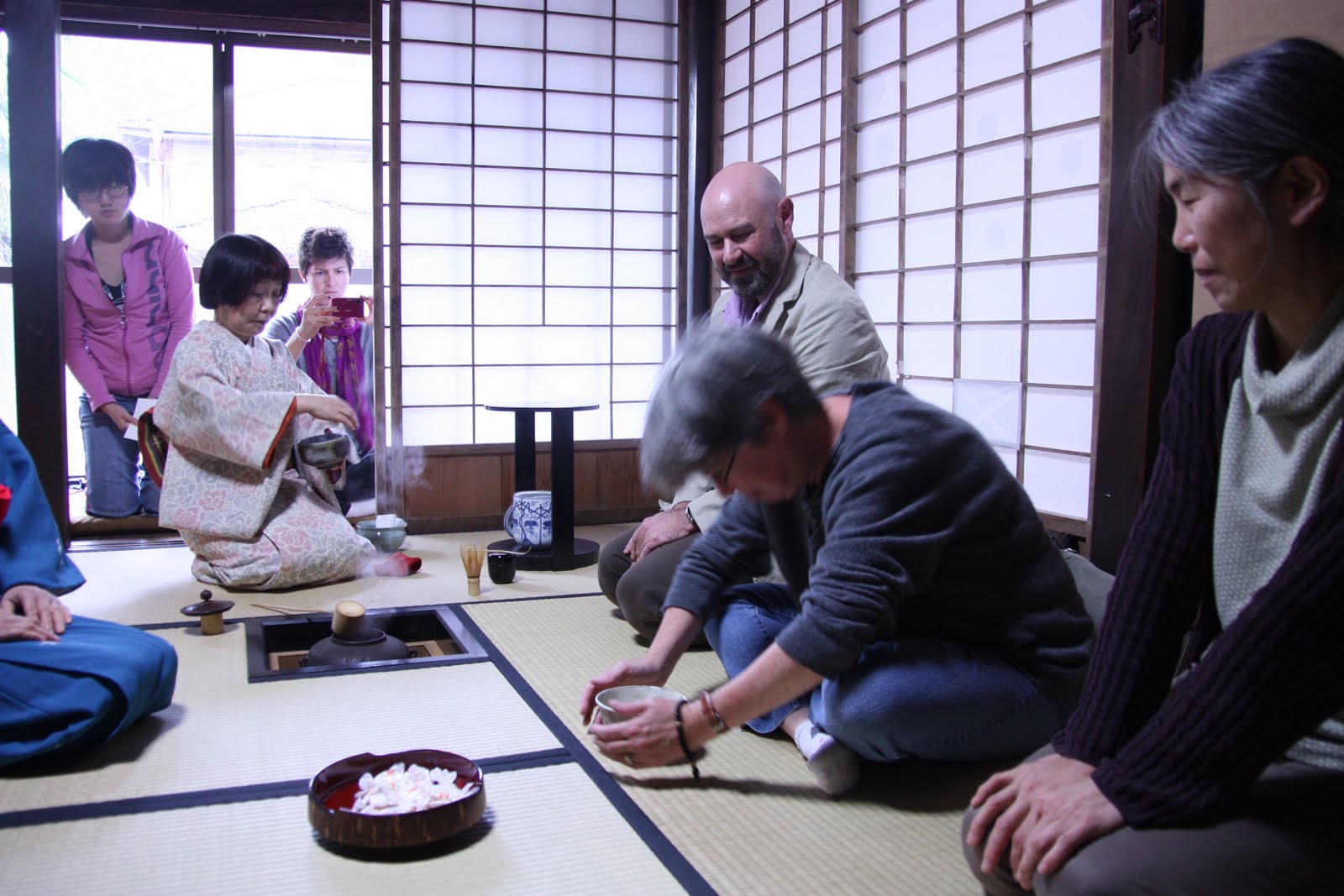
Photo is of monk Thomas Yūhō Kirchner, in the old training hall at Tenryu-ji, in Kyoto. I visited with a class in 2016.

Monday, July 23, 2018

A scholar's mug

One of the two yunomi from St. John's pottery.
Not the scholar's mug!
A few years ago I spent a few days on retreat at St. John's Abbey in Minnesota. In many ways St. John's resembles a medieval monastic enclave. There are bees, a woodworking shop that provides the furnishings for the college, a library, a guest house and a pottery. And a post office, but that sounds pretty modern. 

Caught out in a walk by a sudden thunderstorm, I ducked into the pottery.  There was a fire, there was tea. I spoke with the potters, learned about the huge wood burning kiln named Joanna that is fired but once a year, traded stories of travel in Japan. And I bought two yunomi (tea mugs), one that clearly shows the hands of the potter on it, and another, called a scholar's mug, rougher and clearly marked by the ashes of the kiln.

The first time I used the scholar's mug, I filled it generously and carried it to the table where I was writing.  I absentmindedly picked it up to take a sip, to find the cup too hot to handle.  Ouch!  I left it to cool. The next time I made tea, I made a collar for the mug using a furoshiki, like those you get at a coffee bar.  I quickly got better at folding either a small furoshiki or a thick paper towel to use.

It took almost a week for me to discover the trick of the scholar's mug. Fill it half full. The tea stayed warm, the top cool enough to comfortably hold.  It made me get up to refill it, to stretch at more regular intervals.

This is a true story. And a parable.

Tuesday, August 22, 2017

Angels in glass

From a old column for CatholicPhilly

Stair treads in Hiroshi Sugimoto's installation, at the restored Go'o 
Shrine on Naoshima, Japan. c. Michelle Francl
No one lingered after the 12:10 Mass. The breezes that spun through the open stained glass windows whispered of an August day too wondrously crisp and cool to be inside.

“What can I do to help you get out sooner?” I asked the sacristan.

“Could you close the windows?”

I found the pole and started down the south aisle. The light streamed through the canted stained glass, and I paused for a minute to read the names inscribed along the bottom of each century-old pane.  “William and Margaret White” under St. Patrick and St. Bridget; the Ancient Order of Hibernians made a gift of St. Rita and St. Nicholas of Tolentine.

Each window gently puffed as I swung it closed. “Peace be with you” they seemed to say, blessing me over and over again as I worked my way around the periphery of the sanctuary.

I am reminded of a line from Sainte-Chappelle by Eric Whitacre, a choral composer famous for his intricate a cappella works: Et angeli in vitro molliter cantaverunt.  “And the angels in the glass softly sang.”  Whitacre’s piece tells the story of a young girl visiting Sainte Chappelle, a medieval gothic church in Paris renowned for its striking stained glass windows.

The girl hears the angels in the windows softly singing “Sanctus, sanctus.” Her voice and theirs twine until the light itself sings, “Lord God of Hosts, heaven and earth are full of your glory.”  The score is crystalline, I can hear the dust motes dance in the light that streams through the windows, the stone walls of the church itself sing.

Even a silent chapel has something to say to us. The design of a church is meant to both speak to us of God’s saving work and to encourage us to speak to God in return. Images, whether frescos or stained glass windows, facilitate these conversations.

St. John Damascene, an eighth century Syrian monk, wrote that holy images move him “to contemplation, as a meadow delights the eyes and subtly infuses the soul with the glory of God.” The Catechism of the Catholic Church reminds us that light and darkness speak to us of God [1147].

Stained glass windows sing to us of the company of faith to which we belong: the angels, the saints, the artists who take light and darkness and bend them into a shape that moves us closer to God, the people who supported these artists financially and in prayer as they worked.

Next time you find yourself in a quiet church, see if you can hear the soft voices of the angels and saints in the glass singing, then join your voice with theirs in hymns of praise, thanksgiving and supplication.  Et lumen canit.  For the Light sings.

________

Read the story of the angels in glass (as sung in the Latin or the English translation) here.

Listen to Eric Whitacre talk about the composition of Sainte-Chappelle (along with some snippets of the music).

Take a virtual tour of the Sainte Chappelle sanctuary.

Monday, April 03, 2017

Playing poetry ping-pong

Renga is a 15th century Japanese collaborative poetry form. The kick-off poet writes a hokku (three lines, 5-7-5 syllables each, what we now call a haiku), the next poet adds two 7 syllable lines.  The third poet takes the 2 lines and adds a 5/7/5 set of verses.  And so on...see this example taken from Miner's book Japanese Linked Poetry.  

Renga can be serious or funny (haikai no renga), but the game is not so much as to follow a single through line in the imagery, but to link and shift.  I enjoy the ways in which the shifts can make me blink, and tsukeai, unusual and evocative juxtapositions of words.

One way to play this sort of linked verse game is to write a series of 5/7/5 verses, each one starting with the last line of the previous.  A friend shared the hokku for a recent renga he had started:
without my glasses
i’m groping trying to find
where my glasses are
If I'd been in the game, I might have responded with
where my glasses are
smudged by thoughts I cannot catch
I see drops of grace 
Anyone is welcome to play!

Saturday, January 23, 2016

Winter tea: the scholar's mug

Summer yunomi on patio
at Collegeville Institute
Two summers ago I spent a week at the Collegeville Institute at a workshop on memoir.  The week before I spent time at the St. John's Abbey guesthouse, on a quiet retreat.  I took long walks, (mostly) timed to miss the thunderstorms.  One afternoon rain arrived before I was well back from my walk, so I ducked into the Abbey pottery, where a tea table, with sand and a charcoal brazier was set and ready to share with guests.  I had a cup of tea and enjoyed a delightful conversation with the artist in residence about Japan.

I bought two yunomi (the taller than they are wide Japanese everyday tea cups)  — a summer one and a winter one) — fired in the Abbey's wood kiln.  You can see the marks of the flames on the winter cup, which the potter named the "scholar's mug," and every time I drink from it I think of the abbey's hospitality and Abba Joseph, his hands aflame.

I quickly learned not to fill the handleless mug all the way with tea, the ceramic quickly becomes too hot to lift.  It's a lesson I keep re-learning, as I am tempted to add just a tad more in hopes of not having to return to the kitchen for a refill as often.

As I return to the classroom after my sabbatical, my scholar's mug reminds me not to fill my days or calendar too full.  It's a lesson I have to keep re-learning here, too.  Somehow I have three classes, in different parts of the building, in very different parts of the curriculum (an introductory class, a graduate class, a major's upper division class), scheduled back to back and through lunch.  By the end of the day on Wednesday my metaphorical mug was too hot to handle.

Every day, I begin again.

Friday, October 18, 2013

Sounds of Japan: The Jesuit Bell at Shunko-in


Two years ago when my students and I traveled to Japan we visited Shunkō-in, a monastic cloister within the Myōshin-ji temple complex at the edge of Kyoto.  Shunkō-in hosts Zen meditation instruction in English, our reason for visiting, but also houses the bell rescued from the Jesuit church when it was destroyed in 1587.

We stayed two nights at the temple this year, once again getting instruction in Zen meditation from the vice-abbot whose voice you hear in the video clip.  We also enjoyed his tour of the cloister, including a chance to hear the bell, to see where it had been buried by his grandfather to keep it from being melted down during the second World War, and to learn a bit more about the ways to view Zen gardens (sit down inside, rather than stand on the porch, a perspective which I noted did enhance the sense of borrowed landscape, the way in which things outside of the garden seem to become an integral part of its composition).


A post about the bell written for the feast of Paul Miki and his companions last year.

Thursday, October 17, 2013

A Tale of Gaijin

Murasaki Shikibu (Hiroshige II)
The Tale of Genji is considered by many scholars to be one of the earliest known examples of a novel.  Written by Murasaki Shikibu, the psuedonym of a woman at the Japanese imperial court in the 10th century, Genji's adventures sprawl across time and space, occupying 6 volumes in English translation and covering several generations.  Think Game of Thrones, but warmer.

Our adventures in Japan were more limited in scope, though we did see several spots mentioned in the Tale.

I blogged the trip for the college, so if you want to read the story of the travels, here is a list and links:

Kyoto:  
Dawn Departures (Bryn Mawr to Kyoto in 26 hours)
Mizu, Yuzu and Mitsu (shrines filled with water, hot sun, honey and citrus)
Borrowed Landscapes (dry gardens, the stick of compassion)
Sitting Zazen (talking with a Zen monk about the desert fathers, temples and gardens)
Bamboo and Bento (the bamboo forest and bentos on a bus)

Kumano:  
Rough travel (climbing a mountain - sans a path - and esoteric Buddhism)

Koyasan:  
Koya-san (10th century Buddhist monastic city)
On the Women's Trail (women weren't allowed until the end of the 19th century, but circled the mountain on this trail)
Spaces in translation (Would you believe 5 different trains, a bus, a fleet of taxis and a ferry?  We moved from Koya to Kamikatsu)

Kamikatsu:
In the news (in Japan!)
Fish Sticks (Nakamura-san and the charcoal maker)
Bound in (visiting Nakamura's hermitage, binding books)
Cave meditations (the zero waste village, meditating in a cave, Japanese hot springs)

And yes, all the towns and cities we stayed in began with "k"....except for Osaka and that installment isn't quite up yet.

I look at the list and suddenly am not suprised to be as tired as I am.

Gaijin are foreigners...


Friday, August 02, 2013

Light from light


The Boy spent today visiting two colleges in LA near my brother The Artiste. He had an interview, an information session and a tour at each. The (always very independent) Boy and Crash went to the information sessions and took the tours, while Math Man and I wandered around the campuses, checking out the science buildings. I saw a sign pointing the way toward a James Turrell Skyscape and got excited.

I had seen some of Turrell's work in Japan two years ago. The interplay of light with light in Turrell's work is breathtakingly beautiful (perhaps literally, to view one of the pieces in his current exhibit at the LA County Museum of Art you must sign a waiver  that you understand the potential health hazards in viewing). The solidity of some of the forms Turrell creates from light fascinates my quantum mechanical persona. Matter is not as solid as you think, you can diffract electrons and helium atoms — they act as if they are light. You can write a wave equation to describe molecules, just like light. Turrell makes the case that light is more solid than you think. Maybe I will take my quantum mechanics class on a field trip to the Guggenheim in NYC before the exhibit there closes.

The Skyscape installation at Pomona runs every morning beginning 100 minutes before sunrise (and again at sunset, starting about half an hour before the sun sets). The sky is framed above water, and you sight and contemplate the deep blue plane that seems to be suspended over your head. It's contemplative, slowly unfolding. It fosters patient attention.

This afternoon we're off to see the Turrell exhibit at LACMA.

Tuesday, October 02, 2012

Reflecting on reflecting with Ignatius: writing on teaching

My harvest of limes in Kamikatsu, Japan
Last year at this time I was in Japan with a group of students from the college's 360o program. Today, an essay I wrote reflecting on the experience we had reflecting with our students about the structure of the course appeared — framed loosely around Ignatian repetition and his notion of the Examen.

You can find the essay here.  (Click on the photo to see the full text.)

Monday, June 18, 2012

Symbiots


Last spring a group of students and another faculty member and I made a monthly transect of the campus, walking the same rough line from its staid southern border standing shoulder to shoulder with two private schools to the muddy hillside of brambles that marks its northernmost point. Our tramp took us past the theater, Goodhart, where the early 20th century snowflakes on the facade faintly foreshadowed a magnificent colony of lichen that decorates the fence surrounding the next touch point, the college's pond.

The pond reminded me in many ways of the Moss Temple outside Kyoto I visited last year. The constructed water feature, deliberated shaped, now shaped in turn by what it contains. The beautiful garden of lichen growing on the fence that rings it, themselves containers shaped by an invisible, ongoing dance. Fungi and bacteria well wed, presenting to us as one, the history of their marriage obscured.


There is something apt about lichen growing at a liberal arts college for women. Beatrix Potter, beloved for her tales of Peter Rabbit, was the biologist who first twigged to the hidden duality. In 1897 her paper to that effect was read at the Linnean Society. In thos days, being male trumped being a biologist, so a chemist (her uncle) read her paper, and responded to questions.

Potter was a field biologist who wrote children's books. I wonder how symbiotic her two natures were. Were they as well wed as her beloved lichens? I wonder how many women still take on the lichens' sensibilities, multiple organisms bound into one, inseparable, yet not quite indistinguishable. How well wed are my personae?

Thursday, February 09, 2012

The Jesuit Bell in the Zen Temple: Interfaith grounds


Monday was the feast of Paul Miki and companions, martyrs for the faith in 16th century Japan. The Jesuit homilist gave a brief description of the group, who were marched hundreds of miles from Kyoto to Nagasaki in the winter. In addition to Paul Miki and two other Jesuits, six Franciscan priests and a number of lay people, including some children (altar servers according to one account I read) were crucified on February 6th in Nagasaki, preaching and praying up to the last. Catholicism went underground in Japan for the next two centuries, there were several hundred thousand Catholics still practicing their faith when the Church officially returned in 1867.

I knew the story, but for the first time had a visceral connection. When I was in Kyoto last fall, we visited Shunko-in, a Zen Buddhist temple founded in 1590. The temple has the bell that hung in the first Catholic Church in Japan, Nanban-ji founded in 1576 by the Jesuits. The temple kept the bell safe not only through this first persecution, but the abbot (the grandfather of the current vice-abbot) hid it again when the authorities would have confiscated it to melt down for weapons in WW II.

The vice-abbot showed us the bell and rang it for us after we told him that our first trip had been to a Jesuit retreat house. He also showed us some of the hidden Christian symbols in the gardens and on some of the screens. We often tend to think of interfaith relations as trying to find common ground or trying to convince the ground on one side or the other to shift. Here one faith enfolded and protected the other, giving ground for a seed to remain rooted.

Friday, January 27, 2012

Writing prompts


lichen
Beatrix Potter
children's literature
windy
Mary Poppins
umbrellas

I am prompted to recall that my umbrella is still at English House, where I had been writing.


Photo is of my umbrella in Kyoto. And properly prompted, I once again I am in possession of it.

Tuesday, December 13, 2011

The wind in the pines


In Japan the class visited the local tea teacher in Kamikatsu where we got a taste of the formal tea ceremony. She talked about setting up the kettle on the coals so that when the water came to the boil it made a gentle rustling noise - which she said was meant to sound like the wind in the pines.

I love the sound of the wind in the dried leaves at this time of year, rustling about above me as I walk in the evening. Even in the cold, dark and dry days of winter, there is a sense of purpose and energy in that sound. Life stirs even in the depths of winter.

It's the time of year when I too often run on short sleep rations (despite my best intentions). As a result, a cup of strong, sweet tea can be an enormous grace. Yesterday visitors came and went in my office. Quantum mechanics. Mysticism. (Yes, at the moment these are not the same topic in my office - which is not to say that I don't have some mystified quantum students.) Collegial errands. As I tried to gather the final bits for a talk I gave this afternoon in Washington, DC, I put the kettle on to boil.

I turned to my computer to pull another thread into the talk. Something kept tugging at the edge of my awareness. What is that gentle tinkling noise, too melodic to be a rattle? Window is secure. No one is knocking on the door (for the moment)....

The vibrations from the kettle are just enough to make the glass sugar jar jiggle the tea pot, with the resulting delighful sound. Grace's whispers.

Sunday, November 06, 2011

Column: Cold and Chill, Bless the Lord


Dean Brackley, S.J. died recently, my director shared with me a short excerpt from "Call to Discernment in Troubled Times" when I made the Exercises. It struck such a chord that when I returned home, it was one of the first books I read. I heard Jane Hirshfield read "A Cedary Fragrance" a couple of weeks ago at a conference where we were both speaking.

As warm as the light looks in the photo, you could see your breath!

This column appeared in the Catholic Standard & Times on 27 October 2011.

Cold and chill, bless the Lord; praise and exalt him above all forever. Daniel 3:67

As the gong in the courtyard rang to summon stragglers to morning services, the thermometer in the first floor corridor read 10 C, which made it feel chillier than the 50 F it was. I wrapped my shawl more securely around my shoulders and hoped the dining room tucked deep inside the walls would be a shade warmer.

A dozen of my students and I were staying in a Buddhist monastery tucked into a half-mile high mountain valley south of Osaka. Shojoshin-in was founded almost 1200 years ago, so the lack of central heating is hardly surprising, but after Kyoto’s heat, my students shivered despite their layers, and the monks kindly conjured space heaters to take the chill off the long dormer in which they slept.

Trying not to be envious of the monk’s robes, I dug my faithful “Chemistry Chick” sweatshirt — which has kept me warm through many chilly nights of prayer — out of my bag and elected to go without heat. Cold and chill, could I bless the Lord?

Poet Jane Hirshfield spent many years in a similar unheated monastery, washing her face each morning in the stingingly cold water that was all the taps provided. In her poem, “A Cedary Fragrance”, she writes that she keeps to the practice still: “Not for discipline…but to practice choosing to make the unwanted wanted.”

In his Spiritual Exercises, St. Ignatius of Loyola pushes us to think about our desires for comfort and wealth. Do our preferences for warmth, for security, come between us and God? Can we greet with equanimity what comes, wanted or not, comfortable or not? Would we “want and choose poverty with Christ poor rather than riches”?

Most of the time, I have the luxury to not think about heat. Programmable thermostats and automatic hot water heaters keep me from shivering in the mornings. In Call to Discernment in Troubled Times, Dean Brackley, S.J. notes that this sort of insulated life, while it can free us to pursue great goods, has its risks. When we don’t have to struggle with hunger, disease, violence — or the cold — it can “induce in us a chronic low-grade confusion about what is really important in life.” Life and love.

Church father, Origen suggested in his commentary on the Gospel of Matthew that our small daily practices of asceticism and denial accumulate, that with them we weave a cloak for a cold and shivering Christ. They teach us where to look for Christ. In those who hunger, who thirst, who are cold, who are poor. They sharpen our awareness of need around us, opening us in Christ to a generosity of heart.

I struggled off and on with the cold during our stay, aware that while this small frisson of discomfort was a choice for me, for most of the world, it is not. Last Sunday, as Morning Prayer’s lines of praise tumbled off the page — Cold and chill, bless the Lord — I wondered again if I could bless the Lord if cold and chill were imposed, not elected. I’m still practicing making the unwanted, wanted.


Touch my heart with this grace, O Lord. When I reach out in joy or in sorrow for the things of this world, grant that through them I may know and love You, their Maker and final home. — Karl Rahner, S.J. In “God of My Daily Routine”

Monday, October 10, 2011

Missing

I feel like I've lived through Monday twice (which I have, or at least through a Monday that lasted 36 hours). We left the hotel near Kansai Airport about 10:30 on Monday (Kansai time) and arrived at JFK at 1 pm on Monday (EDT). It took us another 2 hours to get all the students cleared through immigration (it's slow for non-citizens), collect bags, and rent two vans. And then there was still a 2 hour drive home (with a van full of sleeping students, very quiet!).

It was lovely to land and find text messages from The Boy and Math Man greeting me. I've missed them, and Crash and Fluffy. The Boy made his amazing pasta for dinner tonight, a perfect welcome home meal.


What else I missed (yes, I've noticed it's all food):
  • The Boy's pasta
  • Chocolate (I haven't eaten ANY since September 25th)
  • Pizza
  • Meat (most of my meals were meatless)
  • Apples (lots of citrus and Asian pears)
There's food for thought here....


Photo is of baskets at Nakamura's house in the mountains above Kamikatsu.

Sunday, October 09, 2011

Tea kettles


I have a tea kettle in my office — but not in my floor. And not one that makes such a delightful noise when it comes to the boil. This hearth is set into the floor, there is a tiny charcoal fire underneath the cast iron tea pot and is hisses and burbles and sounds much like the wind through the pines. What I could use in my office is a mizusashi, a stoneware jar to keep extra water!

Saturday, October 08, 2011

Prayer, posture and tea


This is a photo of where I sat for morning prayer today, taken after I walked up the road, across the bridge and a few turns up the mountain road. Later in the day, I waded out to one of the rocks mid-river and sat, watching the water. It flowed like thick glass over the rocks; I was sure if I touched it, it would be solid. In other places it burbled like a spring, throwing up drops of water like popcorn, that danced and dazzled in the sunshine.


In the afternoon we visited the local tea teacher, who patiently and kindly led us through the tea ceremony. My knee will only let me briefly kneel in seiza position (back on your heels, with your big toes crossed and about 3" between your knees), and as a result I definitely felt out of kilter. It was awkward to bow, and harder to stay upright. I ended up sitting with my leg crossed, which isn't great for the knee either, but I couldn't figure out any other posture that would be remotely polite. Among other things I wondered about what we think of people in liturgical settings (and there are direct and deliberate parallels between the tea ceremony and Catholic liturgy) who are not in the "correct" posture. I can't genuflect for example, and so substitute a profound bow. How do (or even should) we read each other's posture in liturgy, and even in private prayer?

You can read the adventures of the whole crew here, it's hard to believe that tomorrow we will pack up the bus and make our way back to Kansai, with a short stop in Tokushima to have lunch and do any last shopping (we need another bag!).

Diffraction


I loved the patterns on the water, photographed from the bridge just upriver from where we are staying. The movement of each wave out from a clear center, their crisscrossing leading to constructive and destructive interference. Whose paths do I cross, how does what I do ripple out and interfere, positively or negatively?

Friday, October 07, 2011

Six Reasons Not to Lose Dr. Francl

Part of traveling with a group is counting -- have we lost anyone? The current running joke is that we can't lose me for various reasons. The current list of reasons not to misplace Dr. Francl:

1. She has the device to upload photos to your iPad.
2. She does IT support.
3. She has the snacks in her bag.
4. She has the wi-fi hot spot.
5. She has the money for ice cream.
6. She has the Benadyl and the Dramamine.

Grains of wisdom


Today we spent the morning working in a citrus orchard, picking fruit. What role does physical labor play in the contemplative life? In Koya-san the abbot Hideo told us the story of an older monk, who kept the strict rules of his sect, which do not permit any physical labor. One day when all his servants had the day off, he wandered around, hoping someone would refill his coffee cup.

The rice that I saw newly planted in the late spring is being harvested now, tied up to dry in the paddies.


The adventures of the crew are here.