Showing posts with label 360. Show all posts

Friday, October 18, 2013

Sounds of Japan: The Jesuit Bell at Shunko-in


Two years ago when my students and I traveled to Japan we visited Shunkō-in, a monastic cloister within the Myōshin-ji temple complex at the edge of Kyoto.  Shunkō-in hosts Zen meditation instruction in English, our reason for visiting, but also houses the bell rescued from the Jesuit church when it was destroyed in 1587.

We stayed two nights at the temple this year, once again getting instruction in Zen meditation from the vice-abbot whose voice you hear in the video clip.  We also enjoyed his tour of the cloister, including a chance to hear the bell, to see where it had been buried by his grandfather to keep it from being melted down during the second World War, and to learn a bit more about the ways to view Zen gardens (sit down inside, rather than stand on the porch, a perspective which I noted did enhance the sense of borrowed landscape, the way in which things outside of the garden seem to become an integral part of its composition).


A post about the bell written for the feast of Paul Miki and his companions last year.

Thursday, October 17, 2013

A Tale of Gaijin

Murasaki Shikibu (Hiroshige II)
The Tale of Genji is considered by many scholars to be one of the earliest known examples of a novel.  Written by Murasaki Shikibu, the psuedonym of a woman at the Japanese imperial court in the 10th century, Genji's adventures sprawl across time and space, occupying 6 volumes in English translation and covering several generations.  Think Game of Thrones, but warmer.

Our adventures in Japan were more limited in scope, though we did see several spots mentioned in the Tale.

I blogged the trip for the college, so if you want to read the story of the travels, here is a list and links:

Kyoto:  
Dawn Departures (Bryn Mawr to Kyoto in 26 hours)
Mizu, Yuzu and Mitsu (shrines filled with water, hot sun, honey and citrus)
Borrowed Landscapes (dry gardens, the stick of compassion)
Sitting Zazen (talking with a Zen monk about the desert fathers, temples and gardens)
Bamboo and Bento (the bamboo forest and bentos on a bus)

Kumano:  
Rough travel (climbing a mountain - sans a path - and esoteric Buddhism)

Koyasan:  
Koya-san (10th century Buddhist monastic city)
On the Women's Trail (women weren't allowed until the end of the 19th century, but circled the mountain on this trail)
Spaces in translation (Would you believe 5 different trains, a bus, a fleet of taxis and a ferry?  We moved from Koya to Kamikatsu)

Kamikatsu:
In the news (in Japan!)
Fish Sticks (Nakamura-san and the charcoal maker)
Bound in (visiting Nakamura's hermitage, binding books)
Cave meditations (the zero waste village, meditating in a cave, Japanese hot springs)

And yes, all the towns and cities we stayed in began with "k"....except for Osaka and that installment isn't quite up yet.

I look at the list and suddenly am not suprised to be as tired as I am.

Gaijin are foreigners...


Tuesday, October 02, 2012

Reflecting on reflecting with Ignatius: writing on teaching

My harvest of limes in Kamikatsu, Japan
Last year at this time I was in Japan with a group of students from the college's 360o program. Today, an essay I wrote reflecting on the experience we had reflecting with our students about the structure of the course appeared — framed loosely around Ignatian repetition and his notion of the Examen.

You can find the essay here.  (Click on the photo to see the full text.)

Wednesday, November 30, 2011

The practice of waiting


My contemplative class (whose traveling adventures were previously chronicled here) is reading and talking about Quakerism. We began class today by waiting until someone was moved to speak (we've spend enough time together in silence to be able to do this). We noted that it can be awkward to wait in this way. Will anyone talk? I found I had to remind myself to not talk merely to "coach" them along. Wait. Until. Someone is moved.

We spent some time talking about waiting, and its role in the contemplative life. Our last meeting had focussed on what constitutes obedience in the lay contemplative life — reading Madeleine Delbrel where she recommends using the vagaries of life to form oneself in obedience. At the end of class today I noted that one practice I use to foster patience is to let the person behind me in line at the supermarket go ahead of me. Particularly when it's really crowded. One of my students noted that just the thought made her anxious. "Me, too. That's why I keep practicing."

I'm writing about waiting for Advent...how do you practice waiting? or do you?


Jim McDermott, S.J. has some interesting thoughts about waiting on God, the Spiritual Exercises and Advent here.

Monday, October 10, 2011

Missing

I feel like I've lived through Monday twice (which I have, or at least through a Monday that lasted 36 hours). We left the hotel near Kansai Airport about 10:30 on Monday (Kansai time) and arrived at JFK at 1 pm on Monday (EDT). It took us another 2 hours to get all the students cleared through immigration (it's slow for non-citizens), collect bags, and rent two vans. And then there was still a 2 hour drive home (with a van full of sleeping students, very quiet!).

It was lovely to land and find text messages from The Boy and Math Man greeting me. I've missed them, and Crash and Fluffy. The Boy made his amazing pasta for dinner tonight, a perfect welcome home meal.


What else I missed (yes, I've noticed it's all food):
  • The Boy's pasta
  • Chocolate (I haven't eaten ANY since September 25th)
  • Pizza
  • Meat (most of my meals were meatless)
  • Apples (lots of citrus and Asian pears)
There's food for thought here....


Photo is of baskets at Nakamura's house in the mountains above Kamikatsu.

Saturday, October 08, 2011

Prayer, posture and tea


This is a photo of where I sat for morning prayer today, taken after I walked up the road, across the bridge and a few turns up the mountain road. Later in the day, I waded out to one of the rocks mid-river and sat, watching the water. It flowed like thick glass over the rocks; I was sure if I touched it, it would be solid. In other places it burbled like a spring, throwing up drops of water like popcorn, that danced and dazzled in the sunshine.


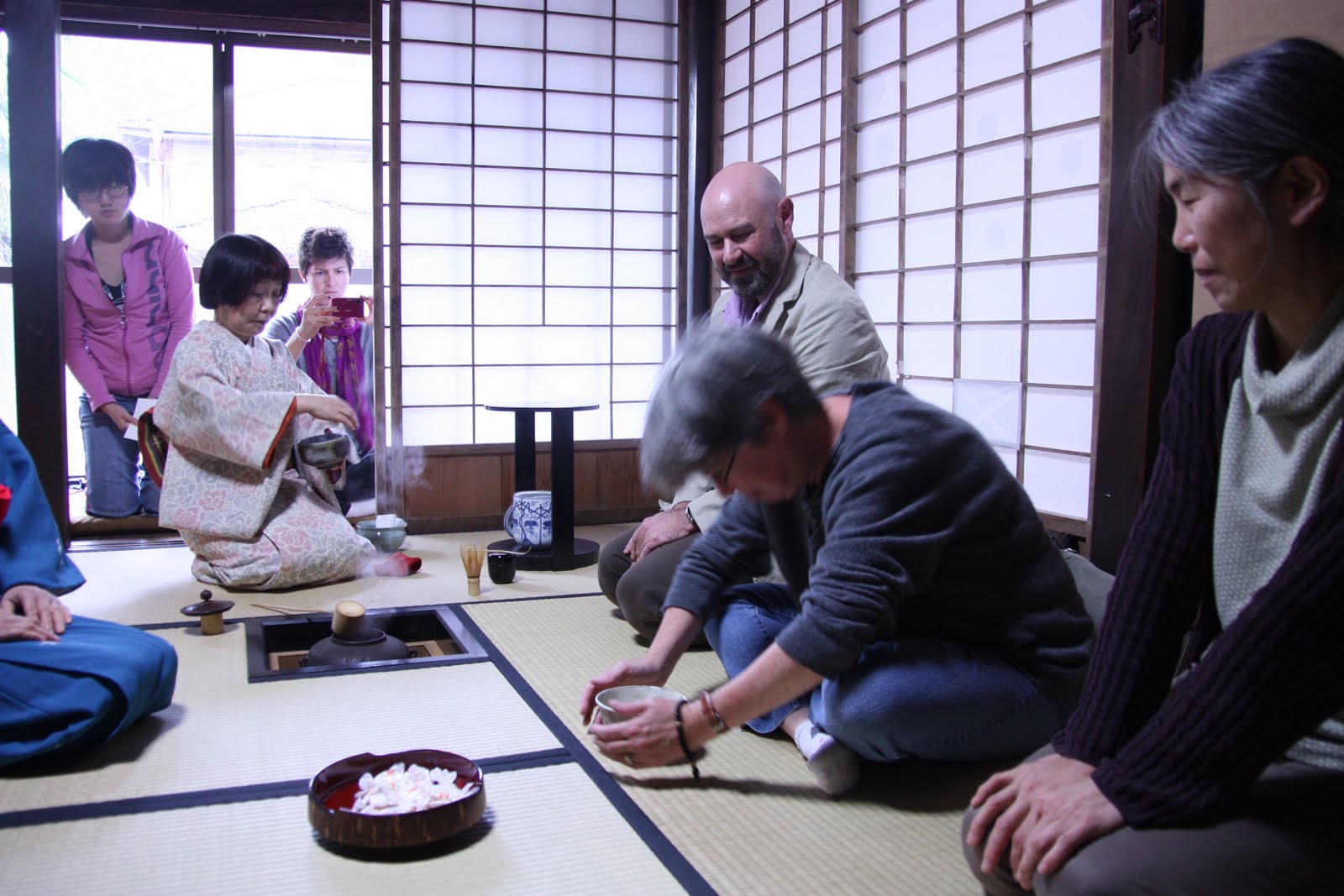
In the afternoon we visited the local tea teacher, who patiently and kindly led us through the tea ceremony. My knee will only let me briefly kneel in seiza position (back on your heels, with your big toes crossed and about 3" between your knees), and as a result I definitely felt out of kilter. It was awkward to bow, and harder to stay upright. I ended up sitting with my leg crossed, which isn't great for the knee either, but I couldn't figure out any other posture that would be remotely polite. Among other things I wondered about what we think of people in liturgical settings (and there are direct and deliberate parallels between the tea ceremony and Catholic liturgy) who are not in the "correct" posture. I can't genuflect for example, and so substitute a profound bow. How do (or even should) we read each other's posture in liturgy, and even in private prayer?

You can read the adventures of the whole crew here, it's hard to believe that tomorrow we will pack up the bus and make our way back to Kansai, with a short stop in Tokushima to have lunch and do any last shopping (we need another bag!).

Friday, October 07, 2011

Six Reasons Not to Lose Dr. Francl

Part of traveling with a group is counting -- have we lost anyone? The current running joke is that we can't lose me for various reasons. The current list of reasons not to misplace Dr. Francl:

1. She has the device to upload photos to your iPad.
2. She does IT support.
3. She has the snacks in her bag.
4. She has the wi-fi hot spot.
5. She has the money for ice cream.
6. She has the Benadyl and the Dramamine.

Grains of wisdom


Today we spent the morning working in a citrus orchard, picking fruit. What role does physical labor play in the contemplative life? In Koya-san the abbot Hideo told us the story of an older monk, who kept the strict rules of his sect, which do not permit any physical labor. One day when all his servants had the day off, he wandered around, hoping someone would refill his coffee cup.

The rice that I saw newly planted in the late spring is being harvested now, tied up to dry in the paddies.


The adventures of the crew are here.

Thursday, October 06, 2011

A different kind of luxury


How much stuff do you need? I had a wonderful lunch today, cooked over a mud hearth. Instead of quantum mechanics, I taught two students how to thread a needle.

We brought a gift from Pennsylvania to Kamikatsu - a piece of stained glass made by Wayne Stratz, riffing off the photos I had taken at my last visit to Nakamura. I bound photos of Wayne at work to show to Nakamura - and he very much enjoyed showing the students the hearth and tea pot that Wayne had captured in glass. The photo at the top is of the onions that got folded into the soup for lunch.

The adventures of the crew are here.

Wednesday, October 05, 2011

Walking the women's path


Yesterday I walked part of the women's path that encircles Mount Koya. Until the late 19th century, women were not permitted to enter the mountain enclave, but would still make arduous hike up to the gates, then walk from shelter to shelter around the entire perimeter. It was not a simple stroll, this path clings to the edges of the mountain and certainly drives home the notion that women belonged on the margins.

This morning we met one last time with Hideo, the young abbot who has been giving us intsruction in meditation. His hands are always on his prayer beads, a constant reminder of the call to prayer. I gave him a copy of Meditations: On the Monk Who Dwells in Daily Life by Thomas Moore (there is an excerpt featured in last Friday's wisdom story at People for Others) as the concept of contemplation in daily life was one of the threads of the conversations we had had.

The adventures of the crew are here.


Photo is of Hideo's hands.

Tuesday, October 04, 2011

Structures of silence


Enclosures aren't always physical. How do we enclose silence with a set schedule? Is silence easier in the morning? At night? While eating?

The adventures of the crew are here


Photo is of a Jizo image, nearly enfolded by a cypress tree trunk in the graveyard at Koyasan.

Saturday, October 01, 2011

Hot springs and cool breezes


The heat has finally broken here, just as we head up into the mountains where it will be cooler than Kyoto. The abbot at the temple where we have been staying looked at us as we left and said, "You're going to freeze on Koya." We assured him we have more layers. On the way from Kyoto to Osaka (where we are staying the night before heading off to Koya-san in the morning) we stopped at a hot springs/bath. I have soaked out ever single kink I might have, in waters that bubbled with minerals, slid down slate sheets, and poured into traditional Japanese tubs. And my students let fish nibble their feet....

You can read the adventures of the crew here.


Photo is from the Moss temple.

Friday, September 30, 2011

Seeing green: Moss temple and kiwi ice cream


We went to the Moss temple today, an amazing place with an ancient tea house. It's still hot and humid (though the weather promises to be cooler tomorrow). The adventures of the crew are here. I'm hoping to get a chance to post some photos here and there and perhaps write a bit for this blog on the bus trip to Osaka tomorrow.

Thursday, September 29, 2011

Jesuit bells and Zen abbots


My class is in Japan, exploring Zen Buddhism and contemplation, but not forgetting the work we are doing on Western contemplation and on psychology and neuroscience. I'm way too tired to blog twice (we were up at 5 am today for services up the hill), but you can read the adventures of my crew here. Find out what Jesuits, bells and a Zen temple have in common.

Tuesday, September 27, 2011

Into great silence

It might be the modern day equivalent of a medieval monastic enclosure. Everyone sleeps in a common dormer; we sit in our assigned places, as if in choir; once the doors are closed, you can't leave; you eat what is served, when it is served; we have made temporary promises of obedience; bells rings and we tighten our belts. There are no cell phones, no landlines, no wi-fi. It is a remarkably silent place, and I imagine not a few of us are praying.

No, I'm not on retreat, I'm on a China Air 747 somewhere between New York and Osaka, traveling with my students and two colleagues to Japan. We're off to see and experience Buddhist practices of mindfullness and meditation in particular, but we are also keeping our eyes open to the ways in which silent spaces are constructed. What constitutes a sacred architecture of silence? of solitude? of stillness? How many of these constructs, physical and metaphorical, cross traditions?

I watched Into Great Silence during the night, preparing to watch it with my students when we are back. This time, I was struck by the sheer physicality of the monks' lives, not only in the quotidian chopping of wood and hauling of water, but in prayer. The young monk lifted off his feet by the bell, the monk prostrate on the floor in his cell, the elderly monk with his canes hurrying to the church.

And I wondered if the monastery I long for is right under my nose.

Sunday, June 05, 2011

A shaky ending


We had a rocky start today, literally. A 5.6 earthquake centered at Fukushima (just north of Tokyo) woke Hank and Marc, but not me, about 1 this morning. Marc felt one aftershock, which I also slept through. Off and on during the trip I've been peripherally aware of the earthquakes which frequently shake Japan. When you check the weather at the government site, you also get information on earthquakes and tsunamis. I realize it's the same level of very mild anxiety I have in San Francisco, I'm more nervous about quakes in a city than when I'm visiting family in rural California.

Marc and I checked out of our rooms (Hank is staying in Tokyo for a few days more, then headed off as a volunteer in the clean up efforts in Northern Japan). We got breakfast the station again, and then returned to the temple area we had gone to our first night here. Today we were more awake, as was the temple and street. The temple monks and nuns were out in the street, offering blessings to those who wished, and street stalls were everywhere. I loved the ones selling red underwear, said to help give energy to ladies of a certain age (and I would be of that age).

The grandmothers were out in force for a minor festival at the shrine, and for the bargains to be had on the street. Do not get in their way, as they will be quick to put an elbow in your side and move through.

I found a jar of the base for the yuzu (a citrus fruit) and honey tea that I so enjoyed on Naoshima. It's now tucked into my bags in the hold of the 777 that I'm aboard, forty thousand feet over the Pacific. I'm crossing my fingers it will be intact when I get home. I also bought baby castellas, little egg and honey sponge cakes that came to Japan with the Portugese. The samples rivaled beignets, and the dozen that are tucked into my bag, along with some mango something (I thought it might be yogurt when I bought it in the store, but once opened, I'm pretty sure it's not -- one of the problems with being illiterate) are food for the plane. The food on the way over was pretty dismal.

Hank got us to Tokyo station and put us on the Narita Express to the airport, and I am now 1200 miles closer to home, anxious to be there and see my guys again.

Saturday, June 04, 2011

Tokyo indulgences


After a long travel day, we ate dinner late last night at a small yakitori place a few doorsdown from our hotel (recommended by the guys who run the hotel). We had some amazing silken tofu in a peppery, but not fiery hot sauce, along with grilled chicken balls, pork belly with chisu (sp?) (a bitter herb) salt shrimp, asparagus, mushrooms, a wonderful assortment.

Back at the hotel, I donned a yukata and tried out the radium baths (with nano bubbles) that are not only used by hotel guests, but also by thelocal neighborhood, particularly the old ladies. The baths are supposed to be good for your rheumatism and hemorrhoids, and make your skin soft. My sore ankle and knee were definitely soothed by a dip in the very hot water (44C).

We grabbed breakfast this morning in the train station, coffee and rolls, then headed out to a fancy department store in downtown Tokyo (Isetan). I really enjoyed getting to video chat with Chris before we left. After two weeks of being very careful what we picked up, knowing that we'd be carrying it hither and yon, and stowing it, we did some shopping for things to bring back. The top two floors of the store offered traditional Japanese goods and some very modern Japanese hand crafts (little mini kiosks from various high profile galleries in Tokyo). For myself, I bought traditional Japanese wooden shoes, with beautiful black, white and red silk straps, and several wrapping scarves (and the instructions for how to turn them into carrying devices of various sorts). It was fun trying to find things for the boys, but I don't want to spoil any surprises here. The place was very high service, one purchase earned me a seat in a chair, along with an English translator.

We descended to the food hall, which made Harrod's look like a local farmers market. It was amazing: the variety, the display, the wonderful samples. The fruit was a sight to behold, displayed like museum pieces in a future where a cantaloupe was an extraordinary rarity, and wrapped in beautiful boxes if you desired. I bypassed the $50 melon (I joke not) for some tiny sweet Satsuma oranges and two golden kiwi, along with some Shanghai dumplings - in skin so thin you could read the NY Times through it. We ate lunchin a small park on the roof of the department store, an oasis that looked like it might be a small pocket park in Philly, except that it was 8 floors about street level. It was nice to be above the hustle and bustle, nice, too, to have view of Tokyo's towers from a bit of a height.
Near our hotel there is small, offbeat shopping street, not quite all for locals, not quite all for tourists, that we browsed between the day's shopping and dinner. Marc was in search of something particular for one of his sons, so we stopped into the very modern (iPads on the desks to do searches and pull up maps) tourist information office. When Marc asked the young man who was staffing it if he spoke English, we got a very firm "Yep!" in reply. He did, having lived for a while in Fresno. By now it was hot and humid, so I was grateful beyond measure when Marc spotted a vending machine (not hard, they are everywhere, even on rural roadsides) with Coke Zero (that's the challenge, it's not served in restaurants, and diet drinks are rarely found in the vending machines). It was cold anda real treat in ways that a cold fizzy drink is not when I can just grab one from the stash in the basement, or the 'fridge at work.

We traversed Tokyo (about a 45 minute trip by train and subway and lots of walking) to have dinner in Rinpongi, our only fancy meal of the trip (we've been sticking to the equivalent of the local pub and take out places). The restaurant specializes in vegetarian cuisine, specifically vegetarian sushi. We ate sushi that looked like it might be salmon, or uni (sea urchin) but was all faux, recreated using vegetables. The meal was many small dishes, all exquisitely plated. In many ways it was a deconstructed version of the monastic meals we had eaten earlier in the trip.

The trip to dinner was a long walk, on top of a day that had included lots of walking, and my ankle, which had not bothered me at all this trip, was rapidly puffing up. We took a taxi back to the hotel - another huge splurge for this trip - the fare made me blink not twice, but four times. And while I bet the bath would have felt amazing, I opted for my futon.

Thursday, June 02, 2011

Shinkansen


Now we are on our way to Tokyo, on the shinkansen (the bullet train), something that seems amazingly luxurious in comparison to the some of the places we've stayed or eaten, and some of the conveyances we've used (little local buses that threaded their way through what I would have thought were impossibly narrow streets). We took the ferry to Uno, then two trains to get us onto the shinkansen to Osaka, changing there for Tokyo.

All told it will take us about 8 hours to get from the beach on Naoshima to our hotel in Osaka. We grabbed a quick snack in the station before getting on the first bullet train, I managed to select and order a piece of sponge cake stuffed with cream and fruit at one of the fancy French bakeries that currently dot Japan (everything was labeled in Japanese and the delightful young woman behind the counter had about as much English as I have Japanese). She came round the front so I could pick out what I wanted and when she went to pack it up she asked me a question with numbers in it. I was confused, she tried again. Ah, she wanted to know how long before I was going to eat the cake so she could pack it with the right number of ice packs. Not being sure, I said two hours, which resulted in four little ice packs, neatly tucked into their own ventilated paper frames, being popped into my cake box, along with the cake and fork (but no napkin!). That went into a blue bag. Marc and Hank opted for less elegantly packed (but equally rich) savory snacks at the place next door. Since we won't get to our hotel until around 8:30 or 9, dinner will be late tonight; snacks are a good idea.

Tomorrow is our last full day in Japan, I feel a bit like I did when I finished the Exercises, lots of things stuffed into my brain (and my bags) that need to get taken out and given some space to expand.

Beware the tanuki

At Naoshima the last two night, we slept in pao, yurts, a few yards from the beach overlooking the Inland Sea. Lodgings this trip have been simple and utilitarian, as befits the quasi-pilgrims we are, and these might have been the simplest so far. I loved falling asleep to the sound of the ocean right outside my door, something I treasure about the Jersey shore, too. And this was a much quieter space than the Jersey shore - no boardwalk (but ice cream available at the little cafe near the front). What Naoshima has that Sea Isle City doesn't is tanuki - small civet cats. You sometimes see statues of these outside Japanese houses, mischevious little animals akin to raccoons, I think. We saw one crossing the road high in the mountains outside Kamikatsu earlier this week.

There were signs at the place we stayed in Naoshima addressed to the tanuki: don't play with the humans' shoes, don't eat the humans' food and use the bathroom in your own house, not the humans' (we suspect this last is an indrect hint for the humans, the bathrooms are a bit of a schlep at night). We were warned to take our shoes into the yurt, not leave them outside, lest the tanuki make off with them (and since I have just the one pair of shoes with me, that would be a problem).

The first night I drifted off to the gentle sound of the waves shushing on the rocky beach, only to be woken somewhere in the middle of the night by a tanuki scrabbling at the yurt wall just outside my window, determined to get inside. He was, at the last, foiled, but the encounter gave me odd dreams the rest of the night.

This morning Marc and I went to tour the Chichu museum, another Tadao Ando building on Naoshima. The building is entirely underground, there is no structure protruding whatsoever, yet several of the galleries are lit by natural light. The collection is small, 5 Monet's in a setting that is as arresting (perhaps even more?) as the paintings. You walk into the room (in slippers, no shoes; they brought Marc an extra large pair slippers, even here the slippers are often huge on me), coming face to face with a huge canvas, framed in the dark doorway, on a white wall that virtually glows. The floor is one inch square cubes of grey and white marble, with clear separations between each cube (the mortar has not been worked into the cracks). The corners of the room don't meet at right angles, but are curved, giving the sensation that you aren't quite sure where the space ends, where are the walls? The paintings seemingly float in midair.

The museum also houses three more pieces by James Turell, include one that was a lighter version of Backside of the Moon. You climbed up a set of black marble steps into a room lit by blacklights and neon tubes. The walls fluoresced pretty strongly and again there was the sensation of not being sure where boundaries were. I was fascinated to note that when I took off my glasses (which screen out a fair amount of UV), the sensation was enhanced, just how much do we see in the UV?

Wednesday, June 01, 2011

Light and darkness


Naoshima, where we are staying for two days, is sprinkled with art installations, including a series of houses that have been reconstructed and then serve as galleries for a permanent collection. The most striking of the installations was (in my opinion) in Minimidera, built by Japanese architect Tadao Ando. The piece inside is by James Turell, called the Back Side of the Moon. The docent at the door briefs you before you go in to this incredibly dark, silent spot.

You walk through a short bent passageway so dark that you have to put your hands on the wall to feel you way. The wall is slightly corrugated and I could hear the fingers of the person in front of me brushing up against the wall, the tap of the docent on the wall warning us of a bend. You reach the room and the docent there firmly took my arm and guided me to a bench to sit. She murmured instructions in Japanese, which of course were lost on me. I sat there waiting for my eyes to adjust. At first, all I could see were the afterimages, the places where the bright sunshine outside had left my cones saturated. They were sharp and angular, the shapes of the walls and plantings outside.

After a few minutes I was surprised to find my eyes had adjusted and I could see the faint outline of what looked like a screen on the wall in front of me. The docent invited us to stand up and walk around if we felt comfortable (thank heavens we are traveling with Hank, who is fluent in Japanese). I walked tentatively toward the screen, though assured that the floor was flat, I was still afraid of falling. I then realized that there were two light sources to the sides of the space, looking like misty tunnel entrances. I nearly walked into the back wall, there was so little sense of depth in this space. I paced between the two diffuse regions of light at either end of the room, fingering my prayer rope and breathing prayers.

By the time we were gently shooed out of the room I could stand at the entrance and see people walking about, slowly feeling out the room. I want to go back, it is an incredible place to sit, to stand, to walk, to pray.

The unabashed slurping of the noodles in the restaurant at lunch was a fascinating thing to listen to, the sounds of joyful eating.

We saw several more art houses in Naoshima, including Ishibashi, which looks much like the abbot's quarters at the temples we saw in Kyoto. The house seems like a sketch of a Zen Buddhist monastery, wall screens are partially painted, with intricate detail in one corner, fading out to nothing. The screens are by a noted artist Hiroshi Senju, who painted the screens in Philadelphia's Japanese house in Fairmount Park.

Go'o Shrine, a Shinto shrine on top of the hill on the far side of the island from where we are staying has an installation as well. A glowing set of glass steps rises up the from the ceremonial floor to the shrine doors. Underneath the shrine is a narrow passageway (you nearly have to sidle in) lined in oxidized metal, which bends sharply at the end where there is another glass staircase, reflected in a pool at your feet. The pool of water is so still it looks almost like a glass mirror, the staircase is lit from above (the top step is embedded in the ground above). I wished I had my tripod to take a photo -- and that they were allowed!

We went back to Minamidera. I walked in the space again, amazed at how little light you need in such utter darkness to see your way. There is no way a photograph could ever capture the sense of light and the simultaneous sense of endless depths and no depth.