Sunday, August 06, 2017
A Whale's Tale
Crash criss-crossed the country in a little red Fiat this summer. Kentucky to DC to Pennsylvania, back to Kentucky, on to Chicago. Seattle, San Francisco and my dad's Central California farm. All this to come and go from his job in Montana, where he was stage managing Macbeth for Shakespeare in the Parks,1 or more precisely, managing the production until it was ready to criss-cross Montana and the Dakotas.
It's a fascinating program, the actors take everything on a 6000 mile road trip — including the stage itself — except for the tech crew. They rehearse with the help of the tech crew, but in the end learn to do for themselves. Including putting up, taking down and packing the stage into the giant trailer they tow, nicknamed The Whale. (See the timelapse embedded in this post!)
Read Crash's interview with two of the actors here: SixByEightPress.
1. Not that Shakespeare in the park, note the plural and the distance from New York.


Saturday, August 05, 2017
J.F. Powers and cloaks of invisibility
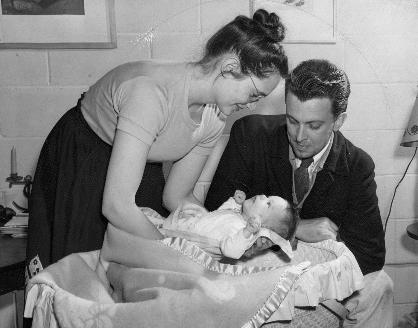 |
| Betty Powers, with J.F. Powers and their daughter |
I was more intrigued by Meyers' lead into the article, which sketches a monastic version of Powers' life (he lived near St. John's Abbey in Collegeville, a place I've spent time writing and retreating). He describes Powers' doing his laundry on his knees in a rusty bathtub, and his "hairshirt house" — drab, shabby and cold. It's a sharply unromantic view of a writer's hermitage.
But where is Mrs. Powers in this sketch? Powers was married and had five children. Were they perhaps living elsewhere? No, they were not. At least one other person lived in that hairshirt house, but somehow she has been rubbed out of this particular picture of Powers. It made me think about The Astronauts Wives which I recently read, and how many of them had been majoring in STEM fields, but dropped out when they married, their other selves tucked into a drawer or a footnote.
Betty Powers née Wahl is not neglected in John Rosengren's memories of Powers ("The Gospel according to J. F. Powers"). Next time I'm in Collegeville's cemetery, I will look for her grave. She was a promising fiction writer when Powers was introduced to her by one of her professors at St. Ben's and continued to write and to publish after she was married.
Powers died while folding his own laundry. An ordinary task.
Friday, August 04, 2017
Arboreal alarm clocks

Usually the end of the summer creeps up slowly. The cicadas hum, the air gets misty, the leaves on the trees wrinkle ever so slightly, their spring greens grow dusty and faded. The garden begins to look a bit spent. I don't need my calendar to tell me summer is waning (though one of the astronomers at the Specola kept saying, "July is going to be over, it's going to be the 8th month of the year." He was aghast at how the year had flown. Me, too.)
It's been a good summer, with stretches of time for thinking and writing, time to explore some new projects and finish off old ones. There was time with family (wedding!) and time to tidy. A bit of retreat time. Time seems more expansive, perhaps because of the longer days, or perhaps because they are less hectic, more predictable.
And for the record, there is a full month of summer left before I begin teaching. If only I could hit snooze on the cicadas, and blissfully go back to my midsummer's dreams.
Monday, July 24, 2017
An observer from the Vatican
 |
| Not this telescope, a very modern Celestron scope with an autoguider |
This telescope has an autoguiding system, you sight on four stars to calibrate, then you can just pull up a celestial feature from the menu and the telescope will twist and turn until it has the selected feature in its field of view. Very cool. The hard part is figuring out what you might want to see and whether or not it is visible.
The visibility depends on whether a particular feature is "up" on this time of the year, the light pollution in the sky, and whether or not it is behind the roof of the Specola! And if you are tall enough to see through the eye piece. I had to stand on a chair (carefully, so as to not fall on the telescope) to see a couple of things.
What to look at? Jupiter! The moons again, strung out like a necklace of pearls, and just a wisp of its stripes to be seen. Saturn, where we strain to see the Cassini division in the rings, and wonder if that is one of the moons of Saturn we see, or....
We pulled out Turn Left at Orion (Guy Consolmagno SJ and Dan Davis' great guide to the sky, even without a telescope, just a good pair of binoculars, you can see fascinating things), to see what we might see. Astronomers suggested galaxies they had studied. We saw Vega, icy blue. We looked for double stars. We saw a ring nebula, which Rich Boyle SJ called a smoke ring, and for all the world that's what it looked like. Does God blow smoke rings?
There were things to be seen even if you weren't looking at the telescope. I saw a meteor streak across the sky. We watched a satellite sail majestically across the heavens, wondered if it was the international space station (no, you can find the ISS's orbits as a function of time on the web and I checked the next day).
There is something about looking up at the heavens, even when the scientific work does not actually require it, that pulls you deeper into the mysteries of both God and the astrophysics.
The title comes from a time when Br. Guy was visiting a telescope to do some observing, and went to Mass at a local parish where the pastor announced they had a visitor: an observer from the Vatican. Not that kind of observer!
Saturday, July 22, 2017
Talking trash and the Lateran Treaty
 |
| There's a phone book. No, there is not a direct listing for the Pope. Yes, I looked. |
There are many ways I'm sure I'm in another world, I would know it even with my eyes closed. The chant drifting in through the open window in my office, which I realize with a start is not a recording, but the nuns in the cloister next door chanting their Office. The burble of the fountain in the courtyard below, the trucks circulating through town towing billboards and booming out ads, and the incredible silence that drops over the town between 2 and 4 for the riposo, the after lunch rest in the heat of the day. And then there is the trash and recycling, which has to be transported across international boundaries.
 |
| View into the enclosed garden. |
The question of how to deal with the Specola's garbage required consulting the provisions of the Lateran Treaty of 1929! Rather than drive the trash and recycling into Rome (indeed, someone used to do that), now it gets moved across that international border between Vatican territory and Italy (and the Vatican reimburses the municipality for the services.) Though it sounds like a long haul, but it's just a few feet from the storage room to the street, a shorter distance than the recycling travels down my driveway at home.
In other ways, this feels much like home. The corso, with its eclectic mix of shops is different from Lancaster Avenue only in that cars are more likely to stop for you at the crosswalks and the incredibly narrow sidewalks. Walking two abreast is a challenge and at peak shopping times, I imagine it looks like a parade of ants threading their way from food source to home and back. The cascade of bells from the cathedral (which are just about even with my window and not even 100 meters away) remind it's noon, louder than Bryn Mawr's bells which chime the hours aways, but still a gentle cue to the passage of time.
 |
Duomo (cathedral) in Albano, St. Bonaventure was once
the bishop here.
|
And I will miss the after Mass-apertivos on the terrace overlooking the gardens. The other night was humid and the long tree lined avenue that leads away from this end of the gardens was misty. The birds whirled up as someone walked by. The whole scene looked like it had been done with CGI, I half expected to see orcs come roaring down the avenue. The sunsets have been glorious and the evenings pleasant, even as the days are hot.
I walk past the cathedral and can see the top of the cloister out my window, all so serene at the moment, but in World War II, the bombs did not spare it. L'Osservatore Romano has the story here.
Subscribe to:
Posts (Atom)